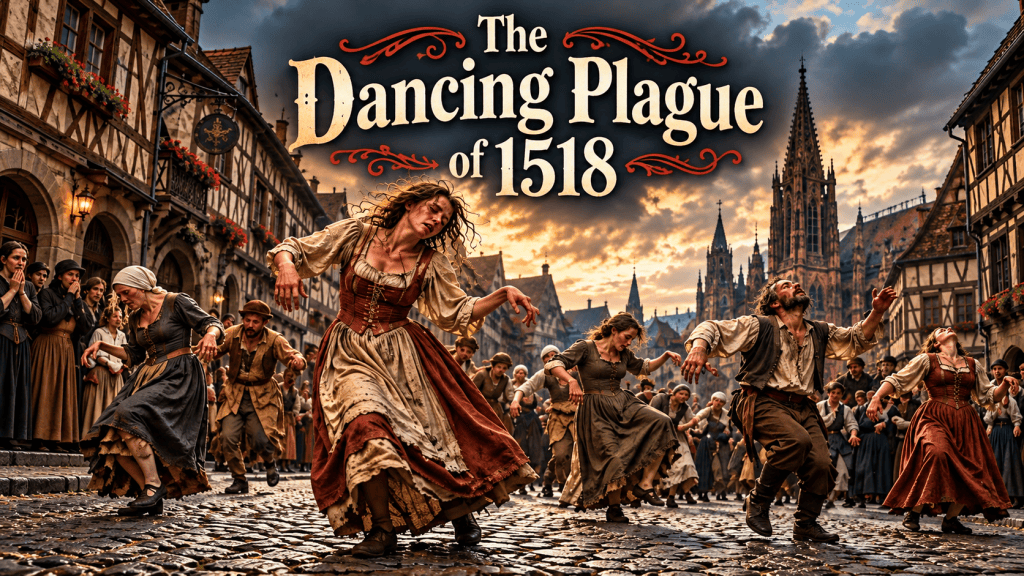
Imagine walking down a narrow European street in the summer of 1518 and coming across a woman dancing.
There is no celebration. No wedding. No festival. No musicians playing a cheerful tune.
Just a woman moving through the street, seemingly unable to stop.
At first, perhaps you would think she was entertaining herself. Maybe you would stop to watch for a moment before continuing with your day.
But then the hours would pass.
She would keep dancing.
And according to historical accounts, before long, other people would begin doing the same thing.
What started with one woman would eventually become one of the strangest recorded episodes in European history.
It’s known today as the Dancing Plague of 1518.
And despite how ridiculous that name might sound, the people who experienced it apparently weren’t having much fun.
Our story takes us to Strasbourg, a bustling city along the Rhine River that was part of the Holy Roman Empire. Today, Strasbourg is located in northeastern France, near the German border.
In the early sixteenth century, the city was an important center of commerce, religion, and political activity. Its streets were filled with merchants, craftspeople, laborers, and families going about their daily lives.
But life in Strasbourg wasn’t particularly easy.
The region had experienced failed harvests, food shortages, disease, and considerable social unrest. Historians examining the period have described a population living under tremendous uncertainty.
Then came the summer of 1518.
According to one chronicle, the strange episode began on July 14, when a woman stepped into the street and started dancing.
Later accounts identify her as Frau Troffea, although her identity is not securely established by the earliest surviving records.
She reportedly continued for days, despite the physical exhaustion that such constant movement would have caused.
Some versions of the story describe her dancing for as long as six days, although the surviving accounts differ in their details.
And then something even stranger happened.
Other people began dancing, too.
Within days, chronicles claimed that dozens of residents had been affected. As the summer continued, reports described the number growing into the hundreds.
One account suggested that more than 400 people had experienced the affliction within several weeks.
Now, before we go any further, there’s an important distinction to make.
Those numbers come from historical chronicles, not from a surviving medical register containing hundreds of individually documented cases. We have evidence that the episode occurred, but we cannot verify every dramatic detail repeated about it.
Still, something serious enough to demand the attention of Strasbourg’s government was happening.
And the city’s response was almost as strange as the dancing itself.
To understand what happened next, we have to remember that medicine in 1518 looked very different from medicine today.
Physicians often explained illness through the balance of bodily humors, believing that conditions involving the blood, heat, and other internal forces could affect both physical and mental health.
According to historical accounts, some of Strasbourg’s physicians interpreted the dancing as a natural sickness rather than a supernatural punishment.
Their proposed treatment?
More dancing.
City officials reportedly arranged places where the afflicted could continue moving. Musicians were brought in, and some accounts describe people being paid to dance alongside those who were suffering.
The reasoning was that allowing the afflicted to continue until the condition had run its course might help them recover.
Imagine being so concerned about people dancing uncontrollably that your solution is to hire musicians and encourage them to keep going.
It sounds almost impossible to believe.
Yet historical research into Strasbourg’s municipal records and chronicles supports the fact that officials experimented with precisely this kind of response.
Unfortunately, the strategy didn’t appear to solve the problem.
Instead, the authorities eventually reversed course.
And this is where we find one of the strongest historical receipts for the entire episode.
A surviving note written by Sebastian Brant, a Strasbourg official, records a council order issued on August 3, 1518.
The city imposed restrictions on dancing until September 29, including a fine of 30 shillings for violations. Although certain private celebrations were still permitted under specific conditions, public dancing was prohibited.
Think about that.
In the summer of 1518, Strasbourg’s government was sufficiently alarmed by a dancing epidemic that it formally restricted dancing throughout the city.
This wasn’t simply a story invented centuries later to entertain curious readers.
The authorities left evidence of their attempts to manage the crisis.
But the dancing wasn’t the only thing troubling the city.
Many people interpreted unusual illnesses through the religious beliefs of their time. Disease, natural disasters, and unexplained events could be understood as signs of divine displeasure.
And the dancing epidemic became closely associated with a particular saint.
Saint Vitus.
During the Middle Ages, Saint Vitus was invoked by people suffering from certain illnesses and involuntary movements. The term St. Vitus’ dance eventually became associated with conditions involving uncontrolled bodily motion, although it has also been used in later medical contexts that should not be confused with the Strasbourg episode.
In 1518, some residents believed that the dancers were suffering under a supernatural affliction connected to the saint.
If Saint Vitus was responsible, they reasoned, perhaps his intervention could also bring relief.
Historical accounts describe afflicted residents being transported to a shrine dedicated to him near Saverne, known in German as Zabern.
There, religious ceremonies were performed.
Some accounts describe sufferers being led around an altar, participating in prayers, and receiving small crosses or specially blessed shoes.
The city reportedly paid for transportation to the shrine.
That detail is particularly revealing.
The authorities had initially experimented with what they considered medical treatment. When that approach failed, they turned toward religious practices that reflected older understandings of disease.
The Dancing Plague of 1518 unfolded at a moment when traditional supernatural explanations and emerging medical ideas existed side by side.
And depending on whom you asked, the cause of the dancing might have been completely different.
But here’s the question that makes the entire story so unsettling.
Were people actually dancing until they died?
If you’ve encountered the Dancing Plague on social media, you’ve probably seen claims that people danced until their hearts stopped or that as many as fifteen people died every day.
Those stories certainly make the episode sound terrifying.
The problem is that the historical evidence isn’t quite so straightforward.
Some chronicles describe deaths associated with the dancing, and historian John Waller has argued that prolonged physical exertion may indeed have proved fatal for some participants.
However, other historical and medical researchers have pointed out that contemporary documentation does not securely establish a death toll.
There is no reliable list of victims proving that hundreds of people danced themselves to death.
That doesn’t mean the outbreak was harmless.
People experiencing prolonged involuntary movement, exhaustion, dehydration, and psychological distress would have faced genuine dangers, particularly in an era without modern medical care.
But when we’re discussing an event that occurred more than five hundred years ago, we have to distinguish between what the surviving records establish and what later storytellers added.
The outbreak was real enough to appear in chronicles and municipal records.
The dramatic death counts are considerably harder to verify.
So, if the dancers weren’t celebrating, and we have no evidence of a contagious dancing disease in the ordinary medical sense, what caused it?
One explanation that has circulated for years involves a fungus called ergot.
Ergot can infect rye and other grains, producing toxic compounds that may cause severe illness. Because rye was a common food source in parts of Europe, historians and researchers have considered whether contaminated bread might have contributed to outbreaks of unusual behavior.
At first, the theory sounds plausible.
But there’s a problem.
Ergot poisoning can cause convulsions, circulatory problems, and other serious symptoms. It does not convincingly explain groups of people engaging in prolonged, apparently organized dancing over days or weeks.
For that reason, many researchers consider ergot poisoning an inadequate explanation for Strasbourg’s dancing epidemic.
Another theory involves what is now called mass psychogenic illness.
This refers to situations in which groups of people experience genuine physical symptoms influenced by psychological and social factors, without an identifiable infectious or toxic cause that explains the pattern.
The symptoms are not necessarily deliberate, and the people experiencing them are not simply pretending.
Historian John Waller has argued that Strasbourg’s extreme social conditions may have helped create an environment in which such an outbreak could occur.
Consider what the population had been enduring.
Food shortages.
Disease.
Economic hardship.
Religious anxiety.
The fear that misfortune might be punishment for wrongdoing.
Now imagine living in a community where people already believed that a saint could afflict someone with uncontrollable dancing.
If one person began exhibiting frightening, unexplained movements, others might interpret those symptoms through the same deeply held beliefs.
Fear could spread.
Expectation could shape experience.
And under conditions of extraordinary stress, a strange episode might become a much larger collective crisis.
It’s an intriguing explanation.
But we should be careful here, too.
No physician examined the dancers using modern diagnostic methods. No laboratory tests survive. We cannot travel back to 1518 and determine precisely what each person experienced.
Mass psychogenic illness is a serious historical hypothesis, not a diagnosis that can be conclusively established five centuries later.
And Strasbourg wasn’t the first European community to report something like this.
In 1374, more than a century earlier, episodes of compulsive dancing were recorded in communities along the Rhine and in neighboring regions.
Accounts describe groups of people moving through towns, sometimes accompanied by musicians, while observers struggled to understand what was happening.
Other medieval stories also describe unusual dancing episodes, although the circumstances and reliability of those accounts vary.
The phenomenon wasn’t unique to one city or one summer.
That makes the events of 1518 even more interesting.
Whatever happened in Strasbourg belonged to a broader history of European beliefs about illness, religion, fear, and involuntary movement.
And the episode also attracted the attention of one of the most unusual medical thinkers of the sixteenth century.
Paracelsus, the Swiss physician and alchemist whose writings challenged many established medical ideas, later discussed the Strasbourg outbreak.
He questioned the belief that saints caused such illnesses and considered explanations involving the body, imagination, and psychological influences.
Not all his ideas would stand up to modern scientific scrutiny.
But his willingness to consider causes other than divine punishment reflected an important shift in how people were beginning to understand unexplained behavior.
The Strasbourg outbreak wasn’t simply a strange event involving people dancing in the streets.
It was also a moment when competing explanations of sickness became visible.
Was the body malfunctioning?
Was the mind involved?
Was the community experiencing some form of collective distress?
Or was the affliction a supernatural warning?
The answers depended heavily on the beliefs and knowledge of the people trying to understand it.
Eventually, the dancing subsided.
Historical accounts associate its decline with the city’s restrictions, the removal of sufferers from public spaces, and religious visits to the shrine of Saint Vitus.
But we cannot establish that any one of those measures caused the outbreak to end.
And that’s where the mystery remains.
More than five centuries later, historians can identify the city, the approximate dates, the official response, and the religious and medical explanations offered at the time.
What they cannot do is tell us with certainty why the dancing began.
Or why it spread.
Or exactly what the participants were experiencing.
I think that’s what makes this story so fascinating.
When we hear the words dancing plague, we naturally imagine something almost comical.
People dancing through the streets. Musicians playing. A city apparently unable to stop moving.
But once you look beyond the unusual name, the story becomes something much darker.
It involves frightened people experiencing behavior they may not have understood or controlled.
Authorities struggling to respond.
Physicians working with the medical knowledge available to them.
And a community trying to decide whether its suffering came from nature, the human mind, or something supernatural.
The most unsettling part isn’t the dancing itself.
It’s the possibility that people were genuinely terrified by what was happening to them, while everyone around them struggled to explain it.
And perhaps the greatest mystery of all is how an event serious enough to prompt official government action could leave behind so many unanswered questions.
We know Strasbourg’s officials tried to intervene.
We know historical chronicles described an extraordinary outbreak.
We know religious and medical explanations competed for acceptance.
But the people at the center of the story remain largely anonymous.
We don’t know what most of them felt, what they believed was happening to their bodies, or how they remembered the experience once it ended.
Their voices have largely disappeared into history.
All that remains are scattered records, conflicting accounts, and one of the strangest questions ever left behind by a European city.
What could make people dance when they desperately wanted to stop?
More than five hundred years later, we’re still trying to find the answer.
—Guyton





Leave a Reply