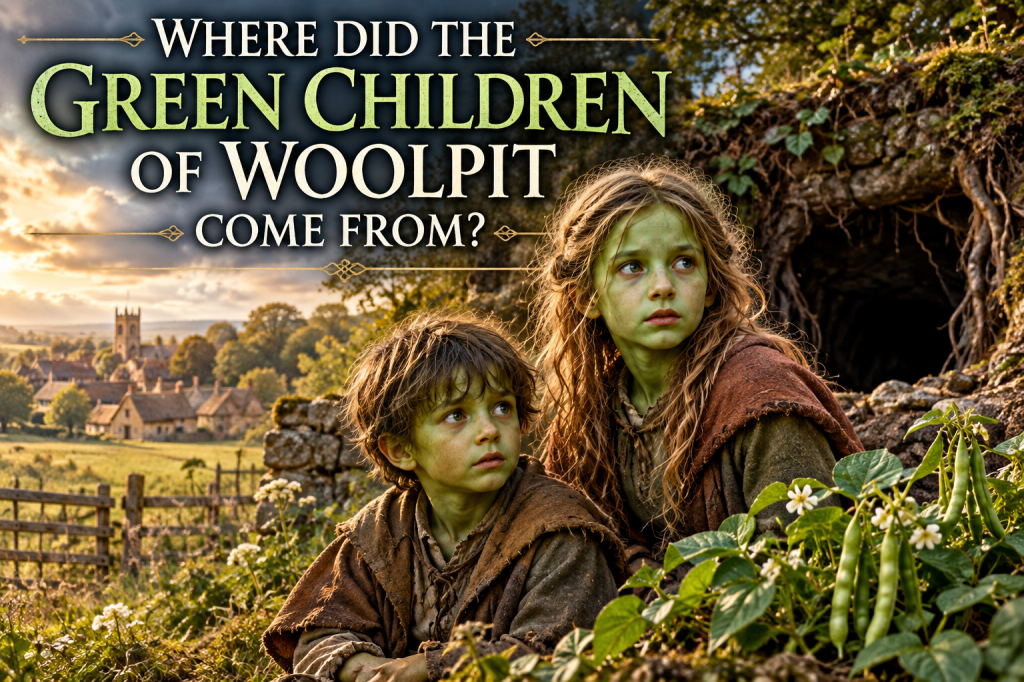
Imagine living in a quiet English village during the twelfth century. You’re going about your ordinary business when someone discovers two children wandering near an old pit.
They’re frightened. They don’t seem to understand a word anyone is saying. Their clothing is unfamiliar, and nobody recognizes their language.
But that’s not what makes this encounter extraordinary.
According to the people who eventually recorded the story, both children had green skin.
Not green clothing. Not green paint.
Green skin.
And nearly nine hundred years later, we’re still trying to understand who these children were and where they supposedly came from.
Welcome to Woolpit, a village in Suffolk, England, whose name has long been associated with pits used to trap wolves.
Sometime during the twelfth century, according to medieval accounts, villagers discovered a young boy and girl near one of these pits.
The children appeared to be brother and sister. They spoke a language nobody understood, wore clothing unlike anything the villagers recognized, and seemed bewildered by their surroundings.
Naturally, people tried to help them.
But there was another problem.
The children refused to eat.
Whatever food the villagers offered, the children wouldn’t touch it.
Then someone brought them freshly harvested beans.
According to Ralph of Coggeshall’s account, the children became intensely interested in the plants. At first, they tried opening the bean stalks, apparently expecting to find food inside them. When they couldn’t find anything, they became distressed.
Eventually, someone opened the bean pods and showed them the beans inside.
The children began eating them eagerly.
Apparently, after arriving in a completely unfamiliar world, the one thing these children recognized was a bean.
And I have to admit, that’s an awfully peculiar detail for a story that’s nearly nine hundred years old.
Over time, the children reportedly began eating other foods. Their strange green coloring gradually faded, and they started adapting to life among the villagers.
Unfortunately, the boy became ill and died.
His sister survived.
And as she grew older and learned to speak English, people finally had an opportunity to ask the question everyone had been wondering.
Where had they come from?
Her reported answer is where this story becomes even stranger.
According to William of Newburgh, the children claimed to come from a place called St. Martin’s Land.
It was a Christian country, they explained, but it wasn’t like England.
There, the sun never shone with the same brightness.
Instead, the land existed in a kind of perpetual twilight.
They described a great river separating their homeland from another country that appeared much brighter.
And somehow, they had ended up in Woolpit.
How?
That depends on which medieval chronicler you ask.
William of Newburgh, writing toward the end of the twelfth century, described the children hearing bells before suddenly finding themselves among the people harvesting crops.
Ralph of Coggeshall, another medieval chronicler, recorded a somewhat different account.
In his version, the children had been following animals when they entered a cavern. They wandered through an underground passage, heard bells ringing, and eventually emerged into a place filled with sunlight.
The brightness was overwhelming.
When people approached them, they reportedly tried to return to the cavern but couldn’t find the entrance.
Now, I don’t know about you, but that sounds remarkably like the beginning of a fairy tale.
Two children emerge from an underground passage into a world they don’t recognize, carrying memories of a distant country where the sunlight is different.
Except this story wasn’t first preserved in a modern fantasy novel.
It appeared in medieval historical chronicles.
William of Newburgh included the account in his Historia rerum Anglicarum, while Ralph of Coggeshall recorded it in his Chronicon Anglicanum.
And that distinction matters.
These men were chroniclers documenting events, stories, and unusual occurrences that reached them. They weren’t claiming to have personally watched two green children emerge from another world.
William referred to testimony he considered credible. Ralph identified a local knight, Sir Richard de Calne, and his household as sources for the story.
According to Ralph, the children were taken into Richard’s care.
So we have two medieval writers preserving versions of the same remarkable account.
But we don’t have two eyewitness statements proving that the events happened exactly as described.
And the differences between their versions are worth paying attention to.
William placed the children’s appearance during the reign of King Stephen, who ruled England from 1135 to 1154.
Ralph didn’t provide the same clear dating.
William reported that the surviving girl eventually married in the town of Lynn.
Ralph described her living for years in Sir Richard’s household, but his surviving account doesn’t establish that same marriage.
Even the details of the children’s mysterious homeland differ.
So what are we supposed to make of all this?
One possibility is that the story grew from an encounter with two real children who had become separated from their community.
Some researchers have suggested they may have been Flemish children, perhaps displaced during the political upheavals of medieval England.
If they spoke a language unfamiliar to the villagers, that could explain why nobody understood them.
And if they had experienced hunger, illness, or displacement, their strange appearance and reluctance to eat unfamiliar foods might have had perfectly ordinary explanations.
But there’s a problem.
We don’t have enough evidence to establish that this is what happened.
The Flemish explanation is a historical theory, not a confirmed identification.
Another suggestion involves the children’s greenish appearance.
Could illness or nutritional deficiency have caused an unusual skin tone?
Possibly. But we cannot diagnose two children from a centuries-old story, especially when we don’t know whether the description was literal, exaggerated, or symbolic.
Then there’s the folkloric interpretation.
Medieval Europe was filled with stories of mysterious beings, hidden realms, underground passages, and strange visitors who appeared from places ordinary people couldn’t reach.
A country of perpetual twilight certainly sounds like it belongs among those traditions.
But resemblance to folklore doesn’t prove the children were fairies, any more than a medical theory proves they were sick.
Perhaps the story contains elements of both history and imagination.
Perhaps an encounter with unfamiliar children became more extraordinary each time it was retold.
Or perhaps the entire account was shaped by the storytelling traditions of the period.
There’s simply no way to know for certain.
What interests me most, though, isn’t the color of their skin or the possibility of an underground kingdom.
It’s the girl.
Because unlike so many mysterious figures in old legends, she didn’t simply disappear into the woods or vanish into the mist.
According to the chronicles, she stayed.
She learned the language. She adapted to the food. She grew up among people who had once found her completely unfamiliar.
William even reported that she eventually married.
If there was a real girl behind this story, imagine what her experience might have been like.
Finding herself somewhere she didn’t recognize, unable to communicate, surrounded by strangers, and separated forever from the place she remembered as home.
Losing her brother.
Learning to live in an entirely different world.
And eventually becoming part of the very community that once considered her an extraordinary mystery.
We often approach stories like this by asking whether the unusual details were real.
Were the children actually green?
Did they come from another country?
Was there really a hidden passage leading somewhere beyond the world the villagers knew?
Those are fascinating questions.
But perhaps there’s another one worth asking.
What if the most extraordinary part of the story wasn’t where the children came from, but what happened when they arrived?
Because somewhere beneath the centuries of speculation is an account of two frightened children who needed food, shelter, and someone willing to care for them.
And at least in the story that survived, someone did.
Today, Woolpit is still a real village in Suffolk, and the green children remain part of its local identity.
Their story has survived wars, changing kingdoms, generations of storytellers, and nearly nine centuries of people trying to explain the inexplicable.
We may never know whether two unusual children actually appeared beside a wolf pit all those years ago.
We may never discover whether St. Martin’s Land was a misunderstood description of somewhere real or simply a place that existed in the imagination.
But I rather like that the mystery has endured.
Not because I think we should accept every extraordinary story without evidence.
Quite the opposite.
I think mysteries deserve curiosity, investigation, and the willingness to admit when the evidence doesn’t give us an answer.
And sometimes, even after centuries of searching, that’s exactly where we’re left.
With two children, an unfamiliar language, a handful of beans, and a village that never quite forgot them.
So where did the Green Children of Woolpit come from?
Nearly nine hundred years later, we still don’t know.
But wherever that mysterious land may have been, I hope the surviving girl eventually found something that felt like home.
—Guyton



Leave a Reply