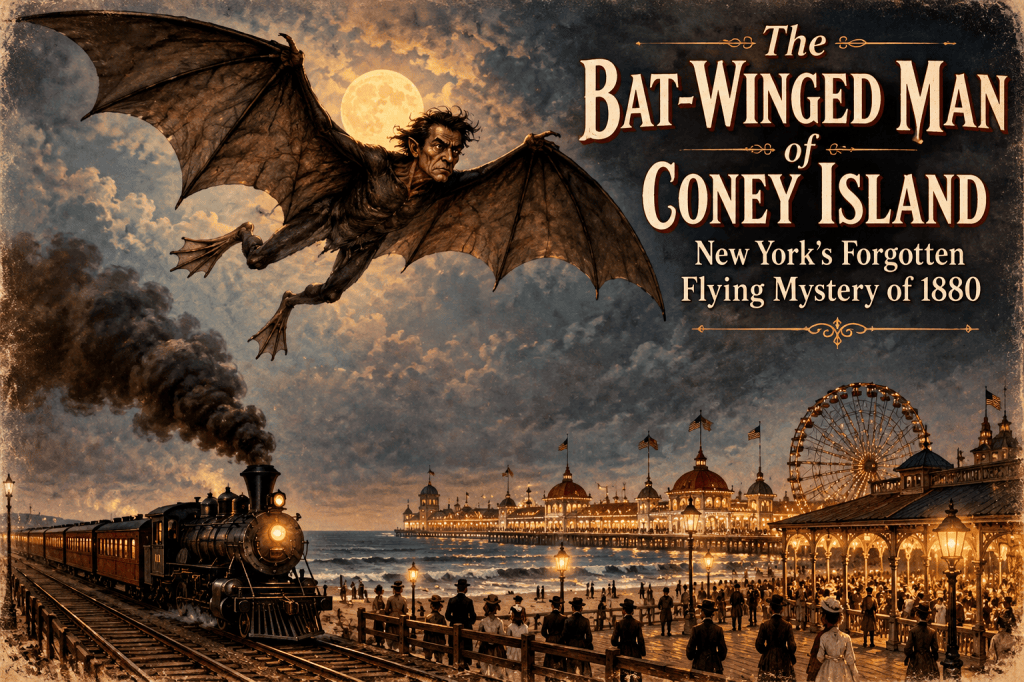
Imagine waking up on a September morning in 1880, pouring yourself a cup of coffee, unfolding the newspaper, and discovering that a mysterious bat-winged man had apparently been flying over New York.
Not a bird. Not a balloon. Not even a particularly ambitious gentleman with a homemade pair of wings.
A man.
With the wings of a bat, the legs of a frog, and, according to the newspaper, a rather unpleasant expression on his face.
And apparently, he was headed for New Jersey.
Now, I don’t know what was happening in New Jersey in September 1880, but evidently, someone—or something—was determined to get there.
If you joined us last week for the strange tale of Iowa’s Van Meter Visitor, you might be wondering whether we’ve developed a particular fascination with mysterious winged creatures.
Apparently, we have.
But before Iowa’s infamous visitor reportedly appeared in 1903, New York had a flying mystery of its own. And this one came with bat wings, frog legs, and an apparent destination of New Jersey.
On Sunday, September 12, 1880, The New York Times published an article titled “An Aerial Mystery.” It described an extraordinary apparition reportedly spotted flying high above Coney Island sometime during the preceding week.
The newspaper claimed that the mysterious figure was traveling approximately 1,000 feet above the ground. Its body appeared dark, its wings resembled those of a bat, and its legs moved in a manner that reminded observers of a frog swimming through water.
Yes, a frog.
Apparently, whatever this creature was, it had borrowed its transportation methods from two entirely different members of the animal kingdom.
And somehow, that wasn’t even the strangest part.
The newspaper claimed witnesses could clearly distinguish the creature’s face, despite its extraordinary altitude. The expression was reportedly cruel and determined, suggesting that this particular visitor had somewhere important to be and absolutely no interest in making friends along the way.
Then came another remarkable detail.
When a locomotive sounded its whistle, the mysterious figure supposedly responded by waving its wings.
Whether this was intended as a greeting, a warning, or simply an acknowledgment of the local railway schedule was not explained.
The newspaper assured readers that respectable witnesses had observed the apparition. They reportedly agreed that the thing flying through the sky was unmistakably human in appearance.
But the story did not begin in New York.
In fact, if we follow the newspaper trail backward, things become considerably more peculiar.
On July 28, 1880, two men named C. A. Youngman and Ben Flexner were standing near a window at a drugstore in Louisville, Kentucky, when they noticed something unusual above the city.
At first, the object looked like the remains of a toy balloon.
But as they watched, it appeared to take on the shape of a person surrounded by machinery.
The figure seemed to be operating the apparatus with both hands and feet. Its legs moved as though pedaling, while its arms worked above its head, possibly controlling wings or fans.
The object changed direction as it traveled through the sky, eventually disappearing into the evening.
The following day, the Louisville Courier-Journal published an account of the sighting.
And Louisville, it seems, had questions.
Quite a few questions.
According to a follow-up published on July 30, curious residents began contacting the drugstore almost immediately. By the end of the day, the newspaper reported that approximately 500 people had visited to ask about the mysterious flying machine.
Imagine trying to conduct an ordinary day’s business while half the city wanted to know whether someone had just pedaled across the sky.
And remember, this was 1880.
The Wright brothers’ famous powered flight was still twenty-three years away.
People had experimented with balloons, gliders, and mechanical flying devices for generations, but the idea of a person navigating the sky by working a strange collection of wings and machinery was extraordinary.
Then another Kentucky account entered the picture.
In Madisonville, a family reportedly witnessed an unusual object moving through the evening sky. Their description differed from the Louisville report. Instead of a recognizable human figure, they described something with rounded shapes at either end, changing from a circular appearance to an oval one as it traveled.
The Courier-Journal published details of that account on August 6.
Was someone secretly testing an experimental flying machine? Had witnesses mistaken an ordinary object for something extraordinary? Or were these reports simply entertaining newspaper stories that grew more elaborate with each retelling?
Nobody produced a mysterious aircraft for examination.
Nobody introduced themselves as the pilot.
And nobody seems to have stepped forward to explain why they were apparently commuting through Kentucky by pedaling through the clouds.
Then, several weeks later, the flying mystery reached Coney Island.
Only this time, the machinery was gone.
In its place was something considerably more unsettling.
A bat-winged man with frog-like legs.
The September article also claimed that a similar apparition had previously appeared over St. Louis and later traveled across Kentucky.
Suddenly, what might have been an isolated New York curiosity became part of a supposed interstate aerial adventure.
But there is an important distinction here. The earlier Kentucky accounts described what witnesses believed might be a flying machine. They did not independently establish the existence of a bat-winged creature.
That connection was supplied by the later newspaper story.
And this is where our mysterious visitor begins to look a little less like a forgotten cryptid and a little more like the product of a very imaginative newsroom.
Because tucked into the original New York Times article was a rather unexpected suggestion.
Perhaps the flying man was none other than Thomas De Witt Talmage.
Now, unless you’re particularly familiar with nineteenth-century American preachers, that name probably doesn’t mean much.
But Talmage was no ordinary minister.
He was a celebrated Brooklyn preacher, famous for his dramatic sermons and energetic delivery. His movements in the pulpit attracted considerable attention, and newspaper writers sometimes poked fun at his theatrical style.
And suddenly, the peculiar description of a man flapping his arms and kicking his legs through the air begins to take on an entirely different meaning.
What if the article wasn’t seriously reporting a monster at all?
What if it was making a joke?
The idea that a well-known preacher had become so animated that he had practically taken flight would have been recognizable satire to at least some contemporary readers.
The article’s extravagant details support that interpretation.
Consider the supposedly unmistakable facial expression of a figure flying approximately 1,000 feet overhead.
Or the creature politely acknowledging a locomotive whistle.
Or the newspaper’s insistence that witnesses were respectable and sober, a familiar kind of reassurance in sensational nineteenth-century reporting.
Read as straightforward testimony, the details are almost impossible to accept.
Read as comedy, they begin to make considerably more sense.
A later investigation by Untapped New York located the original September 12 article and found no independent corroboration for the Coney Island sighting. The researcher also recognized the references to Talmage as a strong indication that the piece was satirical.
And yet, something fascinating happened as the decades passed.
The story survived.
Its newspaper origin gave it an appearance of historical legitimacy. Later collections of strange phenomena repeated the account, and eventually the flying man found a place among tales of unexplained aerial creatures.
The humorous references that might once have signaled a joke became less familiar to modern readers.
The preacher faded from memory.
The wings remained.
And a strange little newspaper story acquired a second life as a cryptid legend.
That, to me, is almost as fascinating as the possibility of a genuine monster.
Because it raises another question: How many extraordinary stories from the past began as entertainment, satire, or deliberate exaggeration, only to become mysteries when their original context was forgotten?
The Kentucky reports add another layer to the puzzle. Those newspaper accounts really were published before the Coney Island story, and they described unusual objects that witnesses allegedly saw in the sky.
But publication is not proof that the sightings happened as described.
We cannot establish that an experimental aircraft crossed Kentucky that summer, much less that it was connected to a bat-winged figure over New York.
We can establish that nineteenth-century newspaper readers encountered some wonderfully strange stories.
And apparently, those stories were interesting enough that we’re still talking about them nearly a century and a half later.
There is something delightful about that.
A mysterious figure appears over Coney Island. It has the wings of a bat, the legs of a frog, and an expression that suggests it woke up on the wrong side of the bed.
It waves at a passing train.
It heads toward New Jersey.
And more than 140 years later, we’re still trying to decide whether the whole thing was a monster sighting, a flying-machine rumor, or a newspaper writer having an exceptionally entertaining afternoon.
Personally, I think the most remarkable part may be that someone managed to turn a possible joke about an enthusiastic preacher into a creature that would eventually find its way into cryptid history.
But that’s the wonderful thing about forgotten newspaper stories.
Sometimes the mystery isn’t what people saw.
Sometimes it’s what people believed they were reading.
So the next time you hear about a strange creature spotted in the skies long ago, remember the Bat-Winged Man of Coney Island.
He may never have existed outside the pages of a newspaper.
But for one extraordinary moment in September 1880, he certainly knew how to make headlines.
And now I’m curious.
If you had opened your newspaper in 1880 and discovered that a bat-winged man with frog legs had been spotted flying toward New Jersey, would you have believed it—or would you have wondered what on earth the newspaper editor had been drinking?
—Guyton







Leave a Reply