Sometimes history reveals a coincidence so extraordinary that it makes us stop and look twice.
A date on the calendar. An event buried in the past. Another event, nearly a century later, sharing that same date.
And then another.
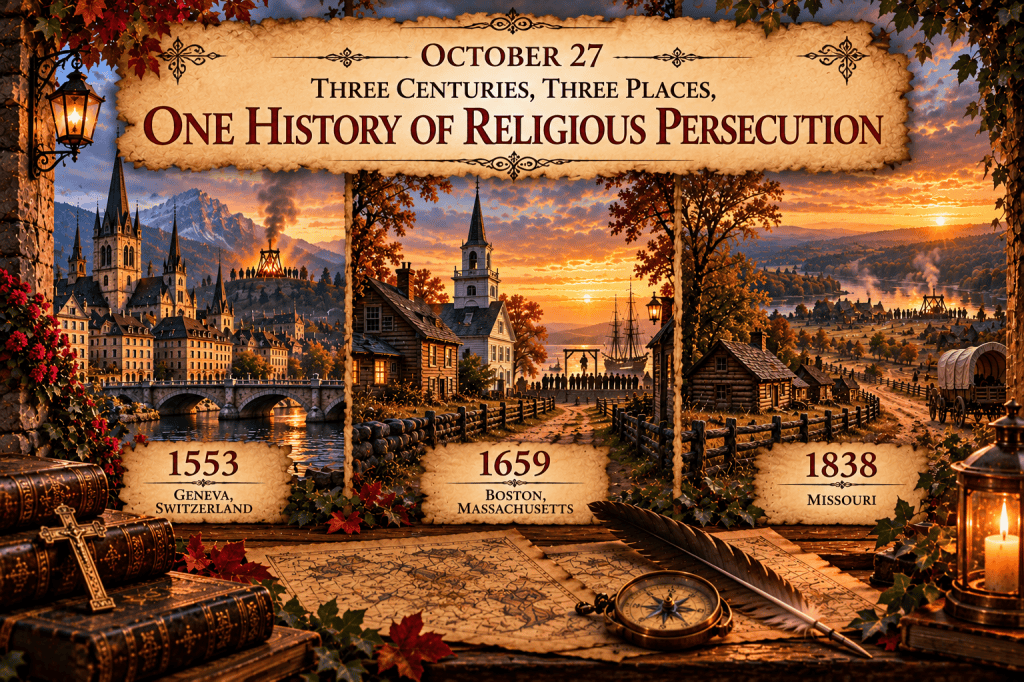
Three different centuries. Three different places. Three separate chapters of history, connected by something far more troubling than coincidence alone.
Religious persecution.
On October 27, 1553, a man was burned alive in Geneva, Switzerland, because his understanding of Christianity differed from that of the religious authorities who condemned him.
On October 27, 1659, two men were hanged in Boston, Massachusetts, because they refused to abandon their religious convictions or obey a law that prohibited their presence.
And on October 27, 1838, the governor of Missouri issued an order authorizing the expulsion of an entire religious community, with extermination presented as an alternative if deemed necessary.
The people involved did not belong to the same religious movement. Their circumstances were different, as were the societies in which they lived.
Yet each event raises a question that has followed humanity through centuries of religious conflict.
What happens when those who possess authority decide that another person’s faith is a threat that must be eliminated?
Our story begins in sixteenth-century Europe, during an era when religious divisions were reshaping kingdoms, governments, and entire communities.
The Protestant Reformation had challenged the authority of the Roman Catholic Church. Religious debates were no longer confined to churches and universities. They influenced political alliances, divided families, and sometimes determined whether a person would live or die.
In the midst of this upheaval was a Spanish physician and theologian named Michael Servetus.
Born around 1511, Servetus was a man of considerable intellectual curiosity. He studied theology, medicine, and other subjects, developing ideas that brought him into conflict with established religious authorities.
Among his most controversial beliefs was his rejection of the traditional Christian doctrine of the Trinity.
To Servetus, his interpretation represented an effort to restore what he believed was the original understanding of Christianity.
To many Catholic and Protestant authorities of his time, those same ideas were heresy.
And in sixteenth-century Europe, heresy could be treated as a crime punishable by death.
Servetus published writings defending his beliefs and eventually became involved in a bitter theological disagreement with the Protestant reformer John Calvin.
The two men exchanged arguments about Christianity, particularly the nature of God and the Trinity.
Their disagreement was not a simple difference of opinion.
It unfolded in a world where religious doctrine and civil authority were closely intertwined, and where challenging accepted beliefs could bring the power of the state down upon an individual.
In 1553, Servetus was arrested in France by Catholic authorities. He escaped imprisonment, but his journey eventually brought him to Geneva, where Calvin was an influential religious leader.
There, Servetus was recognized, arrested, and placed on trial.
The authorities charged him with heresy, including his rejection of the Trinity and his opposition to infant baptism.
On October 26, 1553, Geneva’s governing council sentenced him to death.
The following day, October 27, Servetus was taken to Champel, outside the city, where he was burned at the stake.
He died because the religious beliefs he refused to renounce had been judged intolerable by the authorities.
Calvin supported the punishment of Servetus, although historical accounts distinguish his role in the proceedings from the governing council’s responsibility for the sentence.
The execution became one of the most controversial episodes of the Protestant Reformation.
Even among those who rejected Servetus’s theology, questions emerged about whether religious disagreement should ever justify taking a human life.
The humanist Sebastian Castellio became one of the voices challenging the persecution of people for their beliefs.
The debate surrounding Servetus’s death would contribute to a much larger discussion about religious toleration and freedom of conscience.
But history was far from finished with such conflicts.
One hundred and six years later, on the other side of the Atlantic Ocean, another October 27 would become a day of religious persecution.
By 1659, the Massachusetts Bay Colony had been established for nearly three decades.
Its Puritan settlers had crossed the Atlantic seeking the opportunity to establish a society shaped by their religious convictions.
But the freedom they sought for their own community did not necessarily extend to people whose beliefs challenged the colony’s religious and social order.
Among those regarded as particularly troublesome were members of the Religious Society of Friends, commonly known as Quakers.
The Quaker movement had emerged in England during the seventeenth century. Its followers emphasized the possibility of direct spiritual experience and questioned the need for the established religious hierarchy.
Their beliefs and practices challenged assumptions about worship, authority, and social rank.
To the Puritan leaders of Massachusetts, Quaker missionaries represented a threat to the community they were attempting to preserve.
Colonial officials responded with increasingly severe laws.
Quakers entering Massachusetts could face imprisonment, corporal punishment, banishment, and eventually death if they returned after being expelled.
It is difficult to reconcile the idea of a community seeking religious freedom with laws that punished others for practicing their own faith.
Yet that contradiction became part of colonial New England’s history.
Two English Quakers, William Robinson and Marmaduke Stevenson, traveled to Massachusetts in 1659, knowing that their presence could place them in danger.
They were arrested and ordered to leave the colony under threat of execution.
But they returned.
For Robinson and Stevenson, their religious convictions compelled them to challenge the laws that sought to silence their faith.
For the colonial authorities, their return represented deliberate defiance.
Both men were sentenced to death.
On October 27, 1659, Robinson and Stevenson were taken to Boston Common and hanged.
They were the first two Quakers executed in Massachusetts.
Another Quaker, Mary Dyer, had also been sentenced to death and accompanied them to the gallows that day.
She was reprieved before her execution could take place.
But her story did not end there.
Dyer returned to Massachusetts and was hanged on June 1, 1660, after once again refusing to submit to the colony’s anti-Quaker laws.
A fourth Quaker, William Leddra, was executed in 1661.
The persecution of Quakers in Massachusetts eventually provoked criticism and intervention from outside the colony, and the laws authorizing their execution came to an end.
But the lives lost could not be restored.
And the date remained.
October 27.
A century earlier, a man had died in Geneva after refusing to renounce his interpretation of Christianity.
Now, two men had died in Boston because their own religious convictions placed them in conflict with the authorities.
Different beliefs. Different governments. Different continents.
Yet once again, religious disagreement had been answered with death.
Nearly two more centuries passed.
The world changed dramatically.
The American colonies declared independence from Britain, and the United States adopted a Constitution whose First Amendment prohibited Congress from establishing a religion or restricting its free exercise.
The language of religious liberty had become part of the nation’s founding framework.
But the existence of a constitutional principle did not mean that prejudice, violence, and persecution had disappeared.
In 1830, Joseph Smith organized the religious movement that would become known as the Church of Jesus Christ of Latter-day Saints.
Its followers, commonly called Mormons, established communities and sought places where they could worship and build their lives.
Missouri became an important destination.
But relations between Latter-day Saint settlers and other Missouri residents grew increasingly hostile.
Religious differences played a major role, alongside disputes over land, political influence, migration, and competing claims of authority.
The conflict was not entirely one-sided. Armed groups on both sides participated in violence during the escalating Missouri Mormon War of 1838.
Yet the existence of that violence does not erase what followed.
As tensions intensified, the state’s governor, Lilburn W. Boggs, received reports describing serious unrest and attacks.
On October 27, 1838, he issued an executive order directed to Major General John B. Clark of the Missouri militia.
The order instructed that the Mormons be treated as enemies and declared that they must be driven from Missouri or exterminated if necessary for the public peace.
Those words were not an accusation whispered by an angry neighbor.
They were part of an official order issued by a sitting American governor.
A government had authorized military action that treated an entire religious community as an enemy population.
Three days later, on October 30, an armed mob attacked the Latter-day Saint settlement at Haun’s Mill, killing seventeen men and boys, some of whom died of their injuries afterward.
The massacre was part of the broader violence engulfing Missouri, although the surviving evidence does not establish that the attackers were acting directly under the governor’s October 27 order.
In the aftermath of the conflict, thousands of Latter-day Saints were forced to leave Missouri, many abandoning homes, property, and communities they had worked to establish.
Families faced displacement, hardship, and uncertainty.
The promise of religious freedom had offered them little protection from the hostility surrounding them.
And there is another detail that makes this chapter of history particularly remarkable.
Missouri’s extermination order was not formally rescinded until June 25, 1976.
Nearly 138 years after it was issued, Governor Christopher S. Bond revoked it, acknowledging the injustice of the original directive.
Consider what that means.
An order written in 1838, during a period of violent religious conflict, remained formally unrescinded well into the twentieth century.
The society that produced it had changed.
The people who issued it were long dead.
But the document remained part of the state’s official history until another governor acted to withdraw it.
And once again, the date at the center of the story was October 27.
When I began looking through the events associated with this particular day, I did not expect to find this connection.
At first, they appeared to be three separate historical entries.
A theologian executed in Switzerland.
Two Quakers hanged in colonial Massachusetts.
An American governor ordering the expulsion of a religious community.
But placing them beside one another revealed something that deserves more than a passing glance.
In 1553, religious authorities in Geneva considered one man’s beliefs dangerous enough to justify his execution.
In 1659, colonial authorities in Massachusetts regarded the presence and persistence of Quakers as a threat to their religious society.
In 1838, the government of Missouri treated an entire religious community as an enemy to be removed from the state.
The circumstances were not identical, and the people involved were not interchangeable.
But each episode demonstrates how fear, religious intolerance, and the exercise of political power can combine to produce devastating consequences.
There is an important distinction between disagreeing with someone’s beliefs and denying that person the right to hold them.
Throughout history, people have debated the meaning of Scripture, challenged established doctrines, formed new religious movements, and defended convictions that others considered mistaken.
Disagreement itself is not persecution.
The danger emerges when disagreement becomes a justification for imprisonment, forced removal, or death.
And perhaps that is what makes these three October anniversaries so unsettling.
They remind us that religious persecution has not belonged exclusively to one denomination, one country, or one century.
It has taken different forms under different authorities, often carried out by people who believed they were protecting their communities, defending religious truth, or preserving public order.
The people who suffered its consequences, however, paid a far greater price.
Michael Servetus never lived to see the debates over religious toleration that followed his execution.
William Robinson and Marmaduke Stevenson never saw the end of the Massachusetts laws under which they were condemned.
And the Latter-day Saint families driven from Missouri could not have known that the order directed against their community would remain formally unrescinded for more than a century.
Their stories belong to different chapters of history.
But on the calendar, they share a single day.
October 27.
Three centuries.
Three places.
Three reminders of what can happen when religious difference becomes grounds for persecution.
And perhaps the most important question these events leave us with is not why they happened on the same date.
It is why, across so many generations, humanity has struggled to extend to others the freedom of conscience it so often demands for itself.
If history has shown us the consequences of denying religious freedom, what responsibility do we have to ensure that those lessons are not forgotten?
—Guyton







Leave a Reply