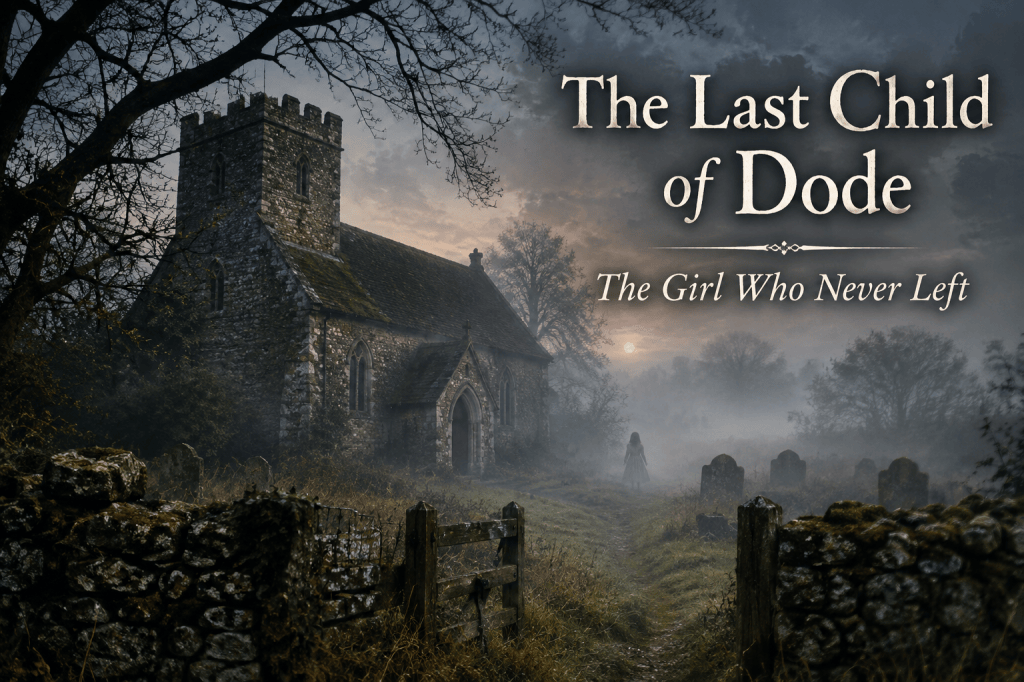
There are places in this world where time seems to have forgotten to move forward. Places where buildings outlive the people who built them, where paths once worn by countless footsteps disappear beneath the grass, and where silence becomes the only remaining witness to centuries of history.
Deep in the countryside of Kent, England, there stands a little stone church that has watched nearly nine hundred years come and go.
It once belonged to a community called Dode.
Today, the village is gone.
But according to an old ghost story, not everyone who lived there ever truly left.
To understand the legend, we must travel back to medieval England, to a time when life revolved around the changing seasons, the land, and the church.
Dode was a small rural parish tucked into the rolling countryside of Kent. Its church, traditionally known as Our Lady of the Meadow, was built during the Norman period, around the beginning of the twelfth century.
It was not a grand cathedral with towering spires and magnificent stained-glass windows. It was a modest place of worship, constructed from stone and flint, with thick walls and the simple architectural features characteristic of its age.
For the people who lived nearby, however, its importance would have had little to do with grandeur.
The church was where generations gathered to worship, where marriages were celebrated, where children were baptized, and where the dead were laid to rest.
It was a place that marked the beginning and ending of lives.
And for a time, life continued in Dode much as it did in countless other English communities.
Then came the fourteenth century.
In 1348, the Black Death reached England.
The disease had already swept through parts of Europe, leaving devastation in its wake. Its arrival brought a terror that is difficult to comprehend from the safety of the modern world.
People did not understand the bacteria responsible for the plague or the complicated ways the infection could spread. They knew only that sickness could arrive suddenly, that death could follow with horrifying speed, and that entire households might be lost.
Across England, communities suffered catastrophic mortality. Fields went untended. Homes stood empty. Churches buried more people than their surviving congregations could bear.
And according to the traditional history of Dode, the plague reached this little Kentish parish in 1349.
The familiar telling of the story says that the Black Death destroyed the village, leaving its church standing among the remains of a community that would never recover.
The historical record offers a more complicated picture.
Dode was indeed a medieval parish, and its church survived long after the settlement declined. In 1367, the parish was united with neighboring Paddlesworth. But precisely how many people lived at Dode, how many died during the plague, and whether the settlement disappeared as suddenly as the legend suggests are questions that surviving records cannot fully answer.
History tells us that the parish faded.
Folklore tells us something far more sorrowful.
It tells us there was one child left.
According to the legend, as the plague claimed the inhabitants of Dode, a little girl of about seven years old remained alive.
Her name has not survived in the telling.
Perhaps, the story suggests, she had already lost her family. Perhaps she had watched the familiar world around her grow quieter with each passing day.
The legend does not tell us everything.
It tells us only that the child sought refuge inside the church.
Imagine, for a moment, the loneliness of such a place.
The same walls that had once sheltered a congregation now surrounded a frightened little girl. Outside stood a village where the ordinary sounds of life had supposedly fallen silent.
No neighbors calling across the fields.
No footsteps approaching the church.
No familiar voices to answer her own.
Only the cold stone walls, the empty church, and whatever hope a child might have found in a place she had been taught was sacred.
But the story does not give her a happy ending.
According to the folklore, the little girl eventually died inside the church, becoming the last victim of a tragedy that had already claimed everyone around her.
And that, the legend says, was not the end of her story.
Stories circulate about a small ghostly figure associated with the old church at Dode.
She became known as the Dode Child.
Some versions of the legend say that her spirit once appeared on a Sunday morning every month. As the years passed, however, the appearances supposedly became less frequent.
Eventually, according to one telling, she was seen only once every seven years.
Why seven?
Was it because the child was said to have been seven years old when she died? Was the interval added by later storytellers, or did it emerge from some older local belief?
The surviving accounts do not provide a reliable answer.
Nor is there a known medieval document identifying the girl, recording her death, or establishing that anyone witnessed her ghost during the centuries immediately following the plague.
The Dode Child belongs to folklore, and the age of the ghost story itself is uncertain.
Yet that uncertainty is part of what makes the legend so compelling.
The church remained while the people who had once gathered around it disappeared from the landscape.
As generations passed, the building endured periods of neglect and ruin. By the beginning of the twentieth century, it had become a remnant of a vanished parish, its medieval stones still standing in the Kent countryside.
Restoration efforts helped preserve the old structure, and in more recent times it has found new life as a place for weddings and ceremonies.
Imagine the contrast.
A building associated in local tradition with the death of an entire community now welcomes couples beginning their lives together.
The same ancient walls that supposedly sheltered a dying child once again hear voices, footsteps, and promises spoken aloud.
And somewhere between those two very different chapters of its history, the legend of the Dode Child continues to linger.
There are other supernatural stories associated with the site, including tales of a spectral bride and a haunted plague pit. Like the account of the little girl, these belong to the traditions surrounding the church rather than to established historical evidence.
But the child’s story has a particular sadness that the others do not.
Perhaps it is because we can imagine the fear of a young girl facing a world she could no longer recognize.
Perhaps it is because the Black Death was real, and the suffering it caused was immense, even if the precise fate of Dode’s inhabitants remains uncertain.
Or perhaps it is because there is something especially unsettling about a child who, according to legend, never found her way home.
When we think of haunted places, we often imagine something frightening waiting in the darkness.
But not every ghost story begins with anger, revenge, or a restless spirit seeking to terrify the living.
Some begin with loss.
Some are stories that communities tell because they cannot bear the thought that the people who once lived among them might be forgotten entirely.
And sometimes a legend gives a name—or at least a presence—to someone whose life was never preserved in the historical record.
We may never know whether a little girl actually sheltered inside Dode’s church during the Black Death.
We may never know whether the story began with a real child, an older local tradition, or the imagination of people who looked upon an abandoned medieval building and wondered what had happened there.
What we do know is that the church still stands.
Nearly nine centuries after its earliest stones were laid, it remains in the Kent countryside, a survivor of changes that erased the community it once served.
The village of Dode has passed into history.
Its people are gone.
But in the folklore surrounding that lonely little church, one child remains.
And if the old story is to be believed, every seven years, she returns.
Perhaps she is searching for the family she lost.
Perhaps she is waiting for someone to open the church doors.
Or perhaps the little girl of Dode never existed at all, except in the stories of those who could not look upon the ancient building without imagining the lives that had vanished around it.
After all these centuries, the question remains.
Was the Dode Child a forgotten victim of the Black Death—or was she born from the silence of a village that history left behind?
—Guyton






Leave a Reply