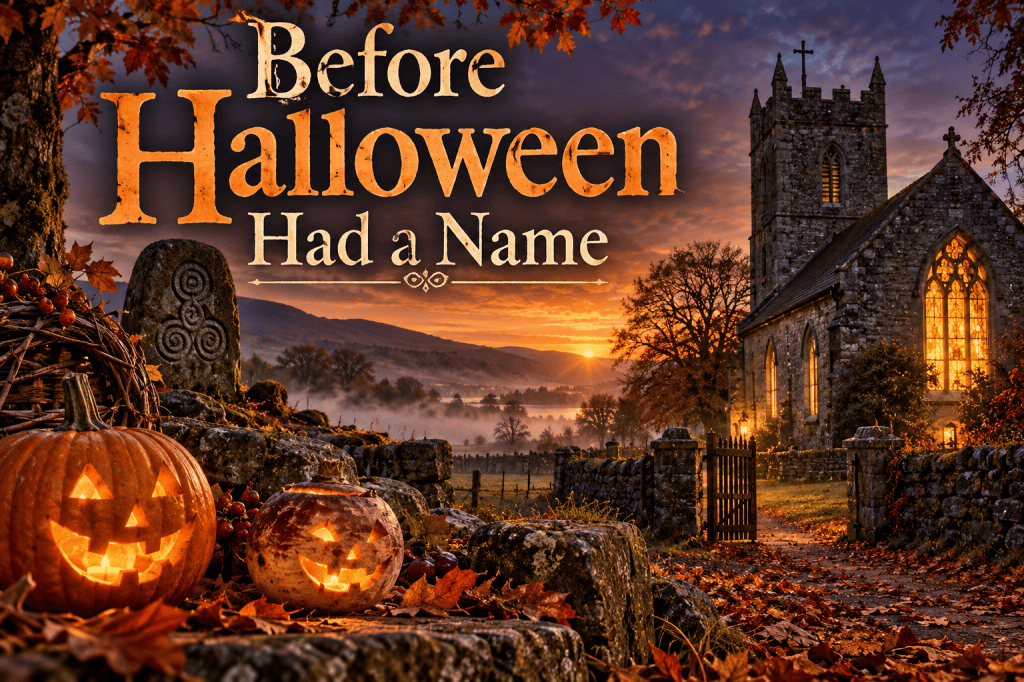
Every October, without fail, I see the same arguments making their way around social media.
Halloween is the devil’s holiday.
It’s a celebration for Satan worshipers.
And if you’re a Christian who participates in Halloween, well, apparently that makes you a bad Christian.
Really?
Because I’m a Christian. I love Halloween. And I have a few questions.
For starters, when did carving a pumpkin become an occult practice? When did passing out miniature candy bars become Satan worship? And exactly which biblical commandment am I breaking when I put a skeleton on my porch?
Because unless that skeleton starts giving me instructions about contacting the dead, I think we’re going to be okay.
Now, before anyone misunderstands me, I absolutely respect another Christian’s decision not to celebrate Halloween. Everyone has the right to follow their own convictions.
But I also believe there’s a difference between practicing your faith and questioning somebody else’s relationship with God because they enjoy a holiday you don’t.
And here’s something that might surprise a few people.
The word Halloween actually comes from Christianity.
Yes, Christianity.
So grab your coffee, because we’re going back a little further than the costume aisle at Walmart.
Long before there were plastic pumpkins, haunted houses, and enough Halloween candy to give an entire neighborhood a sugar rush, people in parts of the Celtic world observed a seasonal festival known as Samhain.
Pronounced approximately SOW-in, Samhain marked the transition from the harvest season into winter.
For communities that depended on farming and livestock, this wasn’t just a change in the weather.
It was a significant turning point in the year.
The harvest had been gathered. The days were growing shorter. Winter was approaching, and survival depended on preparing for the colder months.
And in a world without electricity, central heating, or a weather app telling you when the next cold front was coming, the arrival of winter carried a very different meaning.
Over time, Samhain also became associated with supernatural beliefs.
Irish folklore described this season as a time when the boundary between the human world and the Otherworld could become unusually thin.
Stories told of mysterious beings, strange encounters, and the possibility that the familiar world might briefly become something less familiar.
But there’s something important we need to understand.
Our knowledge of ancient Samhain is incomplete.
Much of the surviving written material comes from centuries after Christianity had already become established in Ireland. That means we cannot confidently reconstruct every ancient ceremony or claim that every modern Halloween tradition came directly from a particular pagan ritual.
And despite what some people insist, Samhain was not a festival created to worship Satan.
The Christian concept of Satan was not the religious foundation of ancient Celtic seasonal observances.
That distinction matters.
Now, let’s talk about where Christianity enters the story.
From the early centuries of the Church, Christians commemorated martyrs and other saints.
Different Christian communities observed these commemorations at different times.
During the eighth and ninth centuries, November 1 became increasingly established in the Western Church as the date for All Saints’ Day, also known as All Hallows’ Day.
It was a day dedicated to honoring the saints.
November 2 later became associated with All Souls’ Day, a time for remembering and praying for the departed in traditions that observed it.
And what do you call the evening before All Hallows’ Day?
All Hallows’ Eve.
Over time, that name became Hallowe’en.
And eventually, Halloween.
So the name of the holiday that some people insist belongs to Satan is actually derived from a Christian holy day.
I’ll give everybody a moment to process that.
Now, does that mean everything associated with Halloween originated in Christianity?
No.
And I don’t think we need to pretend otherwise.
Halloween developed through a complicated mixture of religious observances, seasonal customs, folklore, immigration, and cultural change.
Its name is Christian, while some of the traditions associated with the season have older Celtic connections.
Historians still debate exactly how those traditions influenced one another.
One popular explanation claims the Church deliberately moved All Saints’ Day to November 1 specifically to replace Samhain.
But the historical evidence doesn’t establish that explanation as neatly as it’s often presented.
What we know is that Christian observances and regional seasonal customs developed alongside one another, sometimes overlapping and influencing later traditions.
And that brings us to something else people might find surprising.
Some of the customs that helped shape modern Halloween were connected to Christian practices.
Take souling, for example.
In parts of medieval Britain, poorer members of the community went from house to house during the season surrounding All Souls’ Day.
They received food, cakes, or other charity, and in return they offered prayers for the dead.
These cakes became known as soul cakes.
People going door to door and receiving treats.
Does that sound familiar?
Of course, nobody was showing up dressed as Spider-Man demanding a Reese’s Peanut Butter Cup.
But the resemblance to later Halloween customs is certainly interesting.
Then there was guising, a tradition particularly associated with Scotland and Ireland.
People dressed in disguises and visited homes, sometimes performing songs, poems, or other entertainment in exchange for food or treats.
These customs are among several historical traditions associated with the development of modern Halloween celebrations. Historians have not established one single, uninterrupted origin for trick-or-treating.
Immigrants also carried seasonal customs across the Atlantic.
And once those traditions reached North America, they continued changing.
Halloween celebrations became increasingly popular during the nineteenth and twentieth centuries.
Communities organized parties and festivities.
Children wore costumes.
Pranks became associated with the holiday, sometimes getting so out of hand that towns actively looked for ways to encourage safer celebrations.
And eventually, the modern practice of trick-or-treating became widespread.
By the middle of the twentieth century, Halloween was becoming the neighborhood celebration many of us recognize today.
Children dressed in costumes.
Families decorated their homes.
Neighbors handed out candy.
And somewhere along the way, someone decided candy corn was a good idea.
I’m certainly not complaining.
But here’s where I want to return to something that matters to me personally.
I’m a Christian.
My faith is important to me.
And I understand that the Bible warns against divination, sorcery, and attempting to communicate with the dead.
Those warnings are real.
But I’m not doing any of those things when I celebrate Halloween.
I’m not worshiping Satan.
I’m not attempting to summon spirits.
I’m not participating in occult rituals.
I’m enjoying a holiday.
I’m carving pumpkins, appreciating spooky decorations, watching scary movies, and enjoying traditions that have developed over centuries.
And I don’t believe those activities, by themselves, determine whether someone is a good Christian.
There’s a passage in Matthew 7:1 that says:
“Judge not, that ye be not judged.”
And while that verse doesn’t mean Christians should abandon discernment, it does warn us about the way we judge other people.
Romans 14 also discusses differences of conscience among believers, including how people regard particular days.
Paul wasn’t writing about Halloween specifically, but his teaching about respecting differences of conscience is worth considering.
Romans 14:13 tells believers:
“Let us not therefore judge one another any more.”
I think that’s something we could all spend a little more time reflecting on.
If your Christian convictions lead you not to celebrate Halloween, I respect that.
You don’t have to decorate your house.
You don’t have to hand out candy.
You don’t have to participate in anything that makes you uncomfortable.
But I would hope that same respect could be extended to Christians who make a different choice.
Because there’s a difference between saying, “I don’t celebrate Halloween because of my faith,” and saying, “You’re not a good Christian because you do.”
One is a personal conviction.
The other is a judgment about somebody else’s faith.
And I don’t believe we can measure someone’s relationship with God by whether they have a jack-o’-lantern sitting on their front porch.
Now, I also want to be clear about something.
I’m not suggesting that Halloween is exclusively a Christian holiday today.
It isn’t.
People celebrate it for all sorts of reasons, and many don’t attach any religious significance to it whatsoever.
Others observe the Christian holy days associated with this time of year.
Some follow modern pagan traditions.
And plenty of families simply enjoy the costumes, candy, and decorations.
Modern Halloween means different things to different people.
But that doesn’t change its documented history.
Its name comes from All Hallows’ Eve.
Its traditions developed through centuries of cultural and religious change.
And the claim that Halloween was originally created as a holiday for Satan worshipers simply isn’t supported by that history.
I think that’s important to understand, especially when so much misinformation gets repeated every October.
We don’t have to agree on whether Halloween should be celebrated.
But we should at least be willing to learn where it came from before making declarations about what it means.
And that’s exactly what we’re going to explore this week.
Because Halloween is filled with traditions that have histories of their own.
Why did people begin carving frightening faces into vegetables?
Where did Halloween costumes come from?
How did trick-or-treating become an American tradition?
And why are black cats, witches, ghosts, and other familiar symbols so closely associated with October 31?
Those are stories worth investigating.
Not because everyone has to celebrate Halloween.
But because understanding history is always better than repeating something simply because we’ve heard it before.
As for me, I’ll continue enjoying Halloween.
I’ll continue enjoying my spooky movies, my pumpkins, and all the little traditions that make this time of year so much fun.
And I’ll continue being a Christian.
Because my faith isn’t something I take off when I put on a Halloween costume.
And if you happen to knock on my door looking for candy, I promise I’m not going to ask about your religious beliefs before handing you a Snickers.
Although I might judge you just a little if you tell me you don’t like candy corn.
—Guyton


Leave a Reply