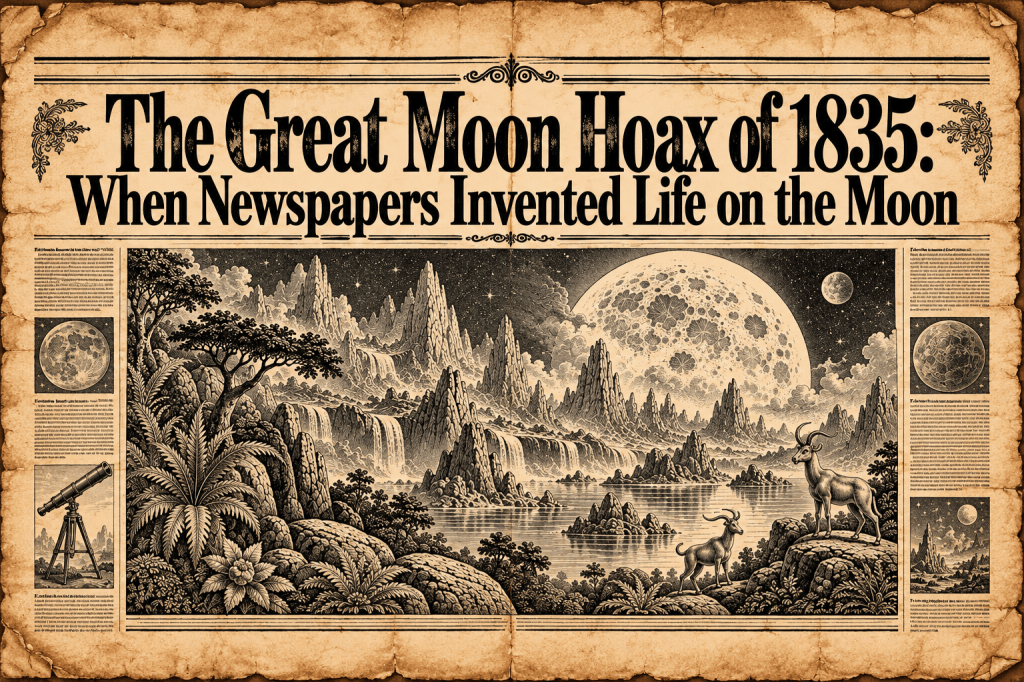
Imagine opening your morning newspaper and discovering that scientists had found life on the Moon.
Not microscopic organisms. Not some mysterious substance that might suggest life existed millions of years ago.
I’m talking about forests, rivers, exotic animals, and an entire civilization of winged humanoids.
And the newspaper wasn’t presenting any of this as fiction.
It claimed that one of the world’s most respected astronomers had made the discoveries himself.
Now, I don’t know about you, but if I had been sitting at my breakfast table in 1835, reading that scientists had discovered bat-winged people living on the Moon, I would have had approximately a thousand questions.
Unfortunately, the newspaper didn’t have the answers.
Because none of it was true.
What unfolded in August 1835 would become one of the most extraordinary examples of sensational journalism in American history.
It’s remembered today as the Great Moon Hoax.
And the more I investigated this story, the more I found myself wondering how anyone involved thought this was a good idea.
Our story begins in New York City on August 25, 1835.
The New York Sun, a relatively young newspaper founded just two years earlier, published the first installment of what appeared to be a groundbreaking scientific report.
The articles were presented under the title Great Astronomical Discoveries, and they promised readers something humanity had wondered about for centuries.
Was there life beyond Earth?
According to the newspaper, the answer was yes.
And apparently, the Moon was practically overflowing with it.
The supposed discoveries were attributed to Sir John Herschel, a respected British astronomer who was conducting genuine scientific observations near the Cape of Good Hope in South Africa.
That part of the story was true.
Herschel had traveled to the Southern Hemisphere to study the night sky. He was an accomplished scientist whose family name carried considerable weight in astronomy.
His father, William Herschel, had discovered Uranus in 1781.
So, when readers encountered a report bearing the younger Herschel’s name, they had a legitimate reason to recognize it.
But recognizing a scientist’s name is not the same thing as verifying a scientific discovery.
And that distinction is where this story begins to unravel.
The newspaper claimed that Herschel had developed an extraordinary telescope capable of observing the lunar surface in unprecedented detail.
The instrument supposedly possessed a lens measuring twenty-four feet across and weighing approximately seven tons.
It was described as so powerful that observers could distinguish remarkably small objects on the Moon.
Just imagine the possibilities.
If such a telescope had actually existed, it would have represented an astonishing technological achievement.
Unfortunately, it didn’t.
The instrument was a product of the writer’s imagination.
And that imaginary telescope was only the beginning.
As the articles continued, readers were introduced to an increasingly elaborate lunar landscape.
There were towering mountains, enormous craters, beautiful lakes, and lush vegetation.
The Moon, which people could observe from Earth as a distant, seemingly barren world, was suddenly described as a thriving natural paradise.
Then came the animals.
The newspaper reported creatures resembling bison, goats, and other familiar Earth animals, although many supposedly possessed unusual physical characteristics.
There were strange birds, unfamiliar mammals, and animals that appeared to combine features of several different species.
One description involved beaverlike creatures that reportedly walked upright.
Another introduced unicornlike animals wandering through the lunar countryside.
And if that wasn’t enough to capture everyone’s attention, the articles eventually revealed something even more extraordinary.
People.
Well, something resembling people.
The supposed lunar inhabitants were described as humanoid creatures approximately four feet tall, covered with short copper-colored hair and possessing membranous wings extending from their shoulders toward their legs.
The writer gave them the scientific-sounding name Vespertilio-homo.
Essentially, bat-men.
According to the fabricated observations, these beings walked upright, communicated with one another, and displayed behavior suggesting intelligence.
The reports even described structures that appeared to be temples.
By this point, readers weren’t merely being told that life existed on the Moon.
They were being introduced to an entirely fictional civilization.
And the newspaper was presenting the whole thing as an astronomical discovery.
Now, here’s where the deception becomes particularly interesting.
The articles didn’t simply appear without an explanation of where the information had supposedly originated.
They claimed to have been reproduced from a supplement to the Edinburgh Journal of Science.
That sounded impressive.
It suggested the discoveries had already passed through a scientific publication before reaching American readers.
There was just one rather significant problem.
The journal had ceased publication years earlier.
The supposed supplement wasn’t a legitimate source for these discoveries.
And the man credited with reporting the observations, Dr. Andrew Grant, was another invention.
He was presented as someone working alongside Herschel, giving the narrative an additional layer of scientific authority.
In reality, the newspaper had constructed an elaborate illusion of credibility.
A real astronomer.
A fictional assistant.
A scientific journal that was no longer publishing.
And a telescope that didn’t exist.
All supporting discoveries that had never happened.
It’s difficult not to admire the creativity involved while simultaneously questioning the judgment behind it.
Because there is a perfectly acceptable place for stories about bat-winged civilizations living on the Moon.
It’s called fiction.
And fiction can be wonderful.
But presenting fiction as verified scientific fact is an entirely different matter.
The man behind the articles was Richard Adams Locke, a British-born journalist working for the New York Sun.
Locke was intelligent, well-read, and familiar with scientific discussions of his time.
He understood enough about astronomy to surround his imaginary discoveries with technical details that might sound convincing to readers unfamiliar with the limitations of contemporary telescopes.
And he knew how to tell a story.
That much is undeniable.
But why would he create such an elaborate deception?
Locke later maintained that the articles were intended as satire.
His target was partly the growing enthusiasm for theories suggesting that other worlds were inhabited.
One prominent figure associated with those ideas was Reverend Thomas Dick, a Scottish minister and popular writer who argued that the universe contained enormous numbers of inhabited worlds.
Dick’s writings combined astronomy, religious thought, and speculation about extraterrestrial life.
Locke apparently considered some of those claims extravagant and wanted to expose what he saw as faulty reasoning.
So, according to the later explanation, he created an absurdly detailed account of lunar life to demonstrate how far such speculation could go.
There’s an interesting irony in that explanation.
If Locke wanted people to recognize the absurdity of unsupported scientific claims, his articles achieved almost the opposite result.
Instead of immediately recognizing the satire, many readers embraced the discoveries.
The story spread rapidly.
Other newspapers reproduced the reports, and the supposed discoveries traveled far beyond New York.
The articles eventually circulated internationally, with illustrations bringing the fictional lunar creatures to life.
The Sun benefited enormously from the attention.
Accounts of the episode describe a substantial increase in circulation, helping establish the newspaper as a major force in the growing popular press.
But not everyone believed what they were reading.
Some newspapers questioned the claims almost immediately.
The Library of Congress preserves contemporary coverage showing that editors debated whether the reports were genuine or an elaborate fabrication.
One Massachusetts newspaper even discussed which publications appeared to accept the discoveries and which regarded them as nonsense.
So, although the Great Moon Hoax fooled many people, it would be inaccurate to claim that everyone believed it.
There were skeptics.
There were questions.
And there were people who recognized that extraordinary scientific claims required something more substantial than a sensational newspaper article.
Unfortunately, skepticism didn’t prevent the story from spreading.
And then things became even more interesting.
Because another writer had already published a story involving travel to the Moon.
His name was Edgar Allan Poe.
Yes, that Edgar Allan Poe.
Earlier in 1835, Poe had published The Unparalleled Adventure of One Hans Pfaall, a fictional account involving a journey to the Moon by balloon.
The story appeared in the Southern Literary Messenger in June, approximately two months before the Sun began publishing its lunar discoveries.
Poe later believed that Locke had borrowed ideas from his work.
Whether the accusation was justified remains uncertain, but the connection adds another remarkable layer to the story.
Two writers were exploring the possibility of life beyond Earth in the same year.
One published an imaginative fictional adventure.
The other presented an imaginary scientific discovery through the format of a newspaper report.
And the latter became an international sensation.
Poe would later produce another famous newspaper deception, The Balloon-Hoax, published in 1844.
Apparently, nineteenth-century writers had a particular fascination with convincing people that extraordinary things were happening in the skies.
But let’s return to Richard Adams Locke, because his explanation that the articles were merely satire deserves a closer look.
If the entire point was to demonstrate how ridiculous unsupported claims could become, why wasn’t the fiction clearly identified once readers began taking it seriously?
Contemporary evidence complicates the idea that everyone involved simply intended a harmless joke.
The Library of Congress documents that Locke responded to accusations of authorship in a letter published at the end of August 1835.
Rather than openly acknowledging that he had written a fictional account, he expressed disbelief that anyone would accuse him of inventing the discoveries.
His response avoided admitting responsibility and continued to treat Herschel’s supposed findings as potentially authentic.
The Smithsonian’s historical research also describes how the newspaper’s publisher resisted revealing the truth while the story was attracting attention.
That doesn’t necessarily prove Locke began the project intending to deceive every reader.
Satire can certainly be misunderstood.
But once the public began accepting the story as fact, the continued presentation of the articles as genuine scientific reporting became a serious ethical problem.
And that’s what bothers me most about this entire episode.
Not the imaginary creatures.
Not the absurd telescope.
Not even the idea of a civilization living on the Moon.
Those details could have made a wonderful piece of speculative fiction.
The problem was that readers were encouraged to believe the discoveries had been verified by a real scientist.
Herschel’s reputation was used to support claims he had never made.
And the authority of scientific publication was imitated to give an invented story the appearance of evidence.
Eventually, the truth emerged.
The discoveries were fictional.
The lunar inhabitants were imaginary.
The extraordinary telescope was imaginary.
And the scientific report that had captivated readers around the world was a carefully constructed fabrication.
The surviving articles became part of the history of journalism, satire, and early science fiction.
Today, copies and illustrations associated with the Great Moon Hoax are preserved by institutions including the Library of Congress and the Smithsonian.
We can actually examine the words and images that helped persuade nineteenth-century readers that the Moon was home to an extraordinary civilization.
And there’s something almost unbelievable about seeing those historical records.
Not because they prove the existence of bat-winged lunar people.
But because they demonstrate how effectively a convincing story can spread when it borrows the appearance of scientific authority.
Of course, the world of 1835 was very different from ours.
People didn’t have spacecraft, lunar landers, or the detailed photographic evidence we possess today.
The Moon remained a place of enormous mystery.
Scientific discoveries were expanding humanity’s understanding of the universe, and many people were eager to believe that the next extraordinary revelation might arrive at any moment.
In that environment, an imaginative newspaper report could exploit both genuine curiosity and the limits of available knowledge.
But I don’t think this story belongs exclusively to the nineteenth century.
We still encounter sensational claims.
We still see extraordinary stories presented with impressive-sounding terminology.
We still find people invoking scientific authority without providing evidence.
And we still have to decide whether something is genuinely remarkable or merely written to capture our attention.
Now, I want to make something very clear.
I love the unusual.
I love folklore, forgotten history, mysterious creatures, and the possibility that the world still holds discoveries we haven’t made.
If someone tells me there’s an extraordinary creature hiding in an unexplored forest, I’m interested.
If someone claims an unusual phenomenon has occurred, I want to know what happened.
But curiosity and belief are not the same thing.
Wanting something to exist doesn’t make it real.
And wanting something to be impossible doesn’t prove that it is.
What matters is the evidence.
If something extraordinary exists, I want us to investigate it carefully, document it honestly, and understand what we’ve discovered.
And if we discover a living creature that has somehow escaped scientific recognition, I would hope we could learn about it without immediately deciding it needs to be captured, exploited, or turned into a spectacle.
Sometimes the most respectful thing we can do is recognize that something exists and leave it in peace.
But if an extraordinary claim turns out to be false, I want to know that, too.
Because inventing evidence doesn’t protect wonder.
It damages it.
The Great Moon Hoax is a perfect example of what happens when storytelling and factual reporting become deliberately entangled.
For a brief moment in 1835, people were invited to believe that the Moon contained forests, strange animals, and an intelligent civilization of winged beings.
The story was imaginative.
It was elaborate.
It was wildly entertaining.
And it wasn’t true.
Nearly two centuries later, we know far more about the Moon than Richard Adams Locke or his readers could have imagined.
Human beings have traveled there, walked across its surface, collected samples, and studied its geological history.
And although the lunar world we’ve discovered bears no resemblance to the fictional paradise described by the New York Sun, its actual history is extraordinary in its own right.
We didn’t need to invent bat-winged people to make the Moon worth exploring.
It was already remarkable.
And perhaps that’s the lesson I take from this entire story.
There’s nothing wrong with wanting the world to be filled with mysteries.
There’s nothing wrong with hoping that something extraordinary might still be waiting to be discovered.
But if we’re going to tell people we’ve found something incredible, we owe them something more than an entertaining story.
We owe them the truth.
Because the unknown is fascinating enough without someone manufacturing the answers.
And if there really are extraordinary things out there waiting to be discovered, I’d much rather find them than be fooled into believing someone already has.
—Guyton






Leave a Reply