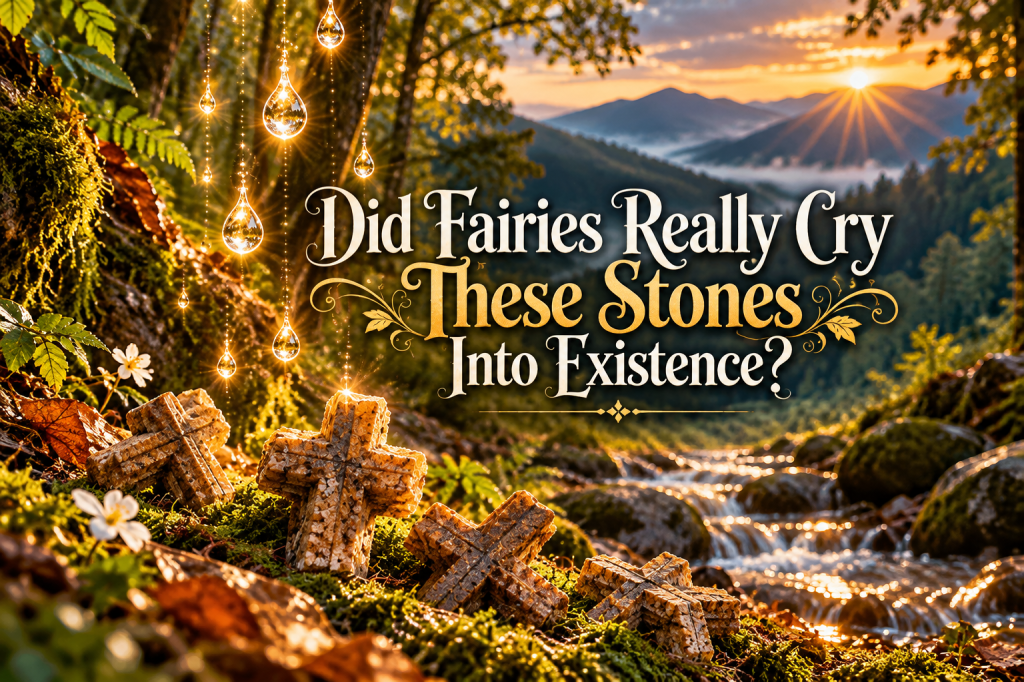
Deep in the foothills of Virginia’s Blue Ridge Mountains, there are tiny stones that have inspired an extraordinary legend.
At first glance, they might not look particularly remarkable. They’re small, brownish, and easily overlooked among the dirt and rocks scattered across the forest floor.
But look a little closer.
Some are shaped like the letter X. Others resemble miniature Christian crosses, complete with intersecting arms that appear almost too perfectly formed to be natural.
And according to an old Appalachian legend, they weren’t always stones.
They were once the tears of fairies.
Now, if you’ve spent any time around here, you already know that I have a weakness for unusual folklore. But what makes this particular story interesting is that the stones themselves are real, the legend appeared in print more than a century ago, and the land where they’re found has a history almost as fascinating as the tale.
So, how did little stone crosses become associated with grieving fairies?
And how much of the story can we actually trace?
Let’s head into the Virginia mountains and find out.
According to the legend, long ago, a community of fairies lived peacefully in the wooded foothills of the Blue Ridge Mountains.
They spent their days among the trees, streams, and wildflowers, enjoying a world seemingly untouched by human troubles.
Some versions describe the fairies dancing near a spring, accompanied by woodland spirits and water nymphs.
Then, one day, a messenger arrived from a distant city.
He brought terrible news.
Jesus Christ had been crucified.
When the fairies learned what had happened, they were overcome with grief. They began to weep, and as their tears fell upon the earth, something extraordinary happened.
Each tear crystallized into a tiny stone cross.
Eventually, the fairies disappeared from the mountains, but the stones remained, scattered throughout the forest as reminders of their sorrow.
It’s a striking story, isn’t it?
A Christian symbol appearing in the natural world, explained through a tradition involving supernatural beings.
But there’s something important to understand.
Although versions of this legend describe events occurring many centuries ago, that doesn’t establish when the story itself originated.
And as it turns out, we can trace the fairy-tears story further back in the written record than the establishment of the state park.
Before we investigate that history, though, we need to examine the stones themselves.
They’re called staurolite crystals, and unlike the fairies in the story, their existence isn’t disputed.
Staurolite is a mineral containing iron, aluminum, silicon, oxygen, and hydrogen. It forms within certain metamorphic rocks that have experienced tremendous heat and pressure deep beneath the Earth’s surface.
Under the right conditions, individual crystals grow together in intersecting arrangements known as crystal twins.
That intersection creates the unusual shapes people have admired for generations.
There are three traditional cross-shaped varieties associated with Virginia’s fairy stones.
The St. Andrew’s cross resembles an X, with two crystals intersecting diagonally.
The Roman cross resembles a more familiar Christian cross.
The Maltese cross is another prized formation, often described as having a shorter, more compact cross shape.
Not every staurolite crystal forms a cross. Many appear as single, elongated crystals without any intersection at all.
According to Virginia State Parks, the Maltese variety is especially rare and sought after.
But how did these little crosses end up scattered across the ground?
The answer involves millions of years of geological change.
As the surrounding rock, often a type called schist, gradually weathered away, the more resistant staurolite crystals became exposed. Eventually, some broke free and accumulated in the soil.
That’s why visitors can still discover them among the dirt and tree roots today.
The stones weren’t carved into crosses by ancient inhabitants or created by some mysterious forgotten civilization.
Nature produced the shapes.
And perhaps that’s part of what made them so fascinating in the first place.
The fairy stones eventually became associated with something beyond their unusual appearance.
They were considered good-luck charms.
According to folklore preserved by Virginia State Parks, people believed the stones could protect their owners from sickness, accidents, disasters, and even witchcraft.
Imagine finding a tiny cross-shaped stone in the mountains and believing it might protect you from misfortune.
It’s easy to understand why something like that would become a treasured keepsake.
The stones were carried in pockets, worn as jewelry, and given as gifts.
There are even stories claiming that Presidents Theodore Roosevelt and Woodrow Wilson carried fairy stones for good luck.
However, there’s a distinction worth making.
Virginia State Parks describes those presidential stories as rumors. Without contemporary documentation establishing that either president actually carried one, we shouldn’t treat the claim as historical fact.
The beliefs surrounding the stones are part of the folklore.
That doesn’t mean the stones possess supernatural powers. It means people attached meaning to something unusual they found in the natural world.
And sometimes, those meanings survive long after anyone remembers where the original stories began.
Here’s where our little trip into Appalachian folklore becomes especially interesting.
You might expect a story involving fairies, ancient mountains, and the crucifixion of Christ to have a clearly documented history stretching back hundreds of years.
But the evidence isn’t quite that straightforward.
One particularly interesting piece of evidence comes from a book published in 1923.
In Near Nature’s Heart, author Crawford Jackson included a poem titled The Stone Crosses and the Fairies.
The poem describes the fairy-stone legend in Patrick County, Virginia, connecting the mysterious crosses to fairies grieving over the crucifixion of Christ.
And that matters.
It means the story was already appearing in published literature roughly a decade before Fairy Stone State Park was established.
But even that discovery doesn’t tell us who originally created the legend.
Jackson’s poem demonstrates that the tradition existed in print by 1923. It doesn’t establish whether the story had been circulating orally for decades, generations, or some shorter period before publication.
The official National Register of Historic Places nomination for Fairy Stone State Park also acknowledges uncertainty surrounding the legend’s origins.
It discusses how the Virginia Commission on Conservation and Development incorporated fairy-stone folklore into promotional materials as the state park system developed.
The historical record leaves questions about how much of the familiar storytelling came from established local traditions and how much may have been adapted or embellished for visitors.
That doesn’t mean someone simply invented the entire legend in the 1930s. Jackson’s earlier poem makes that explanation too simplistic.
But without older, reliably dated evidence, we still cannot establish exactly when the story began.
And that’s an important part of researching folklore.
Sometimes the legend is much easier to find than its beginning.
Today, the stones are closely associated with Fairy Stone State Park in Patrick County, Virginia, with portions of the historic district extending into Henry County.
But before the park opened, the surrounding landscape had a very different identity.
Parts of the property were once associated with a community called Fayerdale.
Fayerdale developed around industrial activities, including iron production and timber operations.
At one time, the settlement had homes, stores, a school, a church, a hotel, and railroad connections.
This wasn’t simply an isolated stretch of wilderness waiting to become a state park.
People lived and worked there.
The community eventually declined as industrial operations changed. A destructive fire damaged the lumber operation in the early twentieth century, contributing to the area’s decline.
Then came the Great Depression.
According to the park’s National Register nomination, on October 20, 1933, Roanoke businessman and newspaper publisher Junius Blair Fishburn donated a large tract of land to Virginia for the creation of a state park.
That’s an especially interesting date for us because today, October 19, falls just one day before the ninety-third anniversary of that recorded donation.
Beginning in the 1930s, approximately 600 Civilian Conservation Corps workers helped transform the landscape into a public recreation area.
The park opened in 1936 as one of Virginia’s original six state parks.
In 2007, its historic district was added to the National Register of Historic Places.
So, beneath the beautiful scenery and charming fairy legend lies another story entirely: a former industrial landscape transformed into a public park during one of the most difficult economic periods in American history.
Now, here’s a detail I certainly didn’t expect when I started looking into these little stones.
Some of the fairy stones sold as souvenirs weren’t entirely natural.
And this isn’t just an internet rumor.
In 1934, mineralogist Joseph K. Roberts published research in American Mineralogist examining staurolite specimens marketed as decorative stones and jewelry.
He documented imitations made from softer rock that could be cut and filed into convincing cross shapes.
Some were darkened with oil to resemble genuine staurolite.
Other specimens were genuine crystals that had been filed or otherwise altered to make their shapes more attractive.
Think about that for a moment.
These little stones had become desirable enough that people were manufacturing lookalikes.
A naturally occurring mineral, surrounded by stories of fairies and good fortune, had developed a commercial market.
And wherever there’s a market for something unusual, apparently there’s also an opportunity for someone to imitate it.
The fact that this was being investigated in the 1930s tells us something about the popularity of fairy stones at the time.
They weren’t merely geological curiosities.
They were souvenirs, jewelry, keepsakes, and objects associated with local identity.
And if you’re wondering whether people can still find these unusual little stones today, the answer is yes.
Virginia’s Fairy Stone State Park remains one of the best-known places associated with these crystals.
The park identifies a designated collecting area near Route 57, where visitors can search for stones.
According to the state’s published guidance, a small number may be collected for personal use, but commercial digging is prohibited.
Visitors should follow current park rules, including restrictions on digging tools and collecting locations.
And you don’t necessarily need to find a perfect little cross.
Single crystals and irregular formations are also part of the natural history of the area.
Of course, staurolite isn’t exclusive to Virginia. The mineral occurs in other regions of the United States and elsewhere in the world.
What makes this particular place distinctive is the abundance of the crystals and the enduring folklore associated with them.
So, did fairies really cry these stones into existence?
Geologically speaking, no.
The stones formed through natural processes involving heat, pressure, crystal growth, and the gradual weathering of surrounding rock.
But the scientific explanation doesn’t erase the story people created around them.
What interests me most is how a tiny mineral formation became connected to something so much larger.
Grief. Faith. Protection. Good fortune. The natural world.
Someone looked at a small stone shaped like a cross and saw more than a mineral.
They saw a story worth telling.
And that story became part of the identity of an entire place.
We know the stones are real.
We know people treasured them.
We know they became popular enough to be sold as jewelry and even imitated.
And thanks to a poem published in 1923, we know the story of grieving fairies was being told in print before Virginia’s state park system was established.
What we don’t know with certainty is who first told the story or how far back that particular tradition reaches.
Perhaps it was passed down through generations before anyone thought to write it down.
Perhaps it evolved as local beliefs met the growing popularity of the stones.
And perhaps the version familiar to visitors today contains embellishments added as the story traveled through the years.
Without stronger historical evidence, those possibilities remain open.
And I think that’s perfectly fine.
Not every mystery needs an invented answer.
Sometimes, the most interesting part of a legend is discovering where the documented history ends and the storytelling begins.
After all, millions of years of geological history gave Virginia its little stone crosses.
Human imagination gave them their fairies.
And together, they created a tradition that people are still talking about today.
—Guyton


Leave a Reply