I’ve traveled through 40 of America’s 50 states. Along the way, I’ve seen beautiful places, met people from all walks of life, and witnessed things that have stayed with me long after the journey ended.
One thing I’ve learned from those travels is that homelessness doesn’t look the same everywhere.
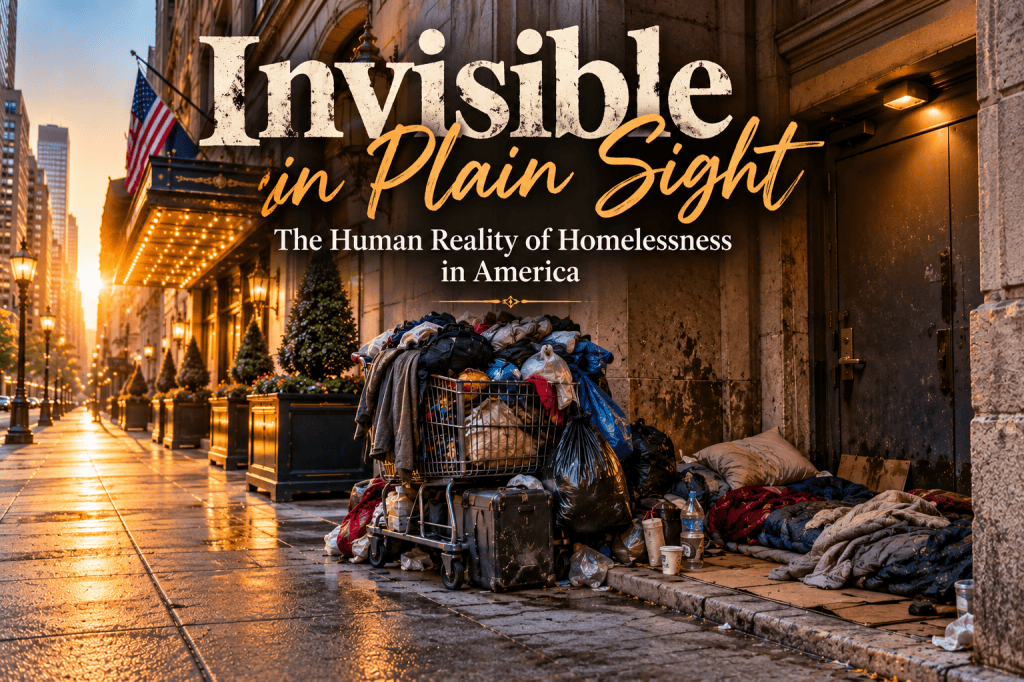
Sometimes it’s a person sleeping on a sidewalk. Sometimes it’s a collection of tents tucked away from the busy streets. Sometimes it’s an entire community built by people who have nowhere else to go. And sometimes, you can walk right past someone experiencing homelessness without ever realizing they have no permanent place to call home.
I’ve seen homelessness take many different forms across this country. And if there’s one thing those experiences have taught me, it’s that you cannot know someone’s story simply by looking at them.
When most people picture homelessness, they imagine someone sleeping beneath a bridge, sitting on a park bench, or standing at an intersection holding a cardboard sign.
But that’s only part of the picture.
In May 2026, the U.S. Department of Housing and Urban Development released its latest nationwide homelessness report. On a single night in January 2025, an estimated 745,652 people were experiencing homelessness in America.
Of those individuals, 266,320 were living without shelter.
The others were staying in emergency shelters, transitional housing, or similar temporary accommodations.
And even those numbers don’t tell the entire story.
They don’t fully capture the people temporarily staying with friends or relatives because they have nowhere else to go. They don’t tell us how many people are one missed paycheck away from losing their homes. And they certainly don’t tell us who these individuals are or what happened in their lives.
A number on a government report cannot tell you someone’s story.
In Portland, Oregon, a group of people experiencing homelessness decided they wanted something more than another night sleeping in a doorway.
In December 2000, they established an encampment called Camp Dignity.
Their beginnings were anything but easy.
As authorities repeatedly moved the encampment, residents packed their belongings into shopping carts and traveled together to new locations. These organized moves became known as shopping cart parades.
But the people involved weren’t simply searching for another place to pitch their tents.
They were organizing.
They wanted safety, stability, and a voice in decisions affecting their lives.
What began as a tent city eventually became Dignity Village, a self-governing community recognized by Portland in 2004.
More than two decades later, Dignity Village remains a place where people without permanent housing can find shelter and participate in running their own community.
It began with people who were tired of being moved along and wanted somewhere they could belong.
And Portland isn’t the only place where people have created communities outside conventional housing.
Deep in Southern California’s desert, near the Salton Sea, sits a place called Slab City.
Built on the remains of a former military installation, Slab City has become known for its unusual mixture of trailers, RVs, improvised shelters, artwork, and off-grid living.
Some people arrive because they cannot afford conventional housing. Others deliberately choose a life outside the usual expectations of society.
Not everyone living there considers themselves homeless.
And that’s an important distinction.
We cannot assume that everyone living differently is living that way for the same reason.
But Slab City demonstrates something worth understanding: a community doesn’t always resemble the neighborhoods we’re accustomed to seeing.
Sometimes it exists in the middle of a desert.
Sometimes it exists in a tent encampment.
And sometimes it exists beneath the streets of one of America’s most famous cities.
Las Vegas is known for its extravagant hotels, casinos, bright lights, and endless entertainment.
Millions of visitors come to experience the excitement aboveground.
But beneath parts of the city lies another world.
Las Vegas has an extensive network of stormwater drainage tunnels, and for years, people experiencing homelessness have sought refuge inside them.
Some have constructed sleeping areas using plywood, discarded furniture, and whatever materials they could find.
In a December 2024 investigation, KFF Health News reported that outreach workers estimated between 1,200 and 1,500 people were living in the tunnels.
Think about that for a moment.
Aboveground, people spend hundreds or thousands of dollars on entertainment and luxurious accommodations.
Belowground, other people are trying to find somewhere to sleep.
And those tunnels aren’t safe homes.
Flash floods can send water rushing through them with little warning. Living underground also makes it difficult to access medical care, sanitation, and other essential services.
Organizations such as Shine a Light have worked to reach people in the tunnels and help those seeking treatment, shelter, or permanent housing.
It’s an extraordinary contrast.
Two entirely different realities existing in the same city, sometimes only a few feet apart.
In Florida, as in many other places across the country, people experiencing homelessness also form informal communities.
People share information, look out for familiar faces, and sometimes help one another find food, supplies, or safer places to stay.
Of course, these communities aren’t free from danger or hardship.
Living without stable housing can expose people to violence, illness, extreme weather, theft, and constant uncertainty.
But homelessness doesn’t automatically mean someone is without friendship, loyalty, or a sense of community.
And it certainly doesn’t mean they’ve stopped being human.
One of the most damaging things we do as a society is assume we already know why someone is homeless.
We see someone sitting outside a store, and before they’ve said a word, we’ve written their story for them.
We assume they’re addicted to drugs.
We assume they’re mentally ill.
We assume they don’t want to work.
We assume they’ve made bad decisions and deserve whatever circumstances they’re living in.
But assumptions aren’t facts.
Not everyone experiencing homelessness struggles with addiction, though some do.
Not everyone is living with a mental illness, though some are.
Sometimes substance use or mental illness contributes to housing instability. Sometimes the trauma of losing a home makes an existing struggle worse.
Sometimes someone loses a job and cannot recover financially.
Sometimes a person leaves an abusive relationship with nowhere safe to go.
Sometimes a medical emergency creates bills that become impossible to manage.
Sometimes a person is employed and still cannot afford stable housing.
And sometimes, the person sleeping beneath that bridge once wore a military uniform.
Sometimes that person served this country, came home, and found themselves fighting battles no one else could see.
But here’s something I believe we need to remember.
A person shouldn’t have to be a veteran to deserve compassion.
They shouldn’t have to prove they’re employed, sober, healthy, or somehow worthy of our sympathy.
Being human should be enough.
There’s another side of homelessness that doesn’t always receive the same attention.
It’s the way the rest of us respond.
Walk through certain areas of Los Angeles, San Diego, Portland, or other major American cities, and you may see people sleeping outdoors while crowds move around them.
Someone walks past carrying a shopping bag.
Someone else is talking on the phone.
Cars pass. Restaurants serve dinner. Businesses open and close.
And a person sitting on the sidewalk becomes another part of the scenery.
I don’t believe everyone who walks past is uncaring.
Sometimes people don’t know what to do. Sometimes they’re afraid. Sometimes they’re struggling themselves. And sometimes they’ve witnessed the same suffering so often that they’ve become accustomed to seeing it.
But becoming accustomed to something doesn’t make it acceptable.
Imagine how lonely it must feel to be surrounded by thousands of people and still feel unseen.
And perhaps that’s something we should think about more often.
Because sometimes people need a meal.
Sometimes they need clean clothes, a warm blanket, medical care, or a safe place to sleep.
Sometimes they need someone who can help them find housing or employment.
And sometimes, they just need somebody willing to listen.
Not somebody who immediately assumes they know what’s wrong.
Not somebody who lectures them about the decisions that brought them there.
Just somebody who recognizes that the person standing in front of them has a life, a history, and a voice.
Volunteering at a soup kitchen or supporting a local outreach organization can be one way to begin understanding those lives beyond the statistics.
It isn’t about rescuing someone or feeling good about ourselves.
It’s about recognizing a shared humanity.
And listening is something we can offer without pretending we have all the answers.
America’s homelessness crisis is complicated. There isn’t one cause, and there won’t be one solution that works for everyone.
Affordable housing matters. Employment opportunities matter. Accessible health care, mental health services, addiction treatment, and support for veterans matter.
So do emergency shelters, community outreach, and programs that help people find and maintain stable housing.
But while we debate policies, budgets, and solutions, there are people living through this reality every single day.
People with names.
People with families.
People with memories of places they once called home.
People who have loved, lost, worked, served, struggled, and survived.
I’ve traveled through 40 states, and I’ve seen enough to know that homelessness isn’t confined to one city, one neighborhood, or one kind of person.
It doesn’t always look like a park bench or a cardboard sign.
Sometimes it looks like a tent city in Portland.
Sometimes it looks like an off-grid settlement in the California desert.
Sometimes it looks like a makeshift bedroom beneath the Las Vegas Strip.
And sometimes it looks like the person standing beside you, whose circumstances you would never suspect.
We cannot solve homelessness simply by noticing it.
But we can begin by refusing to look at people as though they are invisible.
The next time you encounter someone experiencing homelessness, consider something before deciding who they are or how they got there.
You don’t know what they’ve survived.
You don’t know what they’ve lost.
And you don’t know what battles they may still be fighting.
When you see someone experiencing homelessness, do you see a person—or have you already decided their story without ever hearing it?
—Guyton






Leave a Reply