Imagine being taken somewhere because the people around you believed you needed help.
You’re told it’s a hospital. A place where trained professionals will care for you, where your condition might improve, and where you’ll be safe.
But once the doors close, you discover something terrifying.
You cannot simply leave.
You may have little say in your treatment. Your complaints may be dismissed. And the people responsible for your care may also have the power to punish you.
For some Americans confined to psychiatric institutions during the nineteenth and twentieth centuries, this wasn’t a fictional horror story.
It was their reality.
And perhaps the most disturbing part of this history is that many of these institutions began with genuinely humanitarian intentions.
During the early nineteenth century, Americans experiencing mental illness were sometimes confined in jails, poorhouses, or other facilities poorly equipped to provide medical care.
Reformer Dorothea Dix witnessed conditions she considered unacceptable.
In 1843, she presented a report to the Massachusetts legislature describing the treatment of people with mental illnesses. She went on to campaign for publicly supported institutions where patients could receive proper care.
Her efforts helped establish or expand dozens of hospitals across the United States.
The idea was that people experiencing mental illness deserved treatment rather than punishment.
And that was an important change.
Physician Thomas Story Kirkbride promoted another vision of psychiatric care.
He believed the design of a hospital could contribute to recovery.
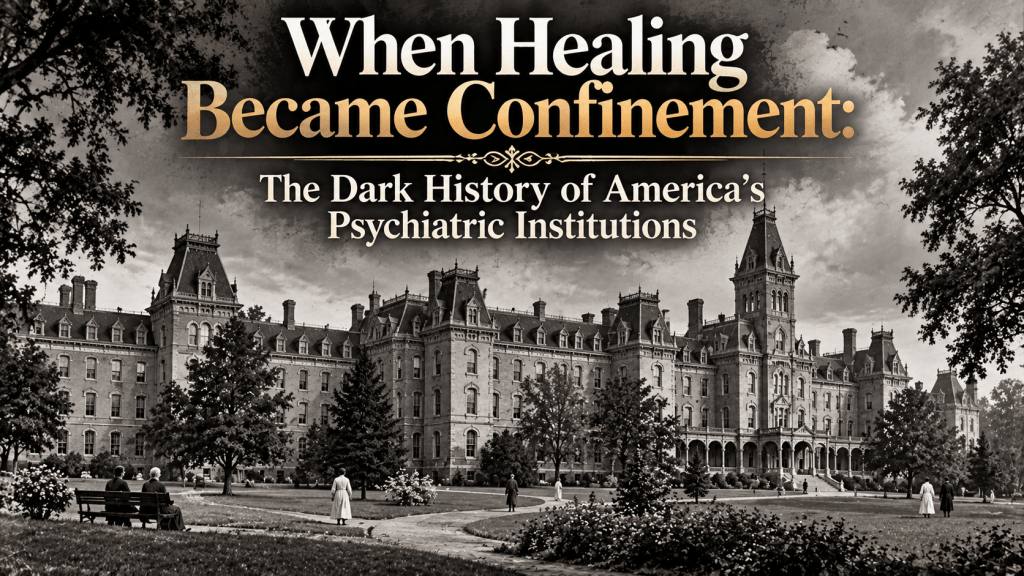
His proposed institutions featured spacious grounds, large windows, natural light, fresh air, and carefully organized wards.
Some were built in beautiful rural settings, surrounded by gardens and farmland.
The buildings themselves could be enormous.
From the outside, they resembled grand estates more than hospitals.
The intention was to create an environment that encouraged healing.
But an institution designed to provide refuge could also become a place where patients lost control over nearly every aspect of their lives.
And as the decades passed, that contradiction became increasingly difficult to ignore.
One of the most revealing stories belongs to a woman named Elizabeth Packard.
In 1860, Packard was committed to the Illinois State Hospital for the Insane in Jacksonville.
Her husband, a minister named Theophilus Packard, disapproved of her religious beliefs and independence.
At the time, Illinois law allowed husbands to arrange the institutionalization of their wives without the same legal protections afforded to men.
Elizabeth was not given the opportunity to defend herself before a jury prior to her commitment.
She remained confined for more than three years.
During that time, she challenged the hospital’s superintendent and documented what she considered the mistreatment of patients.
When she was eventually released, her struggle wasn’t over.
Her husband attempted to have her confined again.
In 1864, legal proceedings finally gave Elizabeth an opportunity to challenge the accusations against her. A jury found her sane.
She subsequently became a prominent advocate for the legal rights of married women and psychiatric patients.
Think about what that means.
A woman spent years confined in a psychiatric institution, in part because her husband considered her beliefs unacceptable.
And the law had permitted it.
Elizabeth’s story wasn’t simply about one marriage or one hospital.
It exposed how easily psychiatric confinement could become entangled with questions of power, obedience, and personal freedom.
But the problems inside American asylums extended far beyond wrongful confinement.
As patient populations grew, many state hospitals became overcrowded and underfunded.
Institutions originally designed around individualized attention increasingly struggled to provide even basic care.
Patients could spend years, sometimes decades, inside.
Some worked without pay.
Others experienced physical restraints, isolation, violence, or neglect.
And the consequences could be fatal.
In March 1896, The Chicago Tribune reported the death of Julian Grabowski, a patient at an Illinois state hospital.
Grabowski, who was paralyzed, died after being exposed to scalding bathwater.
The National Library of Medicine preserves this incident as part of its historical exhibition on psychiatric care.
His death illustrates something important.
Institutional harm wasn’t limited to controversial medical treatments.
Sometimes it involved the failure to provide the most basic protection to a vulnerable person.
A bath should never have been a death sentence.
Yet the history becomes even more disturbing when we examine what physicians once considered legitimate treatment.
During the twentieth century, psychiatry experimented with procedures that carried extraordinary risks.
One was insulin coma therapy.
Introduced during the 1930s, the treatment involved administering insulin to produce severe hypoglycemia, sometimes rendering patients unconscious.
Physicians hoped it could improve certain psychiatric conditions, particularly schizophrenia.
But the procedure could cause seizures, brain injury, and death.
Its effectiveness was never established to the standard we would expect from modern medical research, and the treatment eventually fell out of use.
Another procedure was the lobotomy.
Beginning in the 1930s, surgeons attempted to treat psychiatric symptoms by damaging connections within the brain.
Some physicians believed these operations could relieve severe distress or agitation.
But the consequences could be devastating.
Patients sometimes experienced profound changes in personality, initiative, emotional expression, and cognitive functioning.
Others suffered serious complications.
The fact that these procedures were performed under medical supervision did not make them harmless.
And it’s important to distinguish what physicians hoped to accomplish from what patients actually endured.
Not every historical treatment was intended as cruelty. Some practitioners genuinely believed they were helping people.
But good intentions do not erase injuries.
And calling something treatment does not automatically make it humane.
Then came 1946.
On May 6, Life magazine published an investigation titled “Bedlam 1946.”
Written by Albert Q. Maisel, the article exposed conditions in American state psychiatric hospitals, including Pennsylvania’s Byberry hospital and Cleveland State Hospital in Ohio.
The accompanying photographs were horrifying.
Patients appeared crowded together in filthy conditions.
Some were naked.
Others were restrained.
The investigation described severe staffing shortages, inadequate supervision, and institutions struggling to provide meaningful medical care.
These weren’t photographs from an abandoned building.
They showed places where human beings were living.
Places operating within an established system of psychiatric care.
And the public was being shown what had been happening behind institutional walls.
This is one of the most important distinctions in the history of American asylums.
The abuses weren’t always completely hidden.
Patients complained.
Reformers investigated.
Journalists published accounts.
Warnings reached the public.
Yet institutional conditions could remain dangerous for years.
Why?
There wasn’t one explanation.
Chronic underfunding, overcrowding, inadequate staffing, weak oversight, and the limited rights of institutionalized people all contributed.
And when patients were considered unreliable because of their diagnoses, their accusations could be especially easy to dismiss.
That imbalance of power created opportunities for mistreatment.
A patient who depended on staff for food, bathing, medication, and permission to move about had few ways to protect themselves when that power was abused.
And even when someone outside the institution learned what was happening, meaningful change was not guaranteed.
By the middle of the twentieth century, America’s psychiatric institutions housed hundreds of thousands of people.
The system had become far larger than the early reformers had imagined.
Eventually, public investigations, patient advocacy, legal challenges, new psychiatric medications, and changing approaches to treatment helped drive a major shift.
In 1963, President John F. Kennedy signed legislation supporting the development of community mental health centers.
Over the following decades, the number of patients living in large state psychiatric hospitals declined dramatically.
This process became known as deinstitutionalization.
But closing hospital beds did not automatically solve the problems.
Community services were often insufficient, and some people who needed ongoing treatment and support struggled to obtain it.
The history of psychiatric care did not end neatly with the closing of the old asylum doors.
And it would be inaccurate to claim that every asylum was a place of cruelty.
Some patients received compassionate care. Some professionals worked tirelessly under difficult circumstances. Reformers repeatedly fought to improve conditions.
But neither can we ignore the documented abuses.
The forced confinement.
The neglect.
The dangerous procedures.
The patients whose complaints were disregarded.
And the people who suffered permanent injuries or never returned home.
Today, photographs of abandoned asylums circulate online as supposed evidence of hauntings.
People tell ghost stories about their empty hallways.
They imagine strange noises behind locked doors and shadowy figures standing in the windows.
But I think the real history is far more unsettling than anything supernatural.
Because the suffering that occurred in some of those buildings doesn’t require a ghost story.
It requires us to acknowledge what human beings were capable of doing to other human beings.
And to remember those who fought to expose it.
Elizabeth Packard demanded the right to be heard.
Journalists documented conditions that institutions could no longer easily dismiss.
Patients and advocates challenged the assumption that a psychiatric diagnosis meant surrendering one’s humanity.
Their stories remind us that compassion cannot exist without accountability.
And that the right to receive care should never mean losing the right to be treated like a person.
Perhaps that’s the most haunting part of America’s asylum history.
Not the empty buildings.
Not the locked doors.
But the knowledge that so many people entered those doors seeking help, and some found themselves at the mercy of a system that failed to protect them.
The true horror wasn’t that these places were haunted. It was that the people inside them were human—and too often, that was forgotten.
—Guyton








Leave a Reply