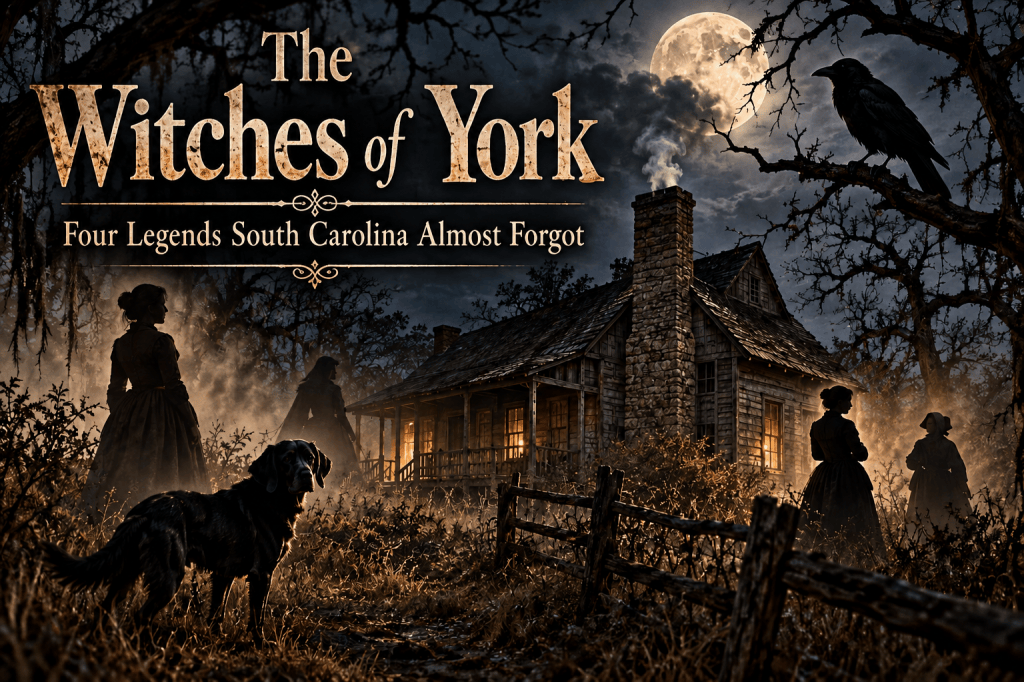
The Strange Stories Preserved in a 1927 Newspaper
When someone mentions witches in American history, most people immediately think of Salem, Massachusetts.
But what if I told you that South Carolina had its own collection of witch stories?
Not the kind that became famous through trials, executions, and history books. These were stories passed between neighbors, whispered through generations, and eventually preserved in the pages of a newspaper.
And some of them are downright strange.
On August 21, 1927, The Charlotte Observer published an article by Earnest Jackson titled “Weird Legends out of the Past: Witches of York.”
It told the stories of four supposed witches and the people who believed they had encountered them in York County, South Carolina.
Two accounts came through the historical research of Dr. Maurice A. Moore, a nineteenth-century chronicler of York County history. The other two had survived through oral tradition.
Nearly a century later, those stories remain accessible because someone recorded a reading of that old newspaper article, and Winthrop University preserved it in its archives.
And I’m glad they did.
Because these aren’t quite the witch stories we’re accustomed to hearing.
The first involves a woman named Mrs. Baldy Fox, who reportedly lived in southern York County in the years following the American Revolution.
According to local belief, Mrs. Fox could place spells on people who had offended her.
One man, Nathaniel Rainey, had been ill for years. His neighbors couldn’t explain his weakness, and eventually they decided his condition must be the work of Mrs. Fox.
Their proposed cure?
Get the supposed witch to bless him.
The community arranged for local women to gather at Rainey’s bedside, each taking a turn offering a blessing. They invited Mrs. Fox, too.
But she didn’t come.
That was when Colonel Edward Lacey, remembered as a Revolutionary War veteran, reportedly rode out to bring her himself.
When they returned, the horse was so exhausted that the neighbors took its condition as further evidence of witchcraft.
Mrs. Fox entered the house and joined the other women.
One by one, they approached the sick man and offered their blessings.
Finally, it was her turn.
Everyone waited for the words they believed would break the spell.
And Mrs. Fox said:
“May my God bless you, Mr. Rainey.”
My God.
Two little words that sent the gathering into a panic.
The neighbors interpreted her choice of words as proof that she had invoked the devil rather than offered the blessing they wanted.
Whether Mrs. Fox was deliberately provoking them, simply choosing her own words, or doing nothing unusual at all, the legend doesn’t tell us.
But it tells us plenty about the people who were frightened of her.
The second story might be even stranger.
Mrs. Abigail McPherson supposedly lived alone several miles east of York. She was described as an older woman with dark hair, piercing eyes, and an enormous black dog.
That dog was important to the legend.
According to local stories, she sometimes rode it through the countryside at night.
But that wasn’t her only alleged means of getting around.
People also believed she could turn herself into a crow.
A neighbor named Thomas Hendricks became convinced that Mrs. McPherson was spreading gossip about everything happening on his property.
He couldn’t understand how she supposedly knew so much.
Then he noticed a crow.
It seemed to be watching him.
And once he began paying attention, he became convinced that the bird was Mrs. McPherson in disguise.
So Hendricks and his wife staged an argument.
They made it sound as though he had beaten her, although the commotion was deliberately faked. The following day, Hendricks visited a nearby store and discovered that the story had already spread.
To him, that settled it.
The crow was a witch.
His next decision was considerably more disturbing.
He melted silver coins into a bullet, believing silver could harm a witch when ordinary lead could not.
When the crow returned, he shot it.
According to the story, the bird cried out with a woman’s voice before flying away.
Hendricks followed in the direction it had gone and eventually found Mrs. McPherson tending an injured arm.
She reportedly explained that she’d fallen.
Hendricks believed he’d found his proof.
But look at what the story actually establishes.
A man suspected his neighbor of gossiping. He noticed a bird. He shot it. Then he found a woman with an injury.
The supernatural explanation came from his interpretation of those events.
And that’s an important distinction.
The third legend concerns Mrs. Rebecca Biggert and a man named Moses Gabbie.
Around 1820, according to the account, Gabbie began behaving in ways his family couldn’t explain.
During the day, he remained in bed, weak and difficult to rouse.
But every night at midnight, he reportedly sprang up screaming and disappeared into the darkness.
He returned at dawn exhausted, sometimes with burrs and briars caught in his clothing.
His explanation was extraordinary.
He claimed Mrs. Biggert was riding him like a horse.
Every night, he said, she took him to another witch’s house, tied him to a chestnut tree, and left him outside while the witches celebrated indoors.
His family tried to stop him from leaving, but nothing worked.
Eventually, a skeptical neighbor named Colonel Billy Ferguson agreed to spend the night keeping watch.
He insisted there was no such thing as witches and was determined to prove it.
Unfortunately, the plan didn’t go quite as expected.
When Moses jumped from bed at midnight, Ferguson leaped up to restrain him.
Except he grabbed the wrong man.
In the darkness, he tackled an older member of the household, who immediately assumed that a witch had attacked him.
The two struggled so fiercely that they nearly destroyed the bed.
Meanwhile, Moses escaped.
I have to admit, for a story about supposed witchcraft, that part sounds suspiciously like an old-fashioned comedy of errors.
But the legend takes another peculiar turn.
The family eventually summoned a man identified as Dr. Brindle, a witch doctor from Lincolnton, North Carolina.
His alleged cure involved an amulet, pins and nails, and the cruel treatment of a black cat.
The story says Mrs. Biggert unexpectedly appeared during the ritual and asked for buttermilk.
When she left, Moses was supposedly cured.
Dr. Moore, who investigated this account, acknowledged that some of the extraordinary objects involved might have been explained by sleight of hand.
He reportedly spoke with Dr. Brindle and people who claimed to have witnessed the events.
But even testimony about a strange occurrence doesn’t establish that witchcraft caused it.
What remains is a remarkable example of how a community tried to explain troubling behavior through the beliefs available to it.
And then there’s the fourth story.
My personal favorite of the collection.
Abner Wayne apparently had a problem.
He was curious.
Very curious.
According to the legend, witches gathered every New Year’s Eve in an abandoned house in northern York County.
There, they supposedly reviewed the spells they’d cast during the previous year and discussed who they intended to trouble during the next one.
Wayne wanted to hear everything.
So he came up with a plan.
He would hide inside the chimney.
Now, I don’t know about you, but climbing into a chimney to spy on a gathering of witches already sounds like the beginning of a terrible decision.
Nevertheless, Wayne did exactly that.
As darkness fell, he climbed into position and waited.
Eventually, the witches arrived.
They lit a fire beneath him.
He stayed hidden, listening as they discussed their activities.
And then they began announcing their plans for the coming year.
Wayne was so excited by what he was hearing that he moved.
A piece of mortar fell from the chimney.
The room went silent.
Then one of the witches announced that someone was spying on them.
Wayne panicked.
He slipped.
And he fell straight into the fireplace.
According to the legend, the witches stripped him and stuck so many pins into his thigh that he resembled a human pincushion.
They sent him home with a warning never to return.
But the story wasn’t finished.
Wayne’s family supposedly discovered that the pins couldn’t be removed.
A witch doctor was called, and he declared that the only solution was to tie a black snake around Wayne’s waist.
There was one small problem.
It was January.
Finding a snake in the middle of winter wasn’t exactly convenient.
Nevertheless, friends and relatives searched until they found one.
The snake was tied around Wayne, the pins supposedly fell out, and he recovered.
And, unsurprisingly, he never tried spying on the witches again.
Four stories.
Four very different encounters with supposed witchcraft.
But there’s something about these legends that I find more interesting than the supernatural claims themselves.
The women at the center of the stories weren’t necessarily doing anything extraordinary.
One was blamed for a man’s unexplained illness.
Another was suspected because she lived alone, looked unusual to her neighbors, and knew too much gossip.
A third was accused of causing behavior that nobody around her understood.
And the final tale transformed a secret gathering into a warning about curiosity and trespassing.
In the original 1927 article, Jackson wrote about how these York County witches had escaped the fame of their New England counterparts.
He also observed that, unlike the women accused during the Salem witch trials, the York County figures weren’t dragged into court or imprisoned for witchcraft, at least according to the accounts he was presenting.
Instead, they were reportedly shunned by their communities.
And that detail matters.
Because a person didn’t have to be convicted of witchcraft for the accusation to change their life.
Sometimes suspicion was punishment enough.
We can’t establish from these legends that anyone possessed supernatural powers. We can’t even independently verify every event the stories describe.
What we can establish is that these tales were important enough to survive in local memory, appear in a newspaper in 1927, and eventually find their way into an archival recording.
They preserve something real, even if the magic wasn’t.
They preserve what people feared.
What they believed.
How they explained illness, misfortune, strange behavior, and neighbors who didn’t quite fit in.
And they remind us that America’s history of witchcraft beliefs extends far beyond Salem.
Sometimes it lives in a forgotten South Carolina newspaper, waiting for somebody curious enough to go looking.
Preferably without climbing into a chimney.
Historical Source: Earnest Jackson, “Weird Legends out of the Past: Witches of York,” The Charlotte Observer, August 21, 1927. Preserved in the Witches of York County archival transcript, Accession 186, Louise Pettus Archives and Special Collections, Winthrop University.
—Guyton






Leave a Reply