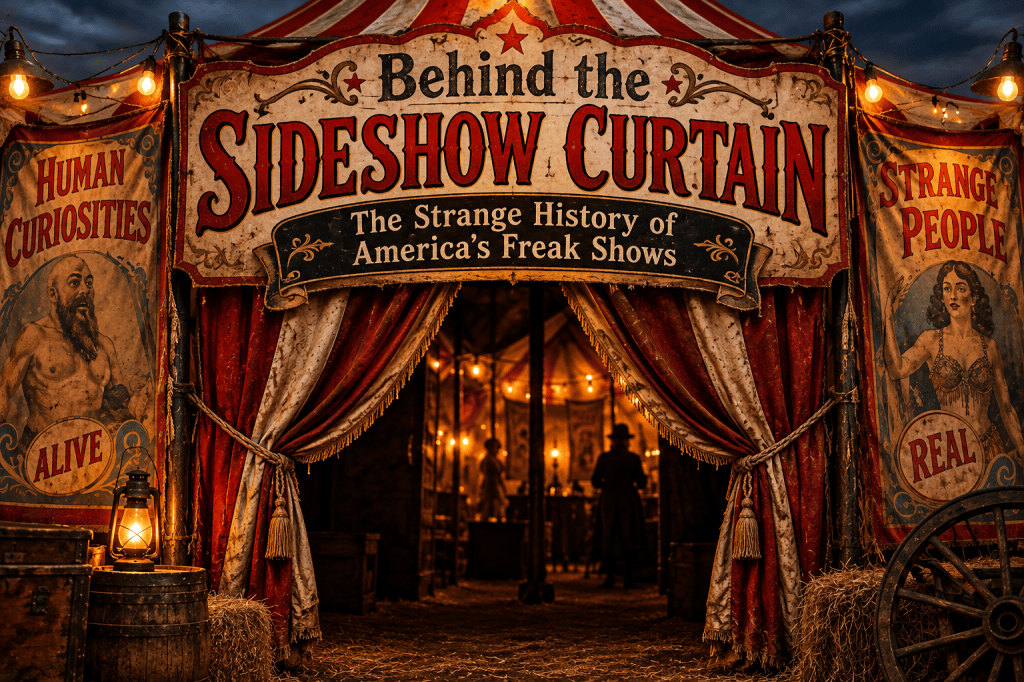
I remember going to a carnival once and seeing a two-headed cow displayed behind glass.
That’s about as close as I’ve ever come to experiencing what people once called a freak show. I’ve never attended one, and I don’t believe I’ve ever met anyone who has.
Of course, I’ve watched American Horror Story: Freak Show. But that’s television, and I have no way of knowing how closely its fictional world resembles the real sideshows of American history.
Beyond that carnival memory and what I’ve seen on television, I really didn’t know much about the subject.
So, naturally, I went down a rabbit hole.
What was really happening behind those enormous painted banners? Who were the people standing on the other side of the curtain? And what happened to them when the crowds went home?
Because the more I started looking into the history of American sideshows, the more I realized that the strangest part wasn’t necessarily what audiences paid to see.
It was how the people being displayed were treated.
During the nineteenth and early twentieth centuries, traveling circuses, dime museums, and carnival sideshows offered Americans the opportunity to witness things they might otherwise never encounter.
There were sword swallowers, fire eaters, magicians, unusual animal specimens, and performers whose physical appearances were advertised as extraordinary.
Some attractions were genuine. Others were illusions. And some were complete fabrications designed to separate curious spectators from their money.
One of the most influential figures in this industry was Phineas Taylor Barnum, better known as P. T. Barnum.
Today, his name is often associated with colorful circus tents, spectacular performances, and the idea of the greatest show on Earth.
But there’s another side to his story.
In 1835, Barnum acquired the right to exhibit an elderly enslaved Black woman named Joice Heth.
He advertised her as being 161 years old and claimed she had cared for George Washington when he was an infant.
Neither claim was true.
People paid admission to see her, listen to her, and examine a woman whose supposed age had become the attraction.
When Joice died in 1836, Barnum arranged a public autopsy. Approximately 1,500 spectators reportedly paid fifty cents apiece to watch.
Even death did not grant her privacy or dignity.
And that’s where I found myself looking at the history of these shows very differently.
Because behind so many of those extraordinary claims was a real person.
Consider Charles Stratton, whom audiences knew as General Tom Thumb.
Stratton had dwarfism and began performing as a child. He became internationally famous, traveled extensively, and developed into a skilled entertainer.
His life was more than his stature, yet his physical difference was central to how he was advertised.
Then there were Chang and Eng Bunker, conjoined twin brothers born in Siam, now Thailand, who eventually settled in North Carolina.
They married sisters, raised families, owned property, and built lives far beyond the stage.
Their history also contains uncomfortable contradictions. Although they experienced public scrutiny because of their bodies, they later became enslavers themselves.
Their story reminds us that historical figures cannot always be divided neatly into heroes and victims. People can experience injustice while also participating in it.
And then there’s William Henry Johnson.
Audiences knew him by a stage name that reduced him to the shape of his head.
He was presented through degrading advertisements that played on racial prejudice and false ideas about human evolution.
Yet William Henry Johnson had a name, a career, and a life that extended far beyond the character created for paying audiences.
I wonder how many spectators ever bothered to learn those things.
Not every performer experienced the sideshow in the same way.
Some found financial independence, developed remarkable talents, traveled the world, and became celebrities.
Others had little control over their working conditions, their earnings, or the identities showmen created for them.
And for children placed on display, the question of consent becomes especially troubling.
It’s tempting to look backward and assume everyone involved was either helpless or entirely comfortable with their circumstances.
But history is rarely that simple.
What we can say is that the audiences were often encouraged to see physical differences as spectacles rather than ordinary variations in human life.
The advertisements promised wonders.
The posters exaggerated.
The barkers shouted.
And somewhere behind all that noise were people trying to make a living.
Meanwhile, the industry also thrived on deception.
Barnum’s famous Feejee Mermaid was no mermaid at all. It was an artificial curiosity assembled from animal remains and promoted as something astonishing.
Other exhibits featured preserved animals with unusual anatomical characteristics, the kind of display that reminds me of the two-headed cow I saw years ago.
Some specimens were genuine. Others were manufactured.
The challenge for the paying customer was figuring out which was which.
As the twentieth century progressed, the traditional sideshow gradually lost its place in mainstream American entertainment.
Movies, television, changing public attitudes, and shifting entertainment markets all played a role.
But the disappearance of those attractions didn’t erase the lives of the people who had worked in them.
Their photographs remain.
Their advertisements survive.
Their names appear in museum collections and historical archives.
And when we look at those photographs today, I think we owe them something more than the same curiosity that once sold admission tickets.
We owe them the effort to see the person.
I started this rabbit hole remembering a two-headed cow behind glass.
I ended it thinking about people whose entire lives were reduced to something a stranger could pay a few cents to stare at.
There’s a difference between appreciating an extraordinary performer and treating another human being as an object.
And perhaps that’s the most important thing this history has to teach us.
The curtain eventually closed. The crowds went home. The painted banners faded.
But the people behind them were never just part of the show.
They were people long before someone decided to sell tickets.
—Guyton




Leave a Reply