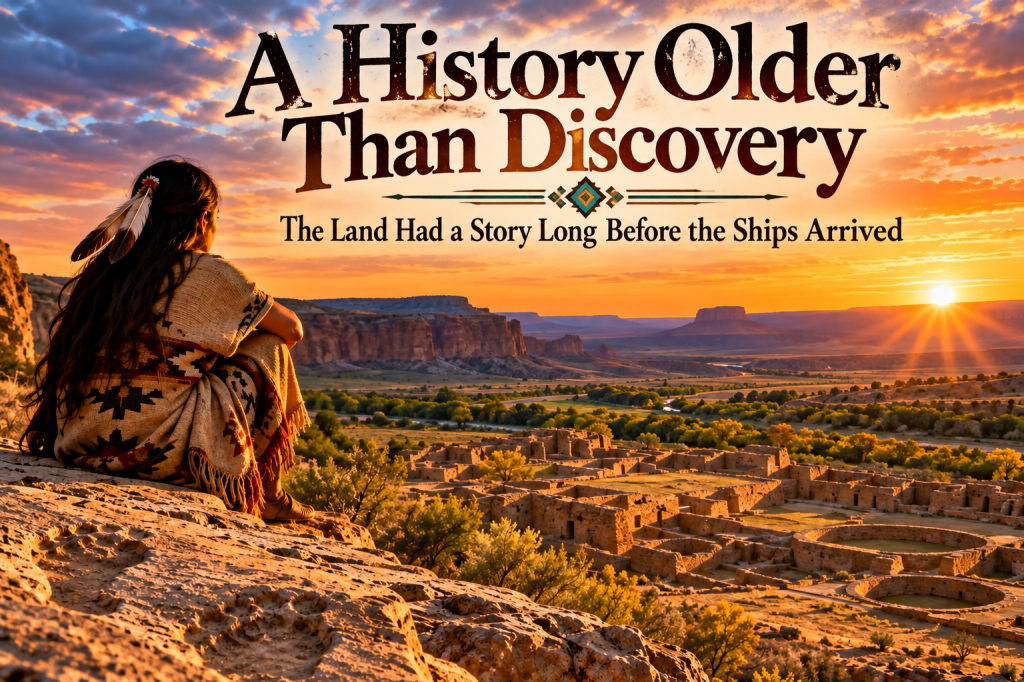
Before Leif Erikson.
Before Christopher Columbus.
Before European voyages were celebrated as discoveries of a new world, there were already people here.
Not just a handful of people wandering through an untouched wilderness. Entire communities. Families. Nations. People with their own languages, traditions, beliefs, and ways of life.
And their history didn’t begin when someone else arrived.
It began thousands upon thousands of years before that.
In what is now New Mexico, researchers discovered something extraordinary beneath the sands of White Sands National Park.
Human footprints.
Not a building. Not a written record. Just footprints left behind in the mud of an ancient landscape.
Scientific studies place some of those footprints between 21,000 and 23,000 years old.
Think about that for a moment.
Thousands of years before the pyramids of Egypt. Long before the Roman Empire. Long before the Vikings crossed the Atlantic.
People were walking across land that would one day become part of the United States.
Some of those footprints belonged to children and teenagers.
I find something incredibly human about that.
We spend so much time learning about kings, explorers, wars, and empires that sometimes we forget history is also made of ordinary moments.
Imagine the ordinary moments those footprints might represent.
Someone walking beside a lake.
A child following an adult.
A family going about its day.
Those footprints survived thousands of years, waiting beneath the earth for someone to recognize what they were.
They remind us that the human story of this land is far older than many of us were taught.
When we talk about the Americas before European contact, we need to remember that there was no single Indigenous civilization representing everyone.
There were many different peoples, with distinct cultures, languages, governments, and histories.
Across the continent, communities adapted to their environments in remarkable ways.
Some cultivated corn, beans, and squash. Others relied on fishing, hunting, gathering, or combinations of these practices.
Trade connected communities across enormous distances. Goods traveled along established routes, but so did knowledge, ideas, and cultural traditions.
People developed sophisticated relationships with the landscapes around them.
They understood the seasons. They observed the natural world. They passed knowledge from one generation to the next.
These were not societies without history.
They were societies whose histories were too often overlooked when someone else began writing the textbooks.
Consider Chaco Canyon in what is now New Mexico.
Beginning around the ninth century, ancestral Pueblo communities developed an extraordinary cultural center.
They constructed massive stone buildings, some several stories tall, and established extensive networks of carefully engineered roads.
Chaco became a center of ceremony, exchange, and social life.
And it was only one example.
Across North America, different Indigenous societies constructed earthworks, established settlements, developed agricultural systems, and maintained extensive networks of exchange.
These accomplishments didn’t require European arrival to give them significance.
They were already significant.
Around the year 1000, Norse voyagers reached North America.
Nearly five centuries later, Christopher Columbus arrived in the Caribbean in 1492.
Those voyages became major events in European history.
But for the Indigenous peoples of the Americas, history was already underway.
Generations had been born, lived, loved, raised families, and passed away.
Communities had grown and changed. Nations had formed relationships, experienced conflicts, established traditions, and developed knowledge over centuries.
The arrival of Europeans marked a turning point, but it was not the beginning.
And the centuries that followed brought profound consequences.
Disease, warfare, forced displacement, broken treaties, and policies aimed at suppressing Indigenous languages and cultures devastated communities throughout the Americas.
We cannot tell this history accurately without acknowledging those realities.
But I don’t want this tribute to be only about what was taken.
Because that would leave out something equally important.
Indigenous peoples are not relics of a vanished world.
They are not simply names on historical markers or figures in museum exhibits.
They are living peoples and nations.
They are parents, grandparents, children, teachers, artists, historians, leaders, and neighbors.
Their languages are spoken, taught, and revitalized. Their traditions continue, sometimes preserved across generations despite extraordinary obstacles.
Their cultures are not frozen in the past. Like every living culture, they continue to grow and change.
And their histories deserve to be understood on their own terms.
Perhaps that’s what Indigenous Peoples’ Day should encourage us to do.
To listen.
To learn.
To recognize the nations whose ancestral homelands we inhabit.
And to understand that the story of this continent is much older, richer, and more complicated than the arrival of any one explorer.
Today, as we recognize Indigenous Peoples’ Day, I hope we remember something.
Long before the ships, the maps, and the familiar names in our history books, there were people here.
People with stories worth telling.
People whose descendants are still telling them.
And perhaps the next time we hear someone say that America was discovered, we’ll remember those ancient footprints in New Mexico.
Because someone had already walked here.
Someone had already called this land home.
Their history did not begin with our discovery of it.
And it deserves to be remembered.
—Guyton


Leave a Reply