We’ve traveled through Ireland, Scotland, England and France.
Now we’re heading somewhere I didn’t expect to find when I sent off my DNA test in 2022.
North Africa.
My ancestry results include a smaller North African percentage, with the testing region associated primarily with places including Morocco, Algeria, Tunisia, Libya, Mauritania and Western Sahara.
And naturally, once I started looking into the folklore connected to that part of my ancestry, it didn’t take long before one name kept appearing.
Aïsha Qandisha.
Or Aicha Kandisha.
You’ll see her name spelled several different ways depending on the language, transliteration and source.
You’ll also find several different explanations for who—or what—she is.
And that’s where things get interesting.
Because if you search for Aïsha Qandisha online, you’re likely to encounter a wonderfully tidy story.
She was a beautiful Moroccan woman.
Portuguese soldiers invaded.
She fought back.
She supposedly used her beauty to lure soldiers to their deaths.
Her family or fiancé was killed.
Eventually, the woman became the legend.
Some versions even tell us that the name Qandisha comes from the Portuguese word condessa, meaning “countess.”
It’s dramatic.
It’s tragic.
It’s cinematic.
There’s just one problem.
We can’t prove that’s what happened.
And by now you know how things work around here.
Show me the receipts.
Aïsha Qandisha is absolutely a documented figure in Moroccan folklore and spiritual traditions.
That part isn’t something the internet recently invented.
Anthropologists and ethnographers have been writing about beliefs surrounding her for generations.
But proving that she began as one specific historical woman who fought Portuguese soldiers is another matter entirely.
The resistance-fighter story exists.
It’s part of the tradition.
Modern scholars discuss it.
But a legend being documented is not the same thing as the events inside that legend being historically documented.
We’ve run into this distinction before.
A source can prove that people told a story.
It cannot automatically prove that the story happened.
So let’s start with what we actually have.
One of the important early Western scholars who documented Moroccan beliefs surrounding jinn was Finnish anthropologist Edward Westermarck.
His research in Morocco during the late nineteenth and early twentieth centuries eventually produced extensive work on Moroccan ritual and belief.
And Aïsha Qandisha appears in that scholarly history.
But Westermarck didn’t hand us a birth certificate for a Moroccan resistance fighter.
In fact, he speculated about much older and entirely different possible origins for the figure.
Later scholars proposed still other explanations.
Anthropologist Vincent Crapanzano wrote extensively about Moroccan spiritual traditions in his 1973 book The Hamadsha: A Study in Moroccan Ethnopsychiatry.
Aïsha Qandisha appears throughout that work in connection with traditions involving jinn, possession, ritual and the Hamadsha.
Crapanzano interpreted some Moroccan traditions involving specifically named jinn as reflecting influences from sub-Saharan Africa.
Other researchers have disagreed.
So already we have a problem if we’re looking for one neat origin story.
The scholars can’t simply hand us one.
And honestly?
Good.
Because folklore usually isn’t neat.
Stories move.
Cultures interact.
Religious ideas, local traditions, historical events and oral storytelling overlap.
One generation tells a story.
Another generation changes it.
Someone gives the spirit a history.
Someone else gives her another name.
Eventually everybody knows who she is, but nobody can quite agree on where she came from.
Aïsha Qandisha fits that pattern remarkably well.
In Moroccan traditions, she is often described as a jinniyya—a female jinn.
And here’s where we need to make an important distinction.
Jinn themselves are part of Islamic religious tradition.
They appear in Islamic scripture and theology.
Aïsha Qandisha, however, is a specific figure belonging to Moroccan regional traditions.
Those are not the same statement.
I’m not going to take Moroccan folklore involving Aïsha Qandisha and tell you, “This is what Islam teaches.”
That would be inaccurate.
Religious teaching and regional folklore can influence one another without being interchangeable.
And this particular figure has accumulated quite a collection of characteristics.
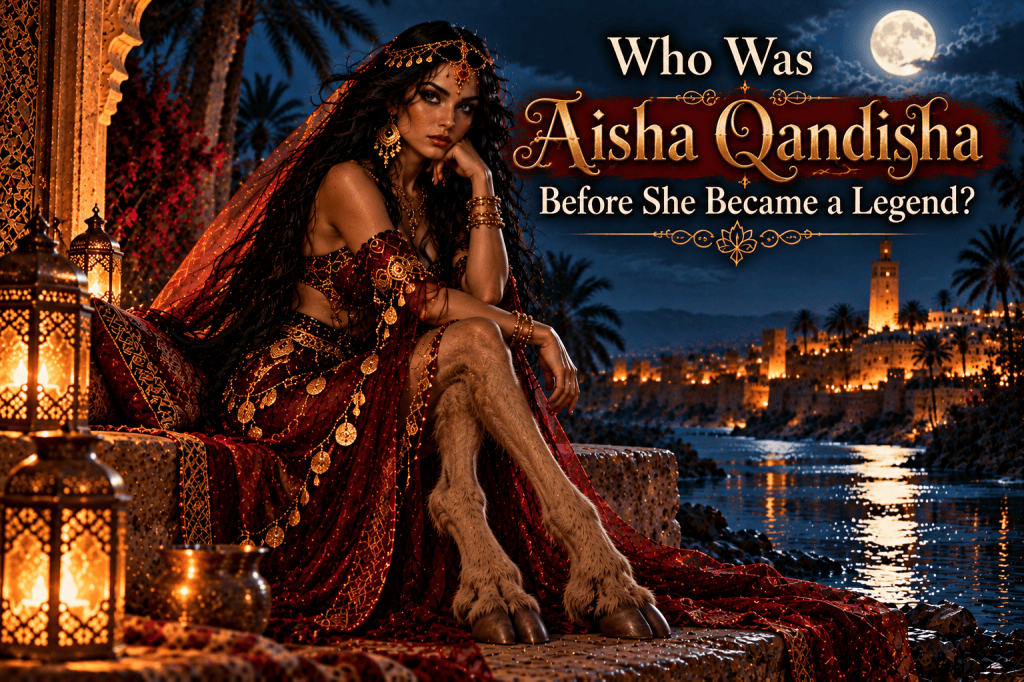
Depending on the tradition, Aïsha Qandisha may appear as an extraordinarily beautiful woman.
That sounds harmless enough.
Until you look down.
Some descriptions give her animal-like legs or hooves.
Goat-like in some versions.
Camel-like in others.
Apparently supernatural beings also suffer from inconsistent witness descriptions.
She is frequently associated with seduction.
Particularly the seduction of men.
A man encounters a beautiful woman.
He follows her.
Then something goes terribly wrong.
If you’re noticing a familiar theme after our Scottish kelpie story, so am I.
Folklore from completely different places has an interesting habit of warning us that the beautiful stranger standing somewhere they probably shouldn’t be standing might deserve a second look.
And apparently the second look should begin with the feet.
Scottish stranger beside the water?
Check for hooves.
Beautiful Moroccan woman appearing somewhere strange?
Once again:
Check the feet.
I don’t make the folklore.
I just report what I find.
But Aïsha Qandisha is much more complicated than a Moroccan version of the seductive monster.
In different traditions she is associated with water, dangerous or isolated places, sexuality, possession, illness, ritual and relationships with human beings.
She also appears within traditions connected with Moroccan communities such as the Hamadsha and Gnawa.
And those traditions can’t responsibly be reduced to “people were scared of a monster.”
For some communities, relationships with named spirits have existed within much larger systems of music, ritual, healing and possession.
That’s precisely why I’m hesitant to call Aïsha Qandisha simply a demon.
That word carries baggage from our own cultural and religious vocabulary that doesn’t necessarily map neatly onto the traditions we’re discussing.
Calling her a figure in Moroccan folklore, or describing how particular sources identify her, is much safer than forcing her into a category that makes sense to us but not necessarily to the people whose tradition we’re talking about.
Then we return to the woman behind the legend.
Was there one?
Maybe.
The Portuguese really did establish and occupy positions along the Moroccan coast during the fifteenth and sixteenth centuries.
That historical setting is real.
And traditions connecting Aïsha Qandisha with resistance against Portuguese forces exist.
But that’s where our receipts start thinning out.
I have not found historical documentation establishing that one identifiable woman named Aïsha Qandisha carried out the exploits attributed to her in the legend.
That doesn’t prove she didn’t exist.
It means I can’t tell you that she did.
And we’re not turning “maybe” into “definitely” just because the definite version makes a better monster story.
The possible connection between Qandisha and the Portuguese condessa is interesting too.
It’s been proposed.
It’s repeated.
It’s part of discussions surrounding the legend.
But proposed etymology isn’t the same thing as a proven origin.
So that stays in the “possible” pile too.
Our receipts for Aïsha Qandisha are therefore different from the ones we had in France.
With the Beast of Gévaudan, we had parish records documenting people who died.
With Black Shuck, we had a pamphlet published in 1577 describing the story.
With Aïsha Qandisha, our strongest receipts establish something different:
People have documented traditions surrounding her.
Anthropologists have studied beliefs involving her.
Scholars have proposed competing explanations for her origins.
The resistance-fighter story exists within the legend.
But nobody has handed us a document that settles who Aïsha Qandisha originally was.
And I think that’s fascinating.
Because perhaps we’re asking the wrong question.
Maybe there isn’t one moment when a woman became Aïsha Qandisha.
Maybe centuries of history, religion, oral tradition, cultural exchange, fear, sexuality and storytelling gradually created the figure people recognize today.
Or maybe somewhere underneath all those layers there really was a woman whose story changed every time someone told it.
We simply don’t know.
And “we don’t know” is going to remain an acceptable answer around here.
I’d rather leave a mystery unresolved than solve it with something somebody made up.
What I do know is that my little ancestry project has now taken us from ancient Irish earthworks to Scottish water horses, a black dog running through an English church, a mysterious predator terrorizing eighteenth-century France and now a Moroccan woman—or spirit—whose origins researchers are still arguing about.
I took a DNA test because I wanted to know what I was.
Four years later, I’m sitting here reading anthropology about a beautiful Moroccan jinniyya with hooves.
Life takes some interesting turns.
So who was Aïsha Qandisha before she became a legend?
A resistance fighter?
A spirit whose traditions are much older?
A figure shaped by several cultures and centuries of storytelling?
A historical woman whose biography disappeared while her legend survived?
I can’t give you the receipt that answers that question.
Nobody can.
But I can give you receipts showing that researchers have been debating her origins for more than a century.
And sometimes that’s where the best folklore lives.
Not in the answer.
In everything people created while trying to find one.
—Guyton




Leave a Reply