So far, our little trip through the places represented in my DNA has taught us some valuable lessons.
Ireland told us not to disturb the fairy fort.
Scotland told us not to climb onto suspicious horses hanging around the water.
England put a giant black dog in a church.
And now we’ve arrived in France.
France brought paperwork.
Lots of paperwork.
Because unlike some creatures that live almost entirely within folklore, the Beast of Gévaudan is attached to something we know absolutely happened.
People were attacked.
People were killed.
Authorities responded.
Hunters were sent out.
The king became involved.
Animals were killed in an attempt to stop it.
And records survive.
What nobody has managed to settle completely is one fairly important question:
What exactly was doing the killing?
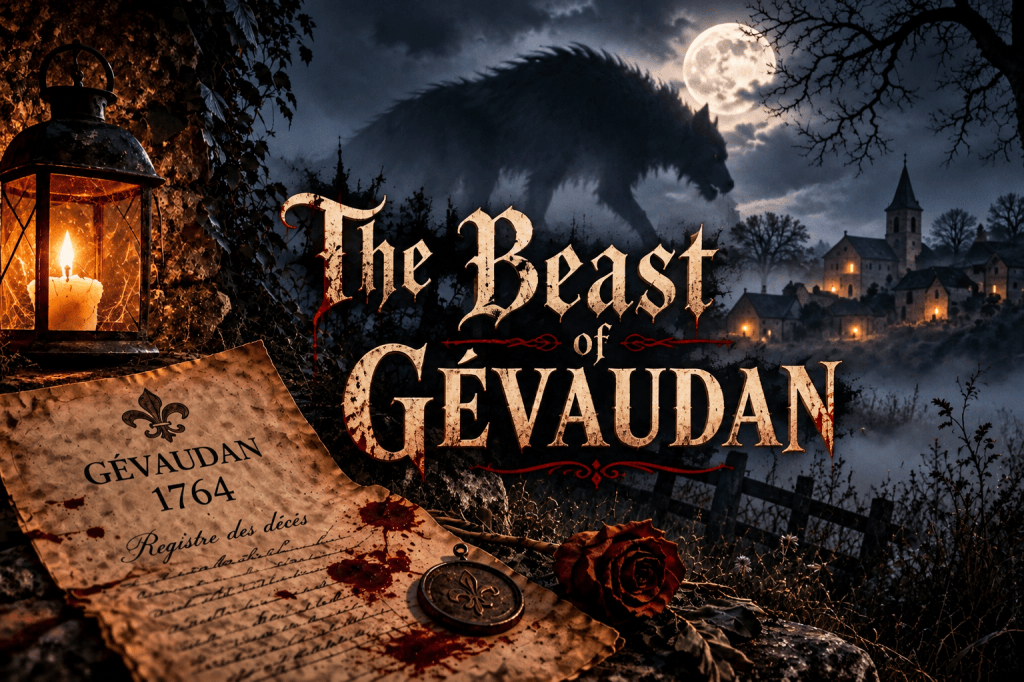
Our story begins in 1764 in Gévaudan, a historical region of southern France.
On June 30, 1764, a 14-year-old girl named Jeanne Boulet was killed near the hamlet of Les Hubacs, in the parish of Saint-Étienne-de-Lugdarès.
Her death is generally recognized as the first fatal attack associated with what would become known as the Beast of Gévaudan.
And Jeanne isn’t simply a name somebody added to the legend centuries later.
Her death was recorded.
Her burial was entered in the parish register on July 1, 1764.
Parish registers from the region preserve records of people killed during the period, and historians have used those documents to reconstruct the attacks.
So before we go any farther:
Yes.
We have receipts.
Again.
Apparently my DNA has sent me on a tour of European archives.
And this time, France brought an entire filing cabinet.
FranceArchives, the French national portal for public archives, catalogs surviving historical material concerning the Beast of Gévaudan.
Among those records are parish documents naming victims and government records concerning the attempts to hunt whatever was attacking people.
One archival file is literally titled Traque de la bête du Gévaudan.
In English:
Hunt for the Beast of Gévaudan.
The file is preserved by the Archives départementales de l’Hérault under the reference C 44 and contains material beginning in 1764.
That’s a receipt.
And some of the surviving parish records are heartbreakingly specific.
One concerns 11-year-old Agnès Mourgues, who was killed on December 21, 1765.
Her burial was recorded the following day, December 22, in the parish of Lorcières.
Her burial record attributes her death to the Beast of Gévaudan.
That document survives in the Archives départementales du Cantal under reference 2 E 251-1.
A child died.
Someone recorded her death.
More than 250 years later, that record survives.
That’s where this story stops feeling like a fun monster mystery for a moment.
These weren’t characters created for a legend.
They were people.
The attacks continued.
Victims were frequently children and young people tending livestock in rural areas.
Reports described a large animal attacking humans, sometimes with extraordinary aggression.
Fear spread.
Then the newspapers got involved.
And if you think sensational news reporting is something humanity invented recently, I regret to inform you that we have been doing this for a very long time.
The story escaped Gévaudan.
Reports appeared in newspapers.
Descriptions circulated.
Rumors grew.
Was it an enormous wolf?
A strange animal nobody recognized?
A hyena?
Something supernatural?
People had theories.
Lots of theories.
Meanwhile, people were still dying.
Eventually this wasn’t merely a local problem anymore.
The attention reached the royal government.
Yes.
We have officially reached the part of the story where the King of France gets involved in hunting the monster.
Louis XV’s gun-bearer and hunting lieutenant, François Antoine, was eventually sent to the region.
In September 1765, Antoine killed a large wolf.
And for a moment, it appeared the mystery had been solved.
The animal was examined.
It was taken toward Versailles.
The royal hunt had succeeded.
The Beast was dead.
Everybody could go home.
Except there was a slight problem.
The attacks started again.
Imagine being the person responsible for explaining that one.
“Your Majesty, excellent news. We killed the Beast.”
Wonderful.
“Tiny update.”
Not wonderful.
People continued to die in attacks attributed to the Beast after the animal killed by Antoine was gone.
And that’s one of the biggest reasons this story refuses to behave itself.
If there was one Beast, what did Antoine kill?
If Antoine killed the Beast, what was responsible for the later deaths?
Were there multiple wolves?
Were unrelated attacks being attributed to the same creature?
Had fear and newspaper coverage transformed several dangerous animals into one legendary monster?
Those questions are still being argued over.
Then, in June 1767, a local man named Jean Chastel killed another large canid.
Afterward, the notorious series of attacks ended.
And naturally, folklore wasn’t going to leave that alone either.
Later versions of the story transformed Chastel’s kill into something almost cinematic.
You may have encountered claims that he killed the Beast using a silver bullet.
Sounds familiar, doesn’t it?
Monster.
Silver bullet.
Problem solved.
Unfortunately for anyone hoping we’ve just found historical evidence for werewolves, that detail belongs to later legend rather than something we can confidently establish from contemporary documentation.
And this is exactly why we’re doing this series the way we are.
The real story is strange enough.
We don’t need to sneak extra monsters into it.
Now let’s talk numbers, because this is where you’ll see different claims depending on what you’re reading.
There isn’t one universally accepted victim total.
Historians disagree about which deaths and attacks should actually be attributed to the Beast.
Some reconstructions produce totals in the eighties.
Others go higher.
You’ll sometimes see numbers exceeding one hundred.
That doesn’t mean the records are useless.
It means historians have to decide whether every reported animal attack during a period of intense fear belonged to one mysterious predator.
And that’s not an easy thing to prove more than 250 years later.
Historian Jean-Marc Moriceau has spent years examining archival records concerning wolves and human attacks in France, including the Gévaudan case.
His work reconstructs the events using historical documents rather than starting with the assumption that every legendary detail must be true.
And those documents reveal something important.
The people who died weren’t folklore characters.
They had names.
They had ages.
They had families.
Many were young.
Whatever was responsible for the attacks, the fear surrounding the Beast wasn’t imaginary.
Something was killing people.
And that changes the way I look at this story.
Because once something frightening is real, folklore doesn’t have to invent the fear.
It only has to explain it.
And human beings are very good at explaining things we don’t understand.
Sometimes too good.
A dangerous predator becomes an unusually large predator.
An unusually large predator becomes a mysterious beast.
The mysterious beast becomes something no ordinary hunter can kill.
Newspapers repeat the descriptions.
Witnesses influence other witnesses.
Rumors become details.
Details become traditions.
Traditions become legends.
And eventually somebody adds a silver bullet.
There is another reason we have to be careful when talking about the Beast of Gévaudan.
Wolves really did attack humans historically.
That isn’t folklore.
Researchers studying historical records have documented wolf attacks on humans in France across several centuries.
That doesn’t mean wolves routinely hunt people today, nor does it mean every Gévaudan attack was necessarily committed by one wolf.
It simply means that when people in eighteenth-century rural France feared wolves, they weren’t inventing the possibility from nothing.
So what was the Beast?
There is no shortage of candidates.
A wolf.
Several wolves.
A wolf-dog hybrid.
An exotic animal.
A trained animal.
A creature nobody properly identified.
And, because humanity cannot resist itself, a werewolf.
We have moved progressively farther away from the receipts.
Could several wolves or other canids have been responsible for attacks that frightened communities and eventually became attributed to one extraordinary Beast?
Absolutely possible.
Can we identify one individual animal beyond reasonable doubt as responsible for every attack?
No.
And that’s where I’m comfortable leaving it.
Because “we don’t know” isn’t a disappointing answer.
Sometimes it’s the most accurate one.
What we do know is extraordinary enough.
Beginning in 1764, people in and around Gévaudan suffered a terrifying series of animal attacks.
The deaths were recorded.
The press reported on them.
Hunters pursued the animal or animals.
Royal authorities became involved.
François Antoine killed a wolf in 1765.
Attacks later resumed.
Jean Chastel killed another large canid in 1767.
And the infamous series of attacks stopped.
Those are the bones of the historical story.
Everything built around those bones is where things get interesting.
And if you’d like to check the receipts instead of taking my word for it, you can.
Start with FranceArchives, the national portal for France’s public archives. Search for “Bête du Gévaudan.” You’ll find archival descriptions and records connected to the attacks, including material preserved by departmental archives.
You can also look for the archival collection titled Traque de la bête du Gévaudan, preserved by the Archives départementales de l’Hérault under C 44.
For a particularly heartbreaking piece of evidence, look up the burial record of Agnès Mourgues, dated December 22, 1765. The University of Lille has made information about this document available through its historical exhibition on monsters and dangerous animals.
For a historian’s reconstruction of the case, look for Jean-Marc Moriceau’s work on the Beast of Gévaudan and his broader research into historical wolf attacks in France.
Historian Jay M. Smith’s Monsters of the Gévaudan: The Making of a Beast also explores how the attacks became a national sensation.
Those are the receipts.
What do they prove?
That people were attacked and killed.
That the deaths were documented.
That authorities organized hunts.
That the French government became involved.
That wolves and other large canids were killed during those efforts.
What don’t they prove?
That eighteenth-century France was being terrorized by an unidentified supernatural monster.
That’s where history ends and legend begins.
And honestly, I think knowing where that line sits makes the story more interesting, not less.
Because France didn’t simply give us a monster story.
It gave us a real tragedy that became a legend while people were still living through it.
We know the victims were real.
We know the hunts were real.
We know the fear was real.
We know the records are real.
The Beast?
That’s where things get complicated.
And after three years of attacks, royal hunters, dead wolves, newspaper stories, frightened villages and more than two centuries of theories, I think France has earned the right to leave us with one unanswered question:
What the hell was it?
—Guyton




Leave a Reply