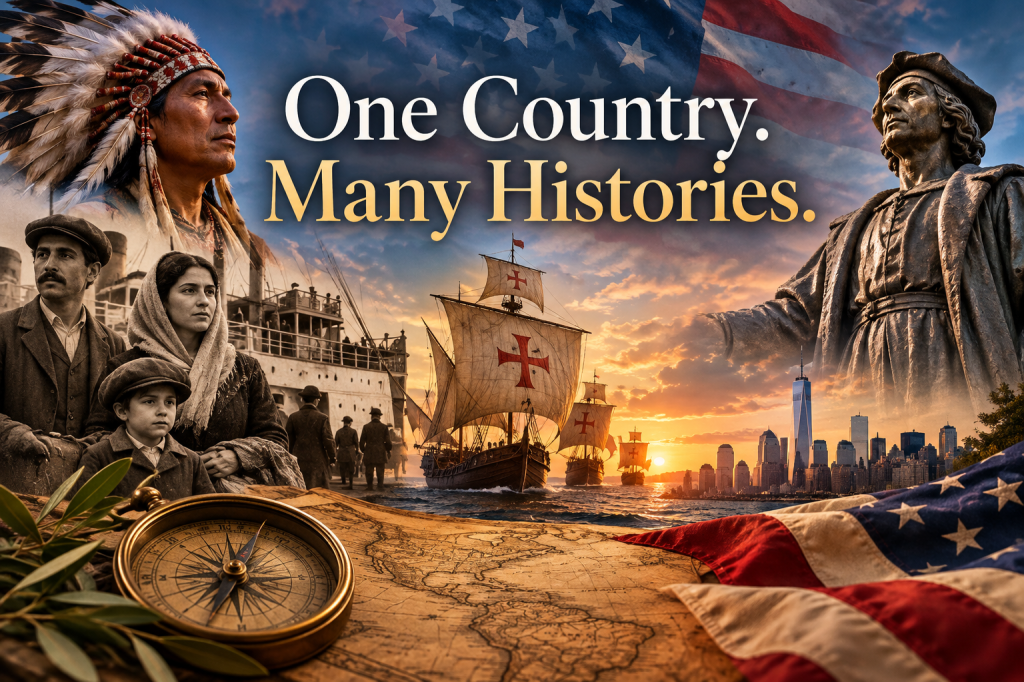
Yesterday was Columbus Day. It was also Indigenous Peoples’ Day.
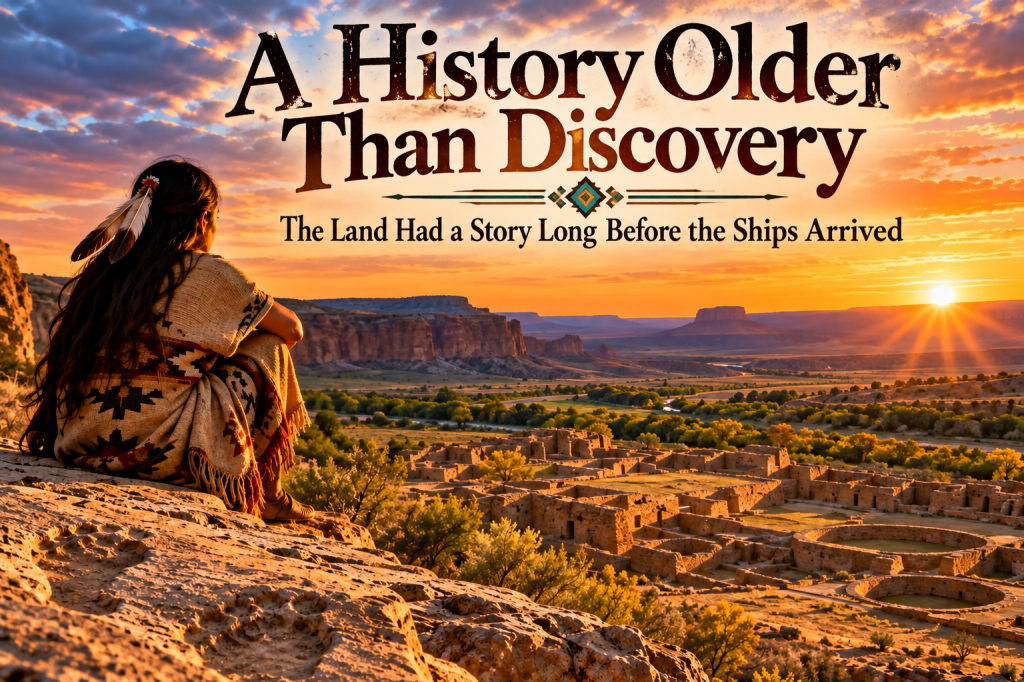
Yesterday, I published a piece titled “A History Older Than Discovery,” recognizing the Indigenous peoples whose histories began long before Europeans arrived in the Americas.
But after a conversation with my husband, I realized there was another part of this discussion I wanted to explore.
Christopher Columbus. Italian American heritage. And the history we were taught in school.
My husband and I attended the same school, and we both remember learning about Columbus.
“In 1492, Columbus sailed the ocean blue.”
We remember being taught that Christopher Columbus discovered America.
But here’s something that surprised us both.
Neither one of us remembers being taught that Christopher Columbus was Italian.
He was born in Genoa, in what is now Italy, around 1451. Italy wasn’t even a unified country at the time. And although Columbus was Genoese, his famous 1492 expedition was sponsored by the Spanish monarchy.
My husband and I both knew the rhyme. We knew about the ships. We knew about 1492.
But somehow, neither of us remembered learning where the man actually came from.
And that made me wonder how much else we were missing.
Columbus’s voyages were undeniably significant. His arrival in the Caribbean in 1492 helped begin an era of sustained contact between Europe and the Americas, changing the course of world history.
But his voyages also became part of a much larger history of European colonization, including exploitation, enslavement, disease, and devastating consequences for Indigenous communities.
Both of those facts belong in the history books.
And there’s another part of Columbus Day’s history that deserves recognition.
For generations of Italian Americans, Columbus Day has represented much more than one explorer.
It has represented heritage, identity, pride, and belonging.
Italian immigrants helped shape this country, but their experiences were not always welcoming ones. Many faced discrimination, hostility, dangerous working conditions, and prejudice simply because of where they came from.
In 1891, eleven Italian immigrants and Italian Americans were killed by a mob in New Orleans following a highly publicized murder trial. The tragedy remains one of the starkest examples of anti-Italian violence in American history.
The following year, President Benjamin Harrison called for a national observance of the 400th anniversary of Columbus’s voyage, amid efforts to improve relations with Italy.
Over time, Columbus became an important symbol for many Italian American communities seeking recognition and acceptance in a country they were helping to build.
And their contributions extend far beyond that symbol.
Generations of Italian Americans have contributed to American agriculture, construction, business, science, medicine, music, art, and the communities so many of us call home.
That history matters.
Italian American heritage deserves recognition and respect, just as Indigenous history deserves recognition and respect.
We can acknowledge the importance of Columbus’s voyages and their consequences without overlooking what Columbus Day has meant to generations of Italian American families.
And we can recognize Indigenous Peoples’ Day without forgetting the many other communities whose sacrifices helped shape this country.
I believe there is room to honor both observances thoughtfully, even when people disagree about what Columbus himself should represent.
Because here’s something I’ve been thinking about.
Some of my own ancestors were brought to this country under servitude.
Their experiences are part of my family’s history, just as countless other families have their own stories of hardship, migration, survival, and sacrifice.
This country took literal blood, sweat, and tears to build.
It wasn’t built by one person, one nationality, or one generation.
It was shaped by Indigenous peoples, immigrants, enslaved people, indentured servants, laborers, farmers, and countless others whose names most of us will never know.
Some came here seeking opportunity. Some were brought here against their will. Some were already here when everything around them began to change.
Their experiences were not identical, but they all belong in the history of the country we now call home.
And that brings me back to what my husband and I remember learning in school.
If we’re going to teach history, why aren’t we teaching the whole story?
Teach the voyages. Teach the discoveries. Teach the accomplishments.
But also teach the discrimination, the exploitation, the suffering, and the consequences.
Teach children about the people who built communities, the people whose labor was taken from them, and the people whose histories existed long before our country had a name.
Stop sugarcoating the uncomfortable parts.
We don’t have to pretend historical figures were perfect to acknowledge their significance. And we don’t have to erase anyone’s contributions to recognize the harm that was done.
History isn’t supposed to be a collection of comfortable stories.
It’s supposed to help us understand how we got here.
Philosopher George Santayana wrote in 1905:
“Those who cannot remember the past are condemned to repeat it.”
But how can we remember the past if we were never taught the whole story?
My husband and I are still learning things about history that we thought we already knew.
And perhaps that’s the point.
We should never stop asking questions. Never stop learning. And never assume that the version of history we learned as children was the complete one.
We can honor our ancestors, recognize the contributions of different communities, and acknowledge the painful chapters of our past.
Those things are not mutually exclusive.
One country. Many histories. And every one of them deserves to be told truthfully.
—Guyton



Leave a Reply