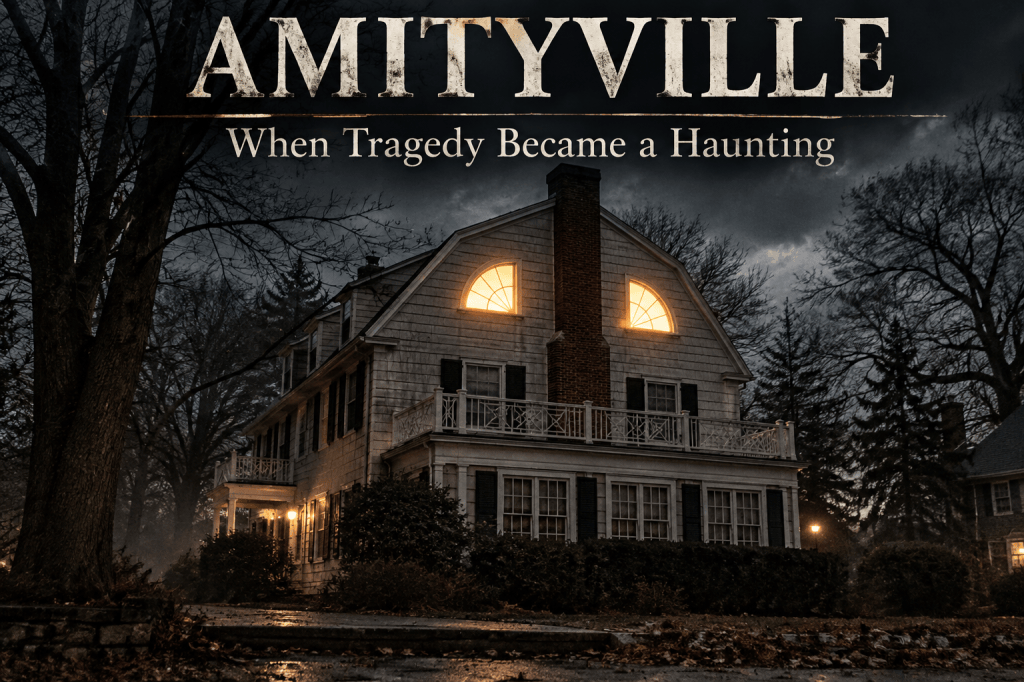
The True Story Behind America’s Most Famous Haunted House
On October 14, 1975, a murder trial began in Suffolk County, New York.
Fifty-one years ago today, Ronald DeFeo Jr. stood trial for the murders of six members of his own family.
You might recognize the name. You might even recognize the house.
Amityville, New York.
A quiet Long Island community that would become forever associated with one of America’s most recognizable horror stories.
But before there were bestselling books, Hollywood movies, paranormal investigations, and decades of arguments about whether the house was haunted, there was a family.
And that’s where this story needs to begin.
In the early morning hours of November 13, 1974, six members of the DeFeo family were murdered inside their home.
Ronald DeFeo Sr. and his wife, Louise, were killed alongside four of their children: Dawn, Allison, Marc, and John Matthew.
Their eldest son, Ronald DeFeo Jr., survived.
Later that day, he entered a local bar claiming that someone had shot his parents. Several people accompanied him back to the house, where the horrifying discovery was made.
At first, DeFeo suggested that organized crime was responsible.
But investigators soon began questioning his account.
The following day, he confessed to killing his family.
The circumstances were deeply disturbing. The victims had been shot in their beds with a rifle, and investigators were puzzled by the apparent lack of a struggle and the absence of reports of gunfire from nearby neighbors.
Questions about exactly how the murders unfolded would continue to generate speculation for decades.
But speculation isn’t the same as evidence.
When DeFeo’s trial began on October 14, 1975, his defense argued that he was not legally responsible for his actions because of insanity.
DeFeo claimed that he had heard voices commanding him to kill.
The jury rejected the defense.
On November 21, 1975, he was convicted of six counts of second-degree murder. He was subsequently sentenced to six terms of imprisonment of 25 years to life.
He would spend the remainder of his life incarcerated, dying in 2021.
And under ordinary circumstances, perhaps the story of the DeFeo family home would have remained primarily a terrible chapter in American criminal history.
But something happened after the trial that changed the house’s reputation forever.
In December 1975, George and Kathy Lutz moved into the former DeFeo home with their three children.
They knew about the murders.
Nevertheless, they purchased the property and began what they presumably hoped would be an ordinary life.
It lasted 28 days.
The Lutz family left the house in January 1976, claiming they had experienced frightening and unexplained events.
Their accounts included strange noises, unusual odors, cold spots, unexplained disturbances, and the sensation of an unwelcome presence.
As the story developed, more sensational details became associated with the house.
There were claims involving mysterious substances, supernatural forces, and a malevolent presence that seemed determined to drive the family away.
If you’ve watched The Amityville Horror, you probably recognize some of those elements.
But here’s where our rabbit hole becomes especially interesting.
How much of that story can actually be verified?
In 1977, author Jay Anson published The Amityville Horror, presenting the Lutz family’s experiences as a true account.
The book became a bestseller.
Then came the 1979 film, followed by sequels, remakes, documentaries, and countless other productions inspired by the house.
Suddenly, a real crime scene had become an entertainment franchise.
And the question of whether the house was genuinely haunted became almost as famous as the murders themselves.
Paranormal investigators visited the property. Supporters of the haunting story pointed to reported experiences and photographs they believed were unusual.
Skeptics questioned the accounts, identified inconsistencies, and challenged details that had become central to the legend.
One particularly controversial figure was William Weber, the attorney who had defended Ronald DeFeo Jr.
Weber later claimed that the haunting narrative had been developed through discussions with the Lutzes.
George Lutz denied that the family’s experiences were invented.
Those competing claims became part of the controversy surrounding the book.
And that’s an important distinction.
We can document the murders.
We can document the trial and conviction.
We can document the Lutz family’s brief residence, the publication of the book, and the films that followed.
What we cannot establish as historical fact is that supernatural activity occurred inside the house.
The haunting remains a collection of disputed claims, not a verified explanation for anything that happened there.
Yet the legend became so powerful that it began overshadowing the very event that made the address infamous.
Think about that for a moment.
Ask someone about Amityville, and they’re likely to mention the house’s unusual windows, the horror movies, or the supposed paranormal activity.
But how often do we hear about Louise?
Or Dawn?
Or Allison, Marc, and John Matthew?
How often do we remember Ronald DeFeo Sr. as a person rather than simply another name attached to a famous crime?
Six people lost their lives in that house.
They weren’t fictional characters created to establish the backstory of a horror film.
They were a family.
And whatever someone believes about the supernatural claims that followed, those murders remain the one part of the story that requires no speculation.
I enjoy horror. I enjoy a good mystery. And I certainly understand why a story like Amityville has fascinated audiences for decades.
It’s a house with a recognizable silhouette, a deeply unsettling history, and a legend that has been retold so many times that separating fact from fiction can feel almost impossible.
But researching the actual events changes how you look at it.
Because there are really two stories here.
One is a documented family tragedy that resulted in a criminal conviction.
The other is a disputed haunting narrative that became a cultural phenomenon.
And somewhere along the way, the second story became more famous than the first.
Today marks 51 years since Ronald DeFeo Jr.’s trial began.
It’s an anniversary worth examining, not because it proves anything about ghosts or demons, but because it reminds us how easily a real event can become buried beneath decades of storytelling.
Maybe that’s what I find most unsettling about Amityville.
Not the claims of supernatural activity.
Not the movies.
Not even the infamous house itself.
It’s the realization that an entire entertainment empire grew around a place where six people lost their lives.
And more than half a century later, we’re still asking whether the house was haunted.
Perhaps we should spend a little more time remembering the people who lived there.
Because before Amityville became a horror story, it was somebody’s home.
—Guyton



Leave a Reply