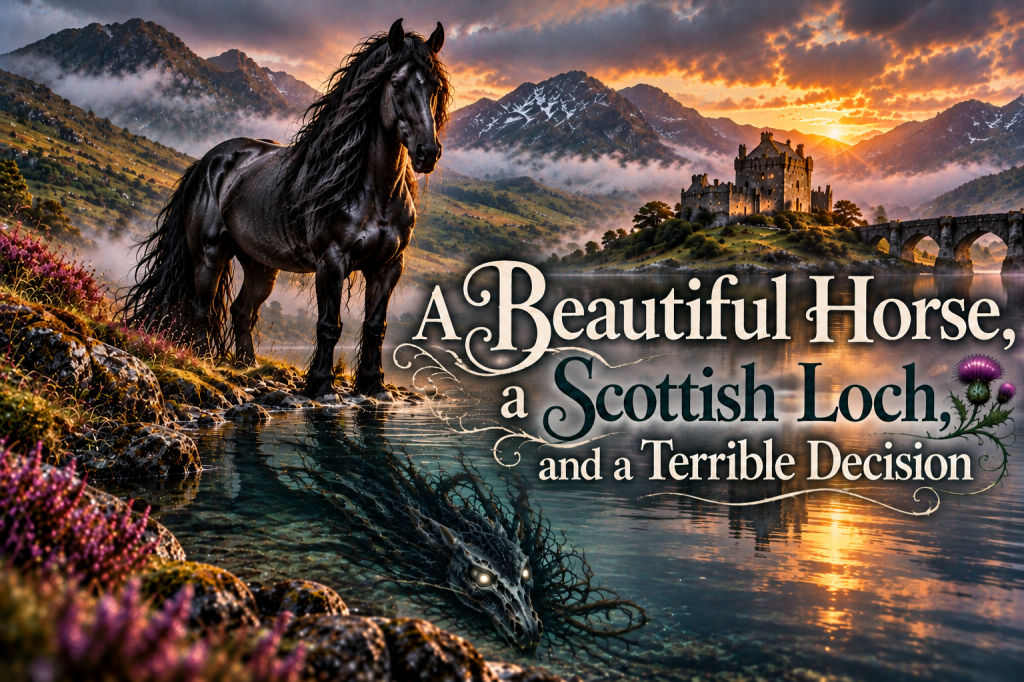
We’ve made it to Scotland.
And apparently Scotland looked at its beautiful lochs, rivers and streams and decided they needed horses.
Not regular horses.
Supernatural horses that might drown you.
Welcome to the kelpie.
If you’ve heard the word before, you may picture a beautiful horse standing mysteriously beside the water. And honestly, that part isn’t too far off.
It’s what happens after you approach the horse that becomes problematic.
Kelpies belong to a long tradition of supernatural water beings in Scottish folklore. Historical references to the word go back centuries, and the Dictionary of the Scots Language describes the kelpie as a water demon associated particularly with rivers and fords, commonly appearing in the shape of a horse.
Sometimes black.
Sometimes white.
Presumably never wearing a sign that says, “Do not pet.”
According to the folklore, the kelpie could lure an unsuspecting traveler onto its back.
And once you climbed aboard, getting off could become a problem.
Stories involving Scottish water horses tell of riders becoming stuck to the creature before it carried them toward the water.
Which seems unnecessarily rude.
You offer someone a ride and then drown them?
One star.
Would not recommend.
But before we go any further, there’s something we need to straighten out.
Because folklore gets messy.
Scottish tradition contains more than one supernatural water horse, and modern retellings have a habit of throwing them all into the same bucket.
Alongside the kelpie is the each-uisge, a Gaelic water-horse tradition particularly associated with lochs and the sea.
The traditions overlap, and depending on the time, place and storyteller, their characteristics can become tangled together.
But they aren’t necessarily interchangeable.
So we’re not going to take every terrifying Scottish water-horse story we can find, call the creature a kelpie and pretend centuries of regional folklore were perfectly organized for our convenience.
They weren’t.
People rarely are.
What we can say is that stories about dangerous supernatural horses associated with water have deep roots in Scottish tradition.
And people didn’t necessarily think of them as fairy tales in the modern sense.
Scotland’s oral-history collections preserve recordings from people who remembered these beliefs as something older generations genuinely took seriously. In one recording made in the early 1950s, a man from South Uist recalled that his mother firmly believed in the existence of the each-uisge.
Imagine growing up with that.
“Don’t go too close to the water.”
Why?
“Because it’s dangerous.”
Fair enough.
“And there’s a supernatural horse in there.”
You know what?
I’m staying home.
But the horse wasn’t always a horse.
Some traditions allowed the kelpie to take human form.
And sometimes that human was described as an attractive man.
Ladies.
We need to have a meeting.
If you are wandering beside a Scottish loch and an unusually handsome stranger appears out of nowhere, check the hair.
Tradition sometimes gives the disguised creature away by leaving water weeds or sand tangled in its hair.
Other versions don’t quite get the transformation right farther down.
Hooves can be a bit of a giveaway.
At that point, I don’t care how handsome he is.
We’re leaving.
And suddenly these stories start looking like something more than entertainment.
Folklore can carry warnings.
A terrifying horse waiting beside dangerous water is one very effective way of teaching children not to wander too close to rivers and other places where they could drown.
Stories about an attractive stranger who isn’t what he appears to be can carry a different warning.
Be careful whom you trust.
Don’t follow strangers.
Appearances can deceive you.
Did every kelpie story exist specifically because somebody was trying to teach a safety lesson?
We can’t say that.
Folklore doesn’t usually give us explanations that neat.
Stories change as people tell them. Different communities preserve different versions. Entertainment, belief, fear, landscape and practical warnings can all become tangled together.
But the connection between frightening water folklore and the very real danger of water isn’t difficult to understand.
“Stay away from the river” is advice.
“Stay away from the river because a supernatural horse will trick you onto its back and drag you under” is advice you remember.
Apparently Scottish parents understood branding.
The stories weren’t always about people becoming victims, either.
Sometimes humans managed to turn the tables.
Folklore collections describe traditions in which a kelpie could be controlled with a special bridle and forced to work.
Heavy work.
Hauling stones.
Building mills.
Even helping construct buildings.
There is a tradition associated with St Vigeans in Angus that a water kelpie was forced to help with the construction of a church.
I need you to appreciate what happened here.
Somebody looked at the supernatural water creature known for terrifying people and essentially said:
You know what you need?
Employment.
I have stones that require moving.
Scottish folklore does not disappoint.
Of course, there are also theories about where the kelpie tradition originally came from.
You’ll sometimes encounter confident claims online connecting kelpies directly to ancient Celtic religion or identifying them as descendants of specific ancient water deities.
The truth isn’t nearly that tidy.
Researchers have proposed older origins for these traditions, and ancient imagery has occasionally been interpreted as possibly representing creatures related to later kelpie folklore.
Possibly.
That’s an important word.
We don’t have enough evidence to take every theory about an ancient origin and turn it into established history.
And around here, we’re not going to do that.
The documented Scottish folklore is interesting enough without adding things we can’t prove.
What we do know is that people told stories about supernatural beings inhabiting dangerous waters.
They described horses that weren’t horses.
Strangers who weren’t human.
Beautiful things that became dangerous the moment you trusted them.
And generations remembered those stories.
Maybe people genuinely believed something supernatural lived beneath the surface.
Maybe some stories kept children away from dangerous water.
Maybe they helped people explain drownings and disappearances in places where water could turn deadly very quickly.
Maybe sometimes people simply enjoyed telling a terrifying story.
Folklore can do more than one thing at once.
That’s part of what makes it worth preserving.
Yesterday, Ireland taught us that perhaps we shouldn’t disturb the fairy fort.
Today, Scotland has contributed another useful piece of ancestral wisdom:
If you’re walking beside the water and find a beautiful unattended horse waiting for you—
admire it from a distance.
And if it turns into a handsome man with seaweed in his hair and hooves for feet?
At that point, I really shouldn’t have to tell you what to do.
—Guyton




Leave a Reply