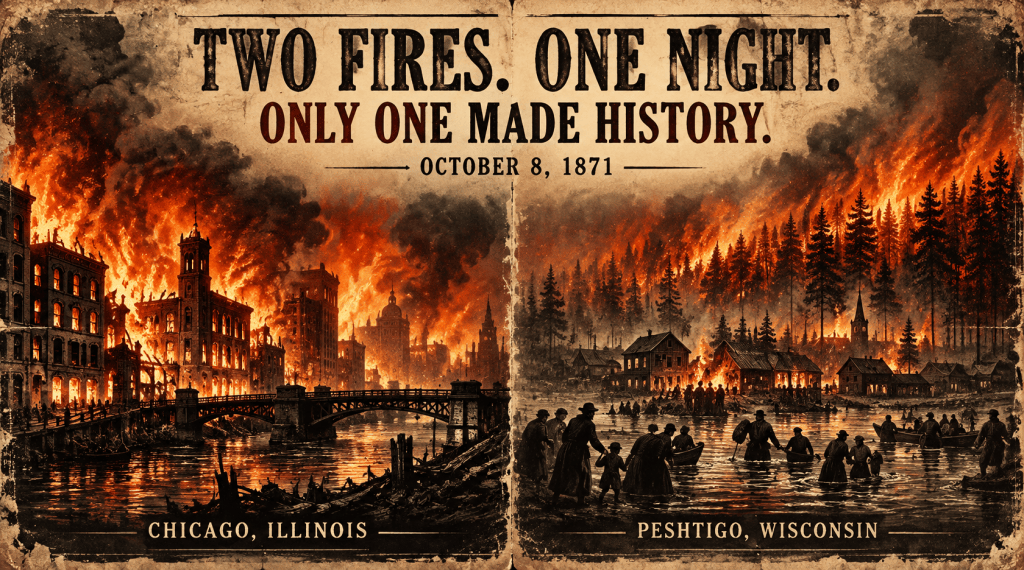
Two Fires. One Night. Only One Made History.
October 8, 1871 — Two American communities faced unimaginable destruction. Yet history would remember them very differently.
Imagine waking up on October 9, 1871, to discover that an American city had nearly burned to the ground.
Buildings destroyed. Families displaced. Hundreds dead.
The newspapers were filled with reports of the Great Chicago Fire. It was a catastrophe that would become one of the most recognizable disasters in American history.
But hundreds of miles away, another community had endured a tragedy of its own.
And that fire had killed far more people.
Its name was Peshtigo.
So why do we remember Chicago while so many Americans have never even heard of Peshtigo?
On the evening of October 8, 1871, fire broke out in Chicago.
Fueled by dry conditions, strong winds, and a city filled with wooden structures, the flames spread rapidly. By the time the fire was extinguished on October 10, approximately 300 people had died, more than 17,000 buildings had been destroyed, and around 100,000 residents were homeless.
The devastation was enormous.
But Chicago wasn’t the only place burning that night.
In northeastern Wisconsin, the lumber town of Peshtigo was surrounded by an increasingly dangerous landscape. Months of dry weather had left forests and logging debris vulnerable to fire.
When fierce winds drove the flames toward the community, residents had little time to escape.
The fire consumed buildings, forests, and entire settlements.
Some residents fled toward the Peshtigo River, hoping the water would protect them from the heat.
For many, it was their only chance of survival.
The Peshtigo Fire and the surrounding firestorm killed an estimated 1,200 to 2,400 people, although the precise number remains uncertain.
It remains the deadliest wildfire in recorded U.S. history.
And yet, it would never occupy the same place in America’s collective memory as the Great Chicago Fire.
In 1871, news didn’t travel the way it does today.
There was no internet, no television, and certainly no instant notification announcing a developing disaster.
Newspapers and telegraph lines were essential for communicating events across the country.
Chicago was a major American city with commercial importance and established connections to the national press. Reports of its destruction spread quickly.
Newspapers across the country carried reports of the catastrophe, including publications in New York, Washington, and Charleston.
Peshtigo faced an additional problem.
Its telegraph wires had burned.
According to the Wisconsin Historical Society, news of the catastrophe had to travel on foot to neighboring communities before reaching larger cities. Madison did not learn of the destruction until October 10.
By then, Chicago’s disaster was already making national headlines.
But it would be misleading to suggest Peshtigo was entirely forgotten at the time.
Once news arrived, communities began sending money, clothing, food, and other supplies. Wisconsin residents organized relief efforts, and donations came from outside the state as well.
People responded.
The tragedy mattered.
Yet the attention the two disasters received—and the place each would eventually occupy in American memory—remained remarkably different.
Historical records preserve accounts from people who experienced the Peshtigo Fire firsthand.
One particularly important witness was Reverend Peter Pernin, a Catholic priest who survived the disaster and later documented what he experienced.
His testimony remains one of the most significant eyewitness accounts of the fire.
Other survivors described terrifying winds, flames spreading through the treetops, and people rushing toward the river in desperate attempts to survive.
Some stood in the water for hours.
Others never emerged.
Historical accounts preserve memories of residents watching their homes disappear and returning afterward to find their community devastated.
These weren’t simply numbers in a historical record.
They were families, neighbors, workers, and children.
They were people who had gone about their ordinary Sunday without knowing how drastically their lives were about to change.
And those who survived carried the memories long after the flames were extinguished.
Perhaps the most surprising discovery is that October 8, 1871, wasn’t just the night Chicago and Peshtigo burned.
Large fires also devastated communities throughout Michigan, including Holland, Manistee, and the Port Huron region.
Prolonged drought, strong winds, and combustible vegetation created dangerous conditions across the Midwest.
This was a regional catastrophe.
Entire communities were affected.
Thousands of people across the region lost their homes, and the combined death toll was staggering.
The familiar story of one burning city represents only part of what happened.
This is where the story becomes more complicated than a comparison of casualty figures.
The Great Chicago Fire was a major national event. Its destruction, rebuilding, and lasting influence on the city’s development helped secure its place in American history.
Peshtigo’s story followed a different path.
Historical research has examined how Chicago’s disaster dominated widely circulated newspaper reports, illustrations, and commemorative material, while Peshtigo received substantially less independent national coverage.
Regional newspapers did document Peshtigo, but those accounts did not achieve the same widespread cultural presence.
That distinction matters.
Because remembering a disaster isn’t simply about how many people died.
It also depends on who tells the story, how far that story travels, and whether future generations continue telling it.
Chicago’s fire became part of America’s historical identity.
Peshtigo’s became a tragedy more closely associated with the communities that survived it.
And while the people of Peshtigo never stopped remembering, its story never achieved the same level of national recognition as Chicago’s.
Today, October 8, 2026, marks 155 years since both disasters began.
Chicago rebuilt.
Peshtigo rebuilt.
Other devastated communities throughout the Midwest rebuilt, too.
But rebuilding doesn’t erase what happened.
And historical recognition shouldn’t depend solely on how famous a city becomes or how many newspaper headlines its tragedy receives.
The Great Chicago Fire deserves its place in history.
So does the Peshtigo Fire.
So do the smaller communities whose losses became footnotes in the story of that terrible night.
Perhaps the lesson isn’t that history deliberately forgot Peshtigo.
Perhaps it’s that history is often shaped by the stories that manage to travel the farthest.
And sometimes, 155 years later, those stories deserve another look.
Because the absence of a famous headline doesn’t mean the absence of a tragedy worth remembering.
—Guyton



Leave a Reply