So now that we know my DNA is largely Scottish and Irish, I suppose there is only one reasonable thing to do.
Start digging through centuries of folklore.
Not literally digging, though.
As it turns out, Ireland has some fairly strong opinions about digging in certain places.
Remember that.
When most of us hear the word “fairy,” we probably picture something tiny. Wings. Sparkles. Maybe a little dress made out of flower petals.
That is not where we’re going today.
Put Tinker Bell back in the Disney movie.
We’re going to Ireland.
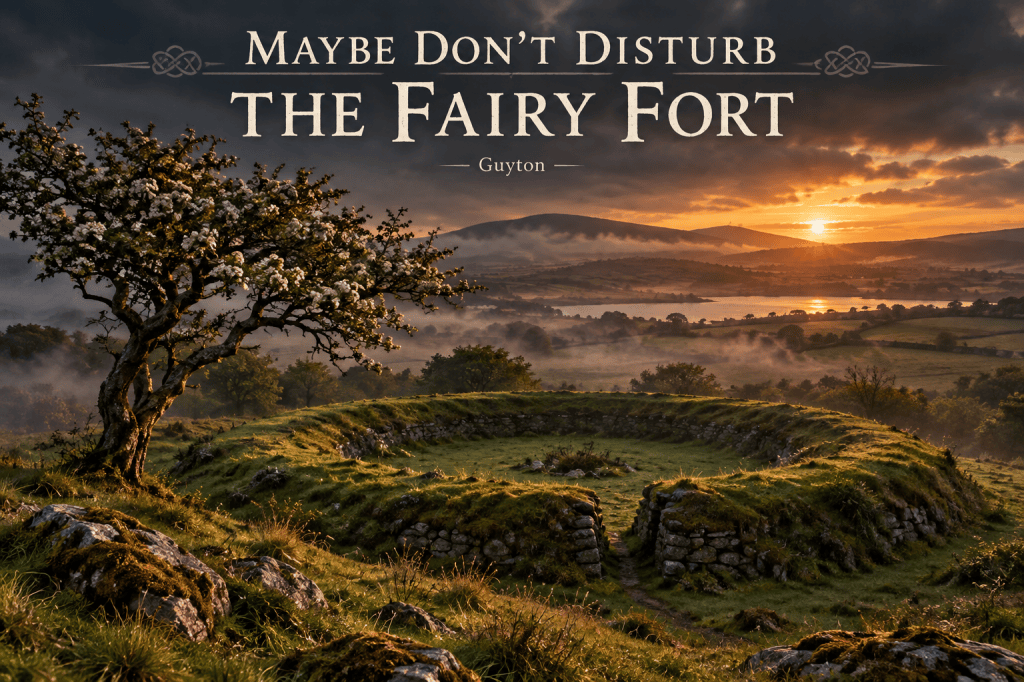
Scattered across the Irish landscape are thousands upon thousands of ancient circular structures commonly called ringforts. Depending on where you are, you might also hear words such as rath, lios or dún used for these places.
And despite the name they would eventually acquire, people didn’t build fairy forts for fairies.
People lived there.
Ringforts were enclosed farmsteads, particularly associated with early medieval Ireland. Many date to roughly AD 500–1100, and estimates suggest tens of thousands were constructed across the country.
Centuries passed.
The people disappeared.
The earthworks remained.
And the stories began.
Some of these ancient places became associated with supernatural beings known in Irish tradition by several names, including na daoine maithe—the Good People.
And before “Good People” makes you feel better about where this is headed, I wouldn’t get too comfortable.
Calling supernatural beings something pleasant doesn’t necessarily mean everyone thought they were harmless.
Irish traditions surrounding these beings were far more complicated than our modern image of the cute little fairy at the bottom of the garden.
They were associated with hills, mounds, ancient places and a world existing alongside our own.
And one lesson appears again and again in Irish folklore:
Leave their places alone.
Don’t dig.
Don’t plow.
Don’t cut certain trees.
Don’t interfere.
Basically, mind your business.
Which, frankly, is advice that could prevent quite a few horror movies.
What makes this particularly fascinating is that we don’t have to rely entirely on modern retellings to find these stories.
During the 1930s, Irish schoolchildren participated in a remarkable project that preserved folklore from their communities. They collected stories from parents, grandparents, neighbors and other local people.
Those accounts survive today in Ireland’s National Folklore Collection.
And thousands of those collected accounts preserve traditions involving fairy forts.
One recorded tradition from County Leitrim tells of a man who cut a whitethorn growing on a fort.
According to the story, afterward he became confused. Familiar surroundings no longer seemed familiar, and he couldn’t properly find his way home.
The tradition also records a remedy for someone believed to have been led astray by fairies:
Turn your coat.
Other Irish accounts preserve similar advice, sometimes telling the unfortunate wanderer to turn clothing inside out or even turn a cap backward.
Now, before anybody heads into the Irish countryside wearing their jacket backward just in case, remember our rule around here.
This is folklore.
I’m not telling you that reversing your wardrobe provides supernatural protection.
I’m telling you that people actually recorded and passed down the belief that it did.
And I find that much more interesting than pretending the story is proven fact.
The warnings didn’t stop with trees.
In County Laois, one collected account described a belief that plowing a rath could bring misfortune upon the family responsible.
The story tells of a man who plowed one anyway.
His horse reportedly died the following day.
Did disturbing a fairy fort kill the horse?
We have absolutely no evidence of that.
Did people tell a story saying it did?
They certainly did.
And stories like that served a very effective purpose.
People left the forts alone.
In fact, heritage researchers have pointed out something rather wonderful about all of this: traditions warning people against interfering with fairy forts may have inadvertently helped preserve actual archaeological sites.
Think about that for a moment.
Folklore may have become conservation.
You don’t need a fence around an ancient monument if generations of people are telling their children:
Don’t touch that.
The Good People live there.
Honestly, that’s one heck of a security system.
But some of the collected stories get considerably stranger.
One account recorded in County Carlow tells of a man passing a rath on a winter night when he heard beautiful music.
Then something extraordinary supposedly happened.
Where the ordinary rath had been, he saw a magnificent castle.
Inside were the Good People, dancing.
A small figure beckoned him to come closer.
He moved toward it.
And suddenly everything disappeared.
No castle.
No dancing.
Just the rath again.
Now we’re talking.
Another collected story, this time from County Limerick, tells of a pony that suddenly refused to continue near a fort.
According to the account, its owner saw a gathering of fairies around a small table beneath a lamp hanging from a tree.
The pony wasn’t interested in going anywhere.
I’m with the pony.
If my horse stops dead in the road and there’s an unexplained dinner party happening underneath a tree beside an ancient fairy fort, our journey has concluded.
We live there now.
Other recorded traditions tell of people digging into forts only for livestock to become sick or die, accidents to happen, or other misfortunes to follow.
Again, these stories aren’t archaeological evidence of supernatural retaliation.
They are evidence of something else.
Belief.
People believed these places mattered.
They believed boundaries existed between the ordinary world and something beyond it.
And whether those stories were meant to explain coincidence, preserve old places, warn children away from dangerous ruins, reinforce community traditions or genuinely describe experiences people couldn’t explain, they survived.
Some of the forts survived too.
That’s what fascinates me most about folklore.
You don’t have to believe a supernatural story literally happened to recognize that the story itself is real.
Someone told it.
Someone remembered it.
Someone thought it was important enough to tell another person.
And eventually, in the 1930s, a child sat down and wrote some of those stories on paper.
Now we’re reading them nearly a century later.
Meanwhile, the earthworks in some of those stories are far older still.
People lived there.
People left.
Generations came and went.
The landscape remembered.
And folklore filled the silence.
So perhaps our first lesson from the Irish side of my DNA is fairly straightforward.
If you find yourself wandering through Ireland and come across an ancient circular earthwork covered in grass and thorn bushes, you don’t need to believe in fairies.
You don’t need to turn your coat inside out.
You don’t need to worry about mysterious music coming from somewhere you can’t quite see.
But considering the archaeological importance of the place—and several centuries’ worth of people essentially giving us the same advice—
maybe don’t disturb the fairy fort.
Just in case.
—Guyton



Leave a comment