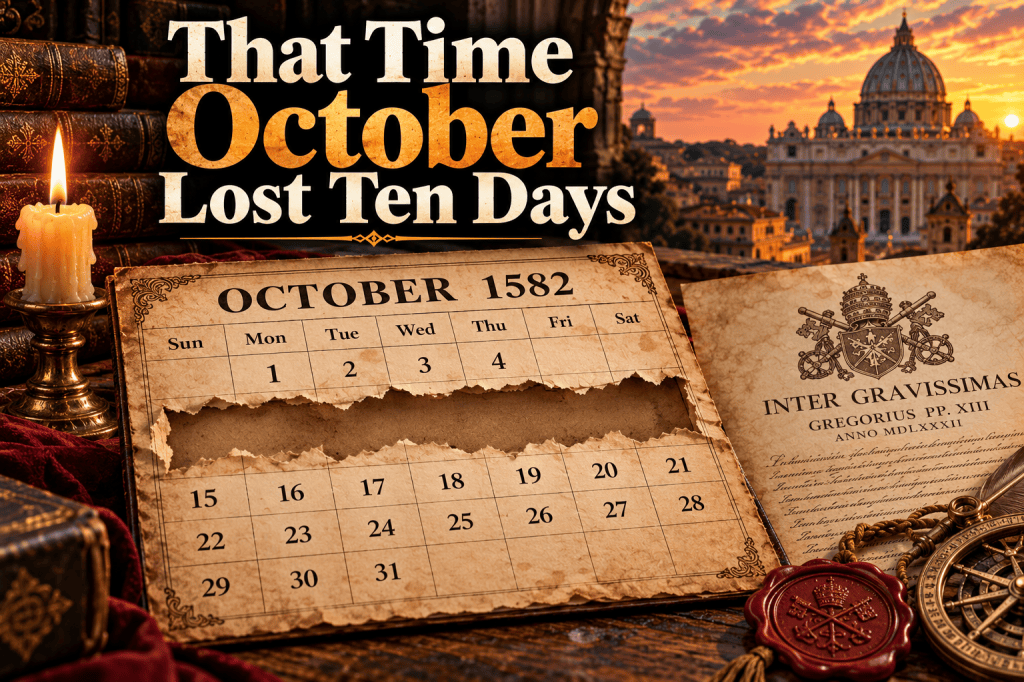
That Time October Lost Ten Days
Imagine going to bed on October 4 and waking up on October 15.
No, you weren’t in a coma.
Nobody stole your calendar.
And you didn’t accidentally sleep for ten days.
The dates simply weren’t there.
That’s exactly what happened in parts of Europe in 1582.
Thursday, October 4 was followed by Friday, October 15.
October 5.
Gone.
October 6.
Gone.
All the way through October 14.
Ten dates simply disappeared from the calendar.
And because today is October 4, I couldn’t possibly learn this information and then keep it to myself.
So what happened?
For centuries, much of Europe had been using the Julian calendar, introduced under Julius Caesar.
It was pretty good.
It just wasn’t quite good enough.
The Julian calendar calculated the year as 365 days and six hours long.
The actual solar year is slightly shorter.
The difference is only about 11 minutes each year.
Which doesn’t sound like much.
And for one year, it isn’t.
But give those 11 minutes more than a thousand years to cause trouble and suddenly you’ve got a problem.
By the 1500s, the calendar had drifted roughly ten days away from where church authorities expected the spring equinox to fall.
That mattered particularly because the date of Easter was calculated in relation to the spring equinox.
Enter Pope Gregory XIII.
In 1582, he issued a papal bull called Inter gravissimas establishing the calendar reform that eventually gave us the Gregorian calendar—the calendar most of us use today.
And part of fixing the problem required getting rid of those accumulated extra dates.
So the order was given.
After October 4, 1582, the calendar would jump to October 15 in the places immediately adopting the reform.
And yes.
Before you ask.
I brought receipts.
Inter gravissimas still exists.
The document was issued by Pope Gregory XIII on February 24, 1582, and it specifically directed that ten days be removed from October of that year.
This isn’t one of those internet stories where somebody says, “Did you know ten mysterious days disappeared?” and everyone copies it until nobody knows where the story originated.
We know where this one came from.
The paperwork survived.
And the people responsible for the reform apparently realized that deleting ten dates from a calendar might create a few practical problems.
Because imagine someone telling you:
“Your payment is due October 10.”
There is no October 10.
“Well, that’s unfortunate.”
The reform actually addressed issues involving things such as payments and obligations so people wouldn’t simply lose ten days from agreements because the dates had been removed.
Humanity may have been changing the calendar, but apparently bills remained undefeated.
There’s another important part of this story, though.
The entire world did not wake up on October 15.
Different countries adopted the Gregorian calendar at different times.
Catholic countries including Spain and Portugal, the Polish-Lithuanian Commonwealth and much of what is now Italy were among those making the October jump in 1582.
France adopted the reform later that same year.
Other countries waited much longer.
Britain and its colonies didn’t adopt the Gregorian calendar until 1752.
Russia waited until after the Russian Revolution.
That created a strange situation in which people living in different countries could experience the exact same day while writing different dates on their calendars.
Same planet.
Same sunrise.
Different date.
And suddenly every historical date I’ve ever read feels slightly more complicated.
But here’s the part I love most.
Nobody actually lost ten days of their life.
People still ate dinner.
They still went to work.
They still slept.
Babies were born.
People died.
The sun rose and set exactly as it always had.
Time didn’t skip.
The calendar did.
So if you’re reading this on October 4, congratulations.
On this date in 1582, people in parts of Europe were about to experience one of the strangest calendar changes in history.
They went to bed on Thursday, October 4.
The next morning was Friday.
October 15.
Ten dates had vanished.
And somewhere, I’m convinced, somebody was just relieved their birthday fell on October 16.
If you’d like to check my receipt, look up Pope Gregory XIII’s Inter gravissimas, issued February 24, 1582.
Because around here, even when October loses ten days—
we keep the paperwork.
—Guyton







Leave a comment