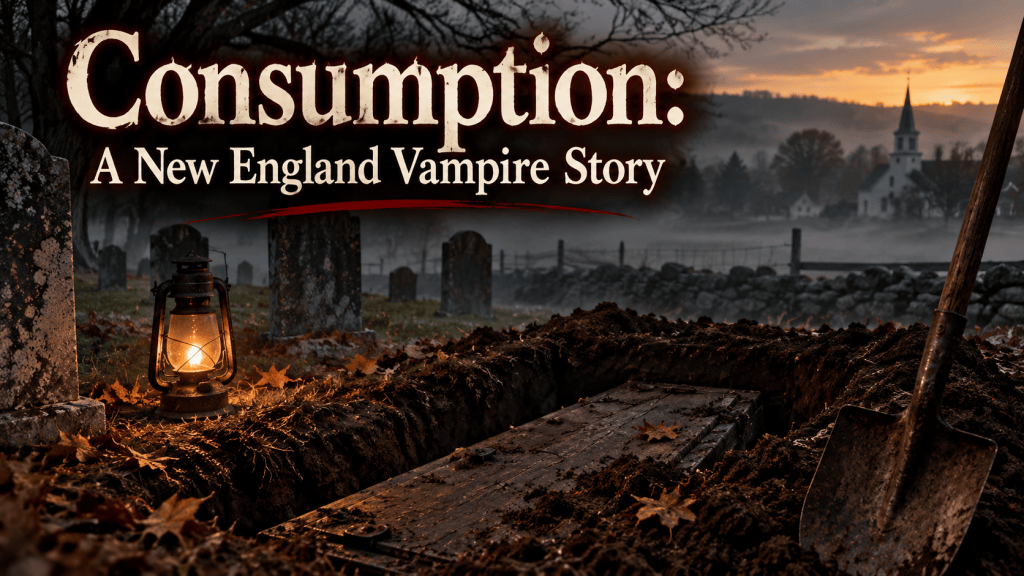
Imagine you live in New England two hundred years ago.
Someone in your family gets sick.
At first, maybe it is just a cough. Then they become tired. They stop eating. They lose weight. The cough gets worse. There are fevers, night sweats, and eventually there may be blood.
They waste away right in front of you.
Then they die.
You bury them.
And a little while later, somebody else in the family starts coughing.
Then somebody else.
What would you believe if the people you loved kept dying and nobody could tell you why?
Because some families in New England eventually came to a terrifying conclusion:
Maybe the dead weren’t finished with them yet.
Today we know the disease they were dealing with.
Tuberculosis.
Back then, it was commonly called consumption, which is an unsettlingly appropriate name when you think about what the disease could do to a person.
Active tuberculosis can cause a persistent cough, weakness, fever, night sweats, loss of appetite, weight loss, and coughing up blood. TB can spread through the air when someone with active disease of the lungs or throat coughs, speaks, or sings. The people they spend time with regularly, including family members, can be particularly exposed.
But here’s the part that makes the old stories start making a strange kind of sense.
Not everyone infected with tuberculosis becomes sick immediately. The bacteria can remain inactive in the body, and active disease can develop months or even years later.
So from inside a nineteenth-century household, the sequence could look something like this:
A mother becomes sick.
She dies.
Months later, her daughter begins wasting away.
She dies.
Then a son becomes ill.
The mother has been underground all this time.
And yet somehow, the dying hasn’t stopped.
Today we can put a name to the invisible thing connecting those deaths.
They couldn’t.
So some New England communities looked somewhere else for an explanation.
They looked underground.
Across New England, there are documented accounts of families exhuming relatives who had died during outbreaks of consumption.
The rituals weren’t all the same.
Sometimes organs were removed and burned.
Sometimes remains were rearranged.
In some accounts, suspected bodies were turned face-down.
There wasn’t a New England Vampire Handbook sitting on everybody’s kitchen table.
These were folk practices, and they varied from place to place.
And despite the name we now give this chapter of history, the people involved weren’t necessarily talking about vampires the way we do.
Nobody was looking for Count Dracula.
The fear was that someone who had died was somehow continuing to prey upon the living.
One of the best-documented cases happened in Exeter, Rhode Island.
Her name was Mercy Lena Brown.
Her family called her Lena.
Tuberculosis had already devastated the Brown family. Lena’s mother, Mary Eliza, died in 1883. Her sister Mary Olive died the following year.
Then her brother Edwin became sick.
Lena herself died of consumption in January 1892.
Edwin was still alive, but he was getting worse.
People in the community began to suspect that one of the dead Brown women might somehow be responsible.
So on March 17, 1892, the bodies of Lena, her mother, and her sister were exhumed.
The older bodies showed the decomposition expected after years in the grave.
Lena’s body was much more intact.
That sounds creepy until you remember something important:
She had been dead for only about two months, during a New England winter.
Dr. Harold Metcalf, who was present for the examination, found nothing supernatural about the condition of her body.
Others weren’t convinced.
Lena’s heart and liver were removed and burned.
The ashes were made into a remedy intended for Edwin.
It didn’t save him.
He died on May 2, 1892.
And here’s something that makes the story even more interesting:
This wasn’t some ancient event from a world without doctors.
It was 1892.
Robert Koch had announced his discovery of the bacterium that causes tuberculosis ten years earlier, in 1882.
Science was moving forward.
Folklore hadn’t disappeared.
For a while, the two existed side by side.
Almost a century later, an old family cemetery was uncovered in Griswold, Connecticut.
Most of the burials weren’t particularly unusual.
One was.
Brass tacks on a coffin had spelled out:
JB 55.
Inside were the remains of a man roughly 50 to 55 years old.
But several years after his burial, someone had reopened his grave.
His skull and thigh bones had been deliberately rearranged across his chest.
Examination of his remains found evidence of a chronic lung infection, possibly tuberculosis.
Decades later, DNA analysis combined with genealogical research pointed toward an identity:
John Barber.
Researchers believe the unusual treatment of his remains fits the pattern of New England’s consumption-related vampire traditions.
But we don’t have a diary from the people who reopened John’s grave telling us exactly what they believed.
History doesn’t give us permission to invent that part.
What we have is a man who suffered from a chronic lung infection that may have been tuberculosis, a grave deliberately reopened after death, bones intentionally rearranged, and a region where similar rituals are historically documented.
Not a campfire story.
Bones.
And this is actually where our rabbit hole started.
Maine.
Maine doesn’t hand us one beautifully documented Mercy Brown story with every name and detail attached.
But it does hand us something pretty remarkable.
In 1862, physician Henry Ingersoll Bowditch published work on consumption that included information from a longtime physician in Saco, Maine, Dr. Allen.
Allen reported that in earlier times, people in the area had frequently disinterred friends who had died of consumption.
That’s not something somebody added to a ghost tour last Tuesday.
It’s sitting in a nineteenth-century medical publication.
The source doesn’t tell us exactly why every one of those bodies was disinterred or what was done to them afterward, so I’m not going to fill in that blank for them.
Separate folklore research by Michael Bell connects Maine with face-down treatment of the dead in this broader New England tradition.
But those are two pieces of evidence, and they deserve to remain two pieces of evidence.
Receipts matter.
Especially when we’re talking about digging up dead people.
So were they really vampires?
No.
They were people who died from disease.
But the families participating in these rituals weren’t necessarily foolish people either.
They were observing something real.
Illness was moving through families.
People were becoming sick after relatives died.
Consumption really could make someone appear as though the life were slowly being drained from them.
They could see the pattern.
They just couldn’t see the bacterium.
And when medicine couldn’t stop what was happening, folklore offered something medicine couldn’t:
Something to do.
Open the grave.
Examine the body.
Burn the heart.
Turn the corpse.
Try anything.
Because doing something—even something horrifying—might have felt better than sitting beside another bed and watching another person you loved begin to cough.
And that’s the part I can’t stop thinking about.
It’s easy to look backward with everything we know today and laugh at people who believed the dead were somehow responsible for the living becoming sick.
But take away antibiotics.
Take away modern diagnostic tests.
Take away our understanding of how tuberculosis spreads.
Take away the CDC and Google and the ability to type symptoms into a search bar at two o’clock in the morning.
Now put yourself inside a farmhouse where you’ve already buried your wife and one of your children.
Another child starts coughing.
What would you do if somebody told you there was one more thing you could try?
Would you say no?
Or would you grab a shovel?
Maybe that’s why the New England vampire stories have survived.
The frightening part isn’t that people once believed in vampires.
The frightening part is understanding why they did.
Because underneath the graves, the burned hearts, the rearranged bones, and all the folklore was something much more ordinary.
People were scared.
People were grieving.
And they were desperately trying to keep the people they still had alive.
Sometimes the scariest stories aren’t about monsters at all.
Sometimes they’re about what ordinary people will do when they’re running out of hope.
—Guyton





Leave a comment