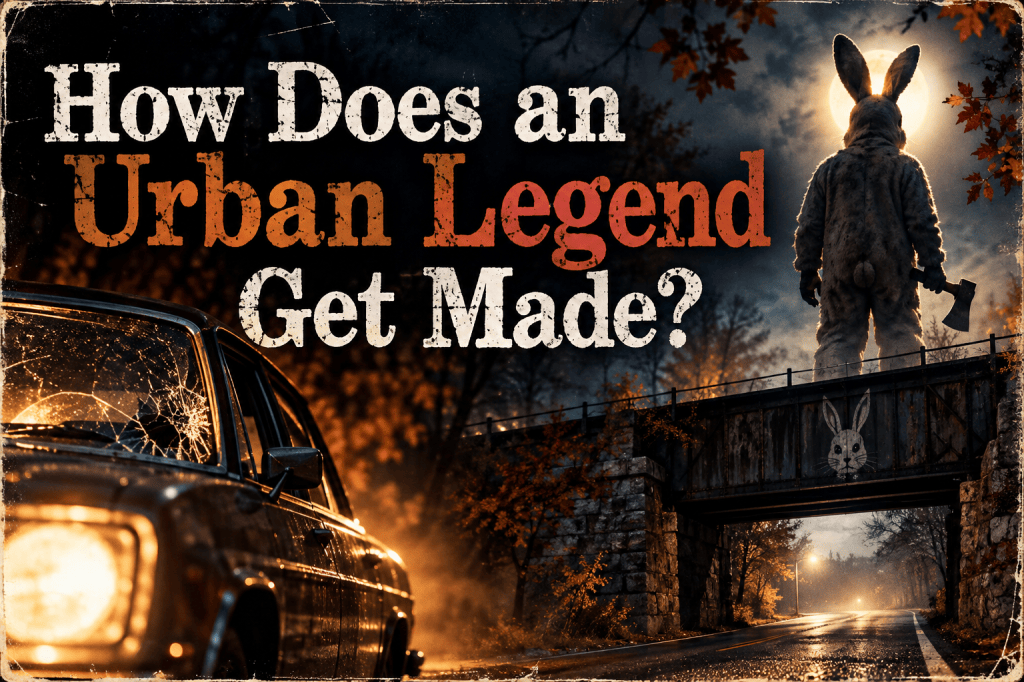
Have you ever stopped to wonder who starts an urban legend?
Not who tells it to you.
Who told them?
And who told the person before that?
Because somehow we all grew up knowing stories nobody remembers being formally introduced to.
Nobody sat us down in school and said, “Okay, children, today we’re going to learn about creepy things that definitely happened to somebody’s cousin’s best friend.”
Yet somehow the stories got around.
So how does an urban legend actually get made?
Apparently, sometimes all you need is a real incident, a rabbit costume, a hatchet, a newspaper and a story strange enough that people can’t stop repeating it.
Let’s go to Fairfax County, Virginia, in October 1970.
This is where the Bunny Man comes in.
If you look up the Bunny Man today, you can find stories involving an escaped inmate, an asylum, murdered people, mutilated rabbits, bodies hanging from a railroad bridge and a supernatural killer who supposedly returns around Halloween.
There is even a place commonly called Bunny Man Bridge.
Sounds like we have ourselves a full-blown horror movie.
Except there’s a problem.
That isn’t where the story started.
So let’s back this bunny up.
In October 1970, a young couple was sitting in a car along Guinea Road in Fairfax County when they reported being confronted by a strangely dressed man.
According to contemporary newspaper reporting, the man yelled at them about being on private property and threw a hatchet through the car window.
Nobody was killed.
Nobody disappeared.
There was no asylum.
There were no bodies hanging from a bridge.
There was, however, a report of a man dressed like a rabbit throwing a hatchet through somebody’s car window.
Which, to be fair, is plenty.
We really didn’t need to add anything. 😂
But people did.
Less than two weeks later, another strange incident was reported in the same general area.
A private security guard named Paul Phillips was watching an unfinished housing development on Guinea Road when he reported seeing a similarly described figure standing on the porch of an unoccupied house.
This time, the person Phillips reported seeing had an axe.
According to the account, the man complained about people trespassing and began chopping at a support on the house.
Fairfax County police responded.
That part isn’t folklore.
A police investigative report survives.
At about 10:30 that night, six officers responded to 5307 Guinea Road after receiving a report of a person dressed as a rabbit and carrying an axe.
They didn’t find him.
The investigation continued, but the identity of whoever was behind the incident was never established.
And honestly?
If the story ended right there, it would still be weird enough for me.
An unidentified person running around Virginia dressed like a rabbit with an axe is not exactly something you shrug off and forget about.
But apparently Fairfax County didn’t forget about it either.
The story spread.
Newspapers continued reporting Bunny Man sightings and rumors.
People talked.
Kids talked.
Teenagers talked.
And then something happened that makes this one of the best examples I’ve found of how an urban legend can grow.
In 1973, only a few years after the original incidents, University of Maryland student Patricia Johnson collected Bunny Man stories for a folklore research paper.
She collected 54 versions from 33 teenagers.
Fifty-four.
We had gone from two documented incidents to dozens of variations in roughly three years.
And they weren’t all telling the same story.
Different locations appeared.
Some versions had Bunny Man chasing people.
Some had him attacking cars.
Some involved vandalism.
And a few had already given him something he didn’t have in the documented 1970 incidents:
Murder victims.
There it is.
That’s the moment that fascinates me.
Because nobody needed the Internet.
Nobody needed TikTok.
Nobody needed somebody sitting behind a computer at three in the morning creating a creepy backstory.
The story was already changing.
People were doing what people have always done.
They were telling it.
And every time a story passes through another person, there is an opportunity for something to shift.
Maybe the location changes.
Maybe the weapon changes.
Maybe something frightening becomes something deadly.
Maybe somebody forgets one detail and replaces it with another.
Maybe someone says, “Well, I heard…”
And suddenly a new piece becomes part of the story.
Eventually, Bunny Man found himself a bridge.
The railroad overpass on Colchester Road near Clifton became so closely associated with the legend that people now call it Bunny Man Bridge.
Here’s the funny part.
The two documented 1970 incidents didn’t happen there.
They happened around Guinea Road.
Somewhere along the way, the legend moved.
And once it got to that creepy little railroad bridge, apparently it got comfortable. 😂
But the story wasn’t finished growing.
Decades later, the Internet arrived.
And Bunny Man got an upgrade.
Online versions began circulating with elaborate histories involving an asylum, escaped inmates, gruesome murders and even a named killer.
There were stories about mutilated rabbits.
There were stories about people being killed and hung from the bridge.
There were dates.
Names.
Backstories.
The kind of details that make something sound researched.
Except Fairfax County Public Library historian-archivist Brian Conley actually did research it.
He went through old newspapers, historical records and documented murder cases trying to find the history behind the legend.
He couldn’t find the asylum described in the story.
He couldn’t find murders matching the Bunny Man mythology.
He couldn’t find the historical record that should have existed if those elaborate stories were true.
What he did find were those strange events from October 1970.
A couple.
A car.
A hatchet.
A security guard.
An unfinished house.
An axe.
And reports of somebody dressed like a rabbit.
That’s where the receipts take us.
Everything after that shows us something else.
How stories grow.
And I think that’s what makes urban legends so interesting.
We tend to imagine somebody inventing one from scratch.
Maybe sometimes they do.
But sometimes there is a tiny piece of something real sitting underneath all those layers.
Something strange happens.
A newspaper reports it.
Someone tells somebody.
That person tells somebody else.
Kids repeat it at school.
Teenagers tell it at parties.
The location changes.
The danger gets bigger.
Somebody adds a victim.
Years pass.
The Internet discovers it.
And suddenly a strange incident involving a man in a rabbit costume has an asylum, a murderer, a haunted bridge and an entire mythology attached to it.
The Bunny Man didn’t need to survive.
The story did.
And maybe that’s the strangest part.
More than fifty years later, we still don’t know who the person behind those original incidents was.
But we know Bunny Man.
Or at least…
we know the story everybody built around him.
So how does an urban legend get made?
Sometimes it starts with something real.
Then somebody tells the story.
Somebody else tells it again.
A detail changes.
A location moves.
Something gets added.
Something else disappears.
Eventually, people stop asking where the story came from because everybody already seems to know it.
And somewhere between what actually happened and what everybody remembers hearing happened, an urban legend is born.
—Guyton





Leave a comment