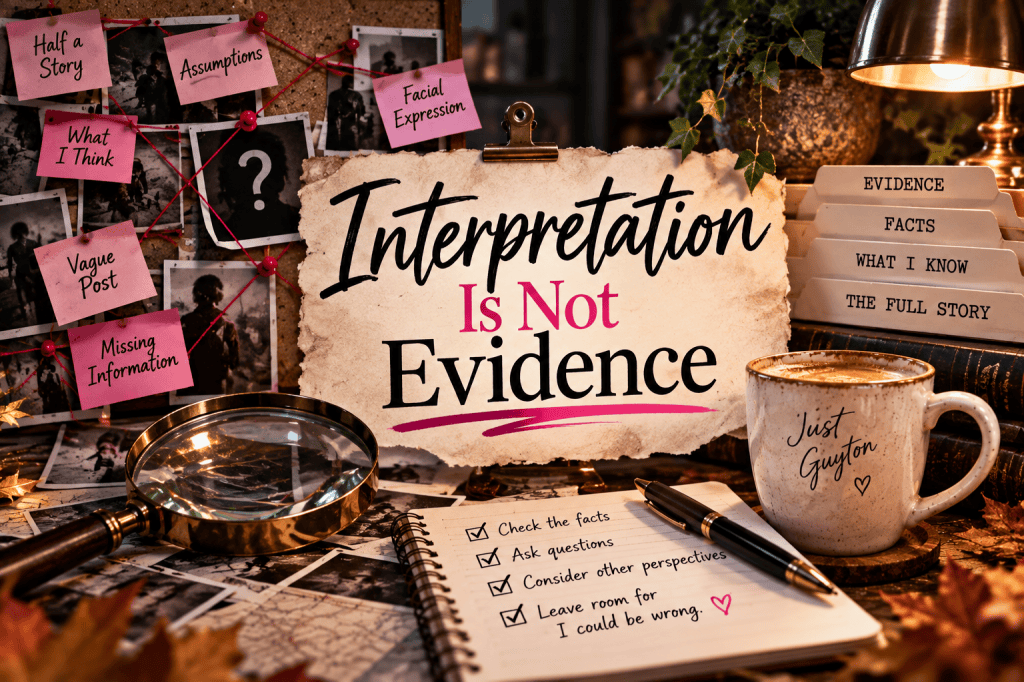
People are funny.
Give us half a story, three facial expressions, a vague Facebook post, and approximately seven minutes, and we will have an entire documentary put together in our heads.
We know what happened.
We know why it happened.
We know who it was about.
We know what everybody meant.
Except sometimes we don’t know a darn thing.
We assumed.
And somewhere along the way, our assumption quietly got promoted to a fact.
I’ve been thinking about this lately, especially as a writer. Writers use examples all the time. Sometimes they’re things we’ve experienced. Sometimes they’re observations we’ve made. Sometimes several different experiences inspire one example. And sometimes we’re simply creating a hypothetical situation because it’s the easiest way to explain a point.
But somebody will read it and immediately think:
I know exactly who she’s talking about.
Do you?
Because I wrote it, and sometimes even I don’t know who you think I’m talking about. 😂
That’s the funny thing about interpretation. We naturally fill in missing information with what makes sense to us.
And we don’t only do it when we’re reading.
We do it in relationships.
Someone doesn’t answer a text quickly enough, so they’re mad.
Someone is quiet, so something must be wrong.
Someone doesn’t invite us somewhere, so obviously they don’t like us.
Someone posts something vaguely relatable on Facebook and suddenly we’re sitting there thinking, Well, I know THAT was about me.
Maybe.
Or maybe Brenda was watching Real Housewives and got inspired. We don’t know. 😂
The problem isn’t that we interpret things. That’s human.
The problem starts when we forget that an interpretation is still an interpretation.
Here’s another example.
Imagine someone offers to help you with something. You didn’t ask. They offered.
You say thank you and accept.
Later, you discover that apparently the offer came with expectations. You were supposed to do certain things in return. You were supposed to behave a certain way. You were supposed to understand that accepting the help created obligations.
There’s just one tiny problem.
Nobody told you.
You didn’t break an agreement.
You didn’t even know there was an agreement.
Somebody wrote a contract in their head and forgot to give you a copy.
And now they’re upset because you didn’t follow the terms.
How exactly were you supposed to do that?
Telepathy?
Carrier pigeon?
Should we have requested the terms and conditions before clicking “accept”? 😂
Unspoken expectations have a way of becoming resentment when people convince themselves that everybody else should just know.
And assumptions can become much more serious than a misunderstanding.
Sometimes we hear one person’s version of a disagreement and decide we know what happened. We assign motives. We decide who’s right, who’s wrong, who was selfish, who was cruel, who was using whom.
Then we start treating people differently based on a conclusion we reached without having all the information.
That’s when interpretation has consequences.
There’s an important difference between saying:
“This is what I observed.”
and
“This is why that person did it.”
The first one describes what you actually know.
The second one requires information you may not have.
And I’m not exempt from this.
None of us are.
We all interpret the world through our own experiences, expectations, emotions, and history. Sometimes we’re going to get it wrong.
The goal isn’t to stop having thoughts about things.
Good luck with that. 😂
Maybe the goal is simply to leave enough room in our thinking for three little words:
I could be wrong.
Maybe that text wasn’t rude.
Maybe that expression wasn’t about you.
Maybe that person wasn’t intentionally ignoring you.
Maybe that Facebook post wasn’t secretly directed at you.
Maybe the person whose story you heard has another side you haven’t heard yet.
And maybe that example in the blog you’re reading isn’t about the person you’ve already decided it’s about.
Sometimes a story is exactly what you think it is.
Sometimes it isn’t.
Before we turn our interpretation into somebody else’s motive, intention, or character, maybe it’s worth remembering:
What I think happened and what actually happened are not automatically the same thing.
Assumptions fill in blanks.
Evidence fills them in correctly.
And those are two very different things.
—Guyton






Leave a comment