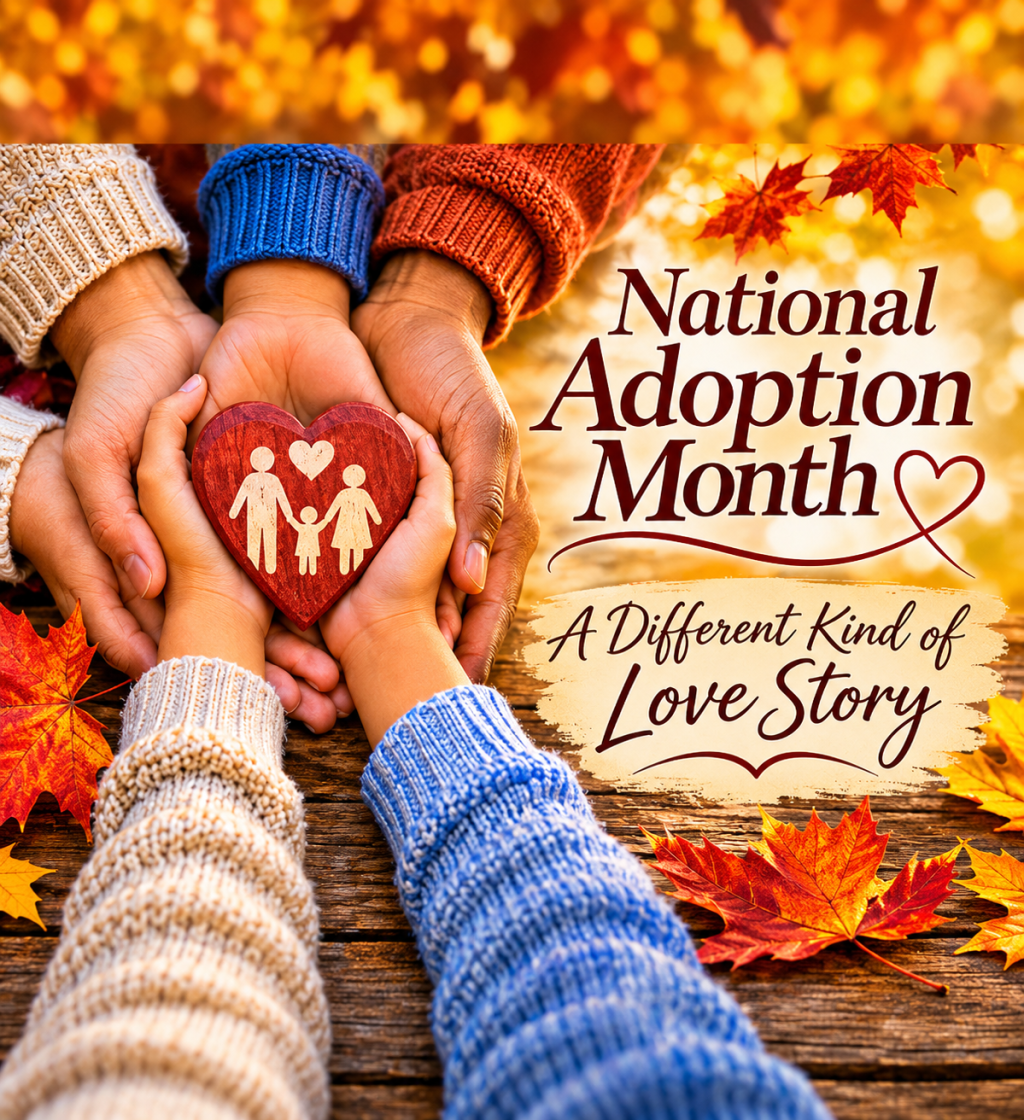
There are many ways a family can begin.
Some begin with a pregnancy that was eagerly anticipated. Others begin after years of waiting, hoping, praying, and wondering whether the dream of becoming a parent will ever come true.
And sometimes, a family begins when two different journeys unexpectedly meet.
November is National Adoption Month, a time dedicated to raising awareness about adoption, particularly the children and teenagers in foster care who are waiting for permanent, loving families.
But I believe it is also an opportunity to have a larger conversation about love, family, personal choices, and the many different circumstances that can bring people together.
Because adoption is something my family and I are familiar with, and perhaps that is one reason I believe this subject deserves to be approached with compassion, understanding, and respect for everyone involved.
There are couples who desperately want children but are unable to conceive.
Some have spent years going through fertility treatments, enduring disappointment after disappointment, and watching the dream of parenthood become something they fear may never happen.
Others may be single people who have always dreamed of becoming parents, or families who simply feel called to open their homes and hearts to a child.
And then there are people facing an entirely different set of circumstances.
Some are experiencing an unexpected pregnancy. Some are struggling financially. Others may feel emotionally unprepared for parenthood, lack a dependable support system, or face circumstances that make raising a child seem impossible.
Their situations are not all the same.
Neither are their choices.
And I believe that is something we need to remember before passing judgment on anyone.
I am a Christian.
My faith is an important part of my life, and it influences how I see the world.
But I am also a firm believer that a woman’s body is her choice.
I know that some people struggle to understand how I can hold both of those beliefs.
To me, however, the answer is simple.
My faith guides the decisions I make for myself. It does not give me the authority to make someone else’s decisions for them.
I do not believe it is my place to tell another woman what she must do with her body.
Her circumstances, her beliefs, and her decisions belong to her.
And as a Christian, I believe her relationship with God is her own.
I can have deeply held personal beliefs while still respecting someone else’s right to make choices that may be different from mine.
I can offer compassion without condemnation.
I can share my perspective without demanding that everyone agree with it.
And I can believe that adoption is a wonderful option without believing that anyone should be pressured into choosing it.
Those things are not contradictions to me.
They are part of treating other human beings with dignity.
And that is why I think conversations about adoption matter.
Sometimes, when people are facing difficult circumstances, they may not realize how many different resources and possibilities are available to them.
For someone who is pregnant and does not feel ready to parent, adoption may be one of the options worth exploring.
It is important to understand, however, that adoption is an alternative to parenting, not an alternative to pregnancy itself.
Pregnancy carries physical, emotional, medical, and financial considerations that no one else has the right to dismiss.
And adoption can bring complicated feelings, including grief and loss, even when a person believes it is the right decision.
No one should be made to feel that choosing adoption is required, that choosing to parent is wrong, or that any deeply personal reproductive decision can be reduced to a simple answer.
But I do believe that people deserve accurate information about the choices available to them.
And adoption is one of those choices.
There are different forms of adoption, each with its own circumstances and legal requirements.
Some children are adopted as infants through private domestic adoption arrangements.
Others are adopted internationally, subject to the laws and protections of the countries involved.
And many children and teenagers are adopted from foster care after courts determine that reunification with their birth families is not possible.
In the United States, National Adoption Month has a particularly important connection to children in foster care.
Its roots reach back to 1976, when Massachusetts Governor Michael Dukakis announced an Adoption Week to draw attention to children waiting for permanent families.
In 1984, President Ronald Reagan proclaimed the first National Adoption Week, bringing the observance to a national audience.
The observance expanded over time, and in 1995, President Bill Clinton proclaimed the first National Adoption Month.
Since then, November has provided an annual opportunity to recognize adoptive families, raise awareness about children awaiting adoption, and encourage conversations about the importance of stable, supportive homes.
But behind every statistic is a real person.
A child with hopes, fears, memories, and a personality all their own.
A teenager who may have spent years wondering whether anyone will ever choose to become a permanent part of their life.
A birth parent who may have made a difficult decision under circumstances that others will never fully understand.
And an adoptive parent who may have waited years for the opportunity to love and raise a child.
Their stories deserve to be told with care.
Because adoption is not simply about adults wanting children.
It is about children and their needs, their identities, their relationships, and their right to be safe, supported, and loved.
And sometimes, that love comes from people who are not related to them by blood.
That idea has always resonated with me.
In fact, when I think about adoption, I often find myself remembering a story from the Bible.
The story of Moses, found in Exodus 1–2.
According to the Book of Exodus, the Israelites were living under oppression in Egypt when Pharaoh ordered that Hebrew baby boys be killed.
One mother, determined to protect her child, hid her infant son for three months.
When she could no longer conceal him, she placed him in a basket among the reeds along the Nile River.
Imagine the fear that mother must have felt.
The uncertainty.
The desperation.
The love that drove her to do everything within her power to protect her child.
She had no way of knowing what would happen next.
But the basket was discovered by Pharaoh’s daughter.
When she saw the crying baby, she took pity on him.
And through a remarkable turn of events, Moses’s own mother was brought in to nurse and care for him during his infancy.
Later, Pharaoh’s daughter took Moses as her son.
The child who had been placed in a basket to escape death was raised in the household of the very ruler whose decree had threatened his life.
It is one of the most extraordinary stories in the Bible.
And while the circumstances of ancient Egypt are very different from adoption today, the story has always reminded me that family can be formed in unexpected ways.
It is also a story about a mother’s desperate effort to protect her child, a woman who responded with compassion, and a child whose life would eventually influence generations.
When I think about Moses, I don’t simply think about the woman who raised him.
I think about his mother, too.
Because adoption stories often involve more than one kind of love.
There may be the love of the person who gives birth to a child.
The love of the people who raise that child.
And, when circumstances allow, the love of extended relatives and others who remain part of the child’s life.
Those relationships do not always fit neatly into the traditional picture of a family.
But that does not make them any less meaningful.
At the same time, I believe we should be careful about how we speak of adoption as a gift.
For some people, adoption truly is experienced as an extraordinary blessing.
It can fulfill a lifelong dream of parenthood.
It can provide a child with security and a permanent family.
It can create bonds that last a lifetime.
But adoption can also involve separation, grief, unanswered questions, and complicated feelings about identity and belonging.
A child may love their adoptive parents deeply while still wondering about their birth family.
A birth parent may feel confident in their decision while also experiencing sadness.
An adoptive parent may be filled with gratitude while recognizing that their family’s beginning involved difficult circumstances for someone else.
All of those feelings can exist together.
And acknowledging them does not diminish the beauty that adoption can bring.
It simply means we are willing to recognize the full humanity of everyone involved.
I also think it is important to remember that adoption should never be presented as a solution to infertility at the expense of a child’s needs.
Children are not gifts owed to adults who long to become parents.
They are individuals deserving of safety, respect, stability, and unconditional love.
Becoming an adoptive parent means accepting responsibility for a child’s entire story, including the parts that began before they entered your home.
It means recognizing that love is not measured by whether two people share the same DNA.
And it means understanding that a child should never have to feel that gratitude for being adopted is a condition of belonging.
A family is built through care, commitment, trust, and the willingness to stand beside one another through life’s difficulties.
Those things matter far more than biology alone.
And for the people who have experienced adoption personally, I believe their voices deserve a place in the conversation.
Adult adoptees have important perspectives about identity, belonging, family separation, and the ways adoption has shaped their lives.
Birth parents deserve to be heard without being reduced to stereotypes or assumptions.
Adoptive parents deserve support as they navigate the responsibilities and joys of raising their children.
And children currently waiting for permanent families deserve more than sympathetic words.
They deserve systems that prioritize their safety and well-being.
National Adoption Month gives us an opportunity to think about all of those things.
It reminds us that family is not always formed in the way we expected.
Sometimes life takes an unexpected turn.
Sometimes the road to parenthood is longer and more difficult than anyone imagined.
Sometimes a person faces a decision they never expected to make.
And sometimes those different journeys lead to a connection that changes several lives forever.
Having some familiarity with adoption, I understand that there can be deeply personal stories behind these decisions.
Not every experience needs to be shared publicly, and not every circumstance is ours to question.
What matters is that we approach one another with kindness and recognize that every family has its own story.
I do not believe we need to know every detail of someone’s circumstances to treat them kindly.
We do not need to agree with every choice to recognize another person’s humanity.
And we certainly do not need to judge someone simply because their journey through life looks different from our own.
If there is one thing I hope people take away from National Adoption Month, it is the importance of approaching adoption with an open heart and an informed mind.
For someone considering adoption as a prospective parent, that may mean learning about the needs of children waiting in foster care, understanding the responsibilities involved, and preparing to provide a loving, stable home.
For someone facing an unexpected pregnancy, it may mean learning about all available options, asking questions, and making a decision without pressure or shame.
And for those of us who are simply observing the month, it may mean listening more carefully to the experiences of people whose families were formed through adoption.
Because love does not always follow the path we imagined.
Sometimes it arrives after years of waiting.
Sometimes it grows through relationships that began in difficult circumstances.
Sometimes it is found in a family that looks entirely different from the one we expected.
And sometimes it reminds us that the most meaningful connections in our lives are not determined by blood alone.
I believe adoption can be a beautiful and life-changing experience.
I believe that every child deserves to be loved, protected, and valued.
I believe people who dream of becoming parents deserve compassion, even when their journey is difficult.
And I believe every person facing a deeply personal decision deserves accurate information, dignity, and the freedom to make that decision for themselves.
My faith teaches me the importance of love and compassion.
And those are the values I want to carry into conversations like this one.
Not judgment.
Not pressure.
Not condemnation.
Just the understanding that life can be complicated, families can be formed in many different ways, and every person involved has a story worth respecting.
This November, as we recognize National Adoption Month, I hope we remember that adoption is about much more than paperwork, legal proceedings, or the moment a child joins a family.
It is about people.
Their histories.
Their hopes.
Their challenges.
And the relationships that help shape the rest of their lives.
Because sometimes the most beautiful love stories are not the ones we planned.
They are the ones that remind us just how many different ways a family can begin.
— GUYTON





Leave a Reply