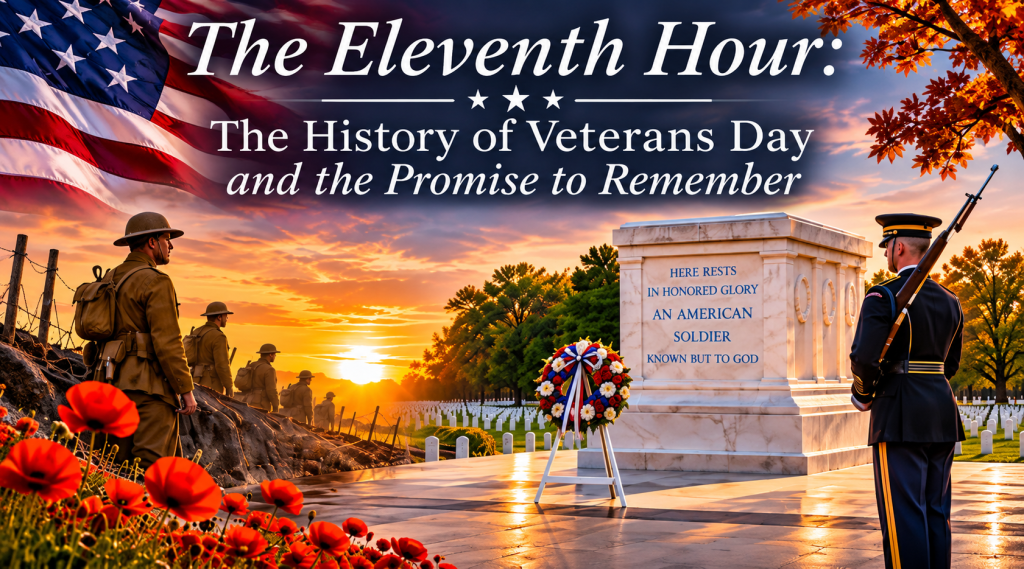
On the eleventh hour of the eleventh day of the eleventh month, the guns finally fell silent.
It was November 11, 1918.
For more than four years, Europe had been consumed by a war unlike anything the world had experienced before. Millions had died, entire communities had been devastated, and countless families had spent their days praying that the people they loved might somehow make it home.
In the trenches, soldiers had endured mud, freezing temperatures, disease, exhaustion, and the constant threat of death. They had watched friends fall beside them and lived through horrors that many would struggle to describe for the remainder of their lives.
Then, at eleven o’clock that morning, an armistice between Germany and the Allied powers took effect on the Western Front.
The fighting stopped.
Imagine what that moment must have felt like.
After years of explosions and gunfire, there was suddenly the possibility of silence. Somewhere, a soldier may have looked toward the sky without fearing what would come next. Somewhere else, another may have thought of his mother, his wife, or the children waiting for him at home.
The war was not formally ended by a peace treaty until June 28, 1919, when the Treaty of Versailles was signed. And the armistice did not bring an immediate end to every conflict or hardship.
But November 11, 1918, became a date the world would never forget.
It was the beginning of a tradition that would eventually become Veterans Day.
A year later, on November 11, 1919, President Woodrow Wilson issued a commemorative message marking the first anniversary of the armistice.
The purpose was not simply to celebrate a military victory. It was also an opportunity to reflect upon the enormous human cost of war and the hope that future generations might live in peace.
The original vision for Armistice Day included parades, public gatherings, and a brief suspension of business beginning at eleven o’clock in the morning.
For a moment, ordinary life would stop so that the nation could remember those who had served.
I find something deeply moving about that idea.
An entire country setting aside a moment of its day to acknowledge the men and women whose lives had been forever changed by war.
Because although the fighting had ended, the experiences of those who survived did not disappear.
Some veterans returned home carrying visible injuries. Others carried memories that would remain with them for the rest of their lives.
And many families never received the homecoming they had prayed for.
On November 11, 1921, another solemn chapter was added to the history of Armistice Day.
An unidentified American soldier who had died during World War I was laid to rest at Arlington National Cemetery.
His name was unknown.
His family could not be identified.
But the nation would honor him as a representative of the countless service members whose identities had been lost to war.
Before his burial, the Unknown Soldier had been brought from France to the United States aboard the USS Olympia. His casket lay in state at the United States Capitol, where tens of thousands of people came to pay their respects.
On the day of his funeral, a procession carried him through Washington and across the Potomac River to Arlington.
President Warren G. Harding attended the ceremony, and Americans across the country observed a period of silence.
A soldier without a name had been given a place of honor in the nation’s memory.
Today, the Tomb of the Unknown Soldier remains one of the most recognized memorials in the United States.
And every November 11, its history reminds us that remembrance is not limited to those whose names appear in history books.
As the years passed, Armistice Day became an increasingly important American tradition.
In 1926, Congress passed a resolution encouraging the annual observance of November 11 through ceremonies, thanksgiving, prayer, and efforts to promote peace and understanding among nations.
Then, on May 13, 1938, Congress made November 11 a federal legal holiday known as Armistice Day.
It was a day closely associated with the veterans of World War I.
But history had other plans.
The war that so many had hoped would be the last great conflict was followed by another devastating world war.
World War II brought millions of additional Americans into military service. Then came the Korean War.
By the early 1950s, the United States had generations of veterans whose experiences extended far beyond the battlefields of World War I.
And a man from Birmingham, Alabama, believed they all deserved recognition.
His name was Raymond Weeks.
A Navy veteran of World War II, Weeks envisioned a national observance that would honor everyone who had served in America’s armed forces, rather than limiting the day to veterans of a single war.
In 1947, he organized a celebration in Birmingham that honored veterans from different generations.
He continued advocating for the idea, writing letters, gathering support, and encouraging national leaders to broaden the meaning of Armistice Day.
I think there’s something wonderful about that part of the story.
One veteran recognized that the service of others deserved to be remembered, and he refused to let the idea fade away.
His determination helped inspire a change that would eventually become part of American history.
Representative Edward H. Rees of Kansas introduced legislation to change the holiday’s name from Armistice Day to Veterans Day.
On June 1, 1954, President Dwight D. Eisenhower signed the legislation into law.
Later that year, Eisenhower issued the first Veterans Day proclamation, encouraging Americans to honor veterans and renew their commitment to peace.
And just like that, a holiday that began with the end of World War I had grown into something much larger.
Veterans Day would now recognize American veterans of all wars.
Over time, its observance would encompass everyone who had served honorably in the United States Armed Forces, whether during wartime or peacetime.
But even then, the story of November 11 was not finished.
In 1968, Congress passed the Uniform Monday Holiday Act, which moved the federal observance of several holidays to Mondays.
Veterans Day was moved to the fourth Monday in October, with the change taking effect in 1971.
The intention was to provide more three-day weekends for federal employees.
But there was a problem.
November 11 was not simply a convenient date on the calendar.
It was the anniversary of the armistice that had ended the fighting on the Western Front in 1918. It carried generations of memories, traditions, and meaning.
Many states and veterans organizations opposed moving the observance away from its original date.
And eventually, the federal government listened.
On September 20, 1975, President Gerald Ford signed legislation returning Veterans Day to November 11, beginning in 1978.
The date had come home.
I think that part of the history is especially important because it reminds us that traditions are not always about convenience.
Sometimes a date matters because of what happened on it, who remembers it, and the people whose lives are forever connected to it.
And November 11 had become far more than an ordinary day.
Today, Veterans Day falls on November 11 every year, although the federal holiday may be observed on an adjacent weekday when the date falls on a weekend.
It is sometimes confused with Memorial Day, but the two observances have different purposes.
Memorial Day is dedicated specifically to remembering those who died while serving in the United States military.
Veterans Day honors all who have served, including the veterans who are still living among us.
The distinction matters.
Because while we must always remember those who never returned home, we must also recognize the men and women who did.
The veterans who came back and raised families. Those who returned to school or work. Those who continued serving their communities long after their military careers ended.
And those whose experiences changed them in ways the rest of us may never fully understand.
Not every veteran has a dramatic story to tell.
Not everyone served on a battlefield.
Some worked in hospitals, maintained equipment, transported supplies, operated communications systems, or performed countless other duties necessary to support their fellow service members.
Others served during peacetime, answering the same commitment to military service without ever being sent into combat.
Their service matters, too.
I sometimes wonder whether we spend enough time listening to veterans rather than simply thanking them.
Every uniform represents an individual life.
A young person who left home for basic training. Someone who missed birthdays, holidays, weddings, and ordinary moments with family. Someone who formed friendships that lasted a lifetime or carried memories that remained difficult to discuss.
And behind many of those veterans were families who made sacrifices of their own.
Parents who worried.
Spouses who waited.
Children who counted the days until someone came home.
Veterans Day gives us an opportunity to recognize those experiences, but I believe our gratitude should extend beyond a single day in November.
We can honor veterans by listening to their stories, preserving their memories, supporting their well-being, and remembering that military service can shape a person’s life long after the uniform has been put away.
We can also remember that gratitude and the hope for peace have been connected to this observance since its earliest days.
That was part of the purpose of Armistice Day in 1919.
And it remains a meaningful part of Veterans Day today.
More than a century has passed since the guns fell silent on November 11, 1918.
The soldiers who stood in those trenches could never have imagined the world we live in today. They could not have known how their experiences would shape a holiday observed by generations of Americans who had not yet been born.
But their story became the beginning of a tradition.
A tradition that grew from remembrance of one war into recognition of all who have served.
A tradition that survived changes in law, changes in leadership, and even an attempt to move it to another month.
And every year, when November 11 arrives, we return to the same date.
The eleventh day of the eleventh month.
A reminder of a moment when the fighting stopped, a nation began to remember, and a promise of gratitude took shape.
To every veteran who has served, whether in war or in peace, thank you.
Thank you for the time you gave, the responsibilities you carried, and the sacrifices that may never be fully understood by those who did not serve.
And to the families who have shared in that service, may your sacrifices never be overlooked.
Because Veterans Day is more than a holiday.
It is a reminder that behind every chapter of military history are real people, real families, and stories worth remembering.
And perhaps the greatest way we can honor those who have served is not simply by remembering them on November 11, but by ensuring that our gratitude, respect, and care continue throughout the year.
—Guyton



Leave a Reply