Somewhere tonight, a mother will lie awake wondering what happened to her child. Somewhere, a father will look at a photograph that has faded with time. Somewhere, a family will mark another birthday, another holiday, another year without answers.
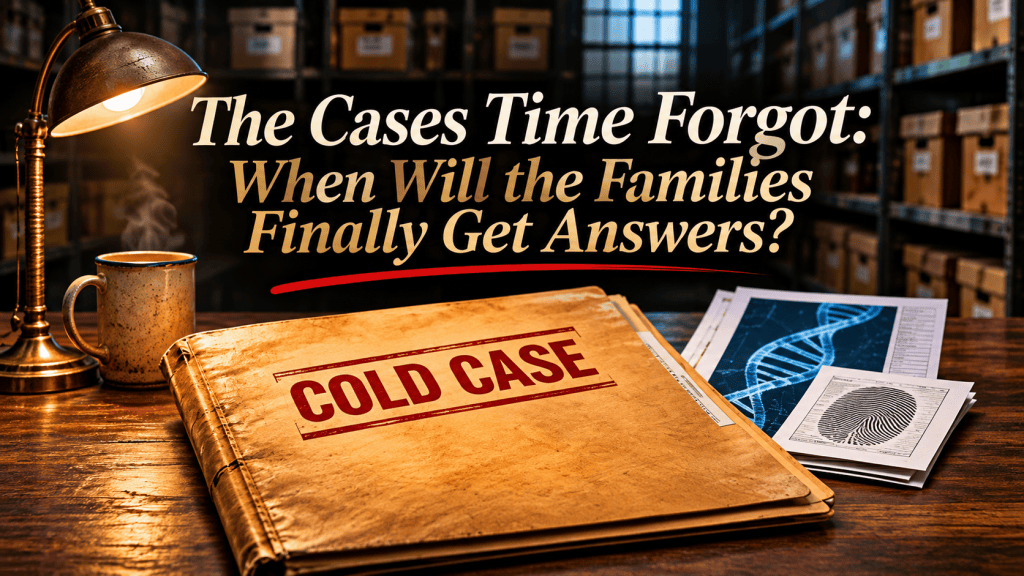
And somewhere, perhaps in a police evidence room, a box containing the very clue they have spent decades praying for may still be sitting on a shelf.
I often find myself thinking about the families behind unsolved cases. Not just the ones featured in documentaries or discussed on television, but the thousands whose stories have never made national headlines.
The mothers who still cry themselves to sleep. The fathers who wonder whether they missed something. The brothers and sisters who have grown older while the person they loved remains forever the age they were when they disappeared or were murdered.
I wonder how many families have spent decades waiting for a telephone call that never came.
And how many of those calls might finally be possible with the technology we have today.
According to historical homicide data compiled by the Murder Accountability Project and published by Project: Cold Case, more than 350,000 homicides in the United States went uncleared between 1965 and 2024. That figure is a cumulative historical estimate, not a precise count of cases still awaiting investigation today.
Even with that distinction, the number is staggering.
Hundreds of thousands of lives, countless unanswered questions, and an unimaginable number of families affected.
There was a time when investigators had little more than fingerprints, witness statements, photographs, and whatever physical evidence they could collect. DNA testing did not become available to criminal investigators until the 1980s.
Today, we have sophisticated DNA testing, forensic investigative genetic genealogy, improved fingerprint technology, and databases capable of connecting information across jurisdictions.
Evidence that once revealed nothing may now tell an entirely different story.
Think about Joseph Augustus Zarelli.
In 1957, the body of a little boy was discovered in Philadelphia. For decades, he was known simply as the Boy in the Box. Investigators worked tirelessly to identify him, but the years passed without an answer.
Then, in December 2022, authorities announced that advances in DNA analysis and forensic genetic genealogy had finally given him back his name.
Joseph Augustus Zarelli.
He was only four years old.
For 65 years, the world had known him by the circumstances of his death rather than the name he was given at birth.
His murder remains unsolved, but his identification was an extraordinary breakthrough. It proved that even after more than half a century, modern technology could uncover answers that once seemed impossible.
And that brings me to a question I cannot seem to shake.
How many more Josephs are out there?
How many unidentified people are waiting for their names to be restored? How many unsolved murders contain evidence that has never been examined using today’s technology?
I understand that not every case can be solved. Evidence deteriorates, disappears, or becomes contaminated. Witnesses die. Memories fade. Sometimes there simply isn’t enough information to determine what happened.
Law enforcement agencies also face enormous responsibilities. Detectives must investigate new crimes while older cases continue to demand attention. Forensic testing costs money, experienced investigators are needed, and laboratories have limited resources.
But understanding those challenges doesn’t mean we should stop asking whether more can be done.
The National Institute of Justice has documented the potential of advances in DNA technology to uncover information from previously unproductive evidence. Federal programs have also provided funding to help investigators and prosecutors pursue violent cold cases using DNA evidence.
Those efforts deserve recognition, as do the investigators, scientists, genealogists, and countless others who continue working long after public attention has faded.
But I can’t help wondering whether we could find ways to give them more help.
And this is where I might make a few internet detectives a little uncomfortable.
We live in a world where people spend hours researching cold cases online. They study timelines, examine public records, compare photographs, and discuss theories. Some have legitimate investigative experience. Others are simply interested in true crime.
And then there are those who have apparently solved six murders, identified three suspects, and uncovered an international conspiracy before finishing their morning coffee.
You know exactly the ones I’m talking about.
But joking aside, what if some of that enthusiasm could be put to good use?
What if more people could receive proper training and volunteer their skills under the supervision of qualified investigators?
I’m certainly not suggesting unrestricted access to evidence or encouraging people to investigate private citizens on their own. We don’t need innocent people being publicly accused because someone watched a documentary and decided they knew more than the detectives.
Families have already endured enough without becoming subjects of online harassment and speculation.
But there are people with valuable skills who might genuinely want to help.
Retired detectives. Genealogists. Historians. Archivists. Researchers. People who understand how to organize records, trace family histories, and recognize connections in old documents.
With appropriate training, confidentiality protections, and professional oversight, perhaps more of those skills could support cold-case investigations.
And there are already examples of this kind of collaboration.
The DNA Doe Project works with skilled volunteers and law enforcement agencies to help identify unidentified human remains through investigative genetic genealogy.
It demonstrates that people outside traditional law enforcement can make meaningful contributions when their work is conducted responsibly.
Imagine what additional partnerships might accomplish.
Old case files could be digitized and organized. Evidence could be reviewed for new forensic testing opportunities. Investigators might receive additional assistance pursuing leads that have waited years for attention.
Most importantly, families might finally receive the telephone calls they have spent decades hoping for.
Because I think that’s what we sometimes forget when discussing cold cases.
These aren’t puzzles created for our entertainment.
They are people’s lives.
They are children who never came home. Mothers and fathers taken from their families. Brothers, sisters, grandparents, friends, and neighbors whose absence changed the lives of everyone who loved them.
And while the rest of the world continues moving forward, those families are often left standing in the same moment.
Waiting.
Wondering.
Hoping.
Some have spent more years searching for answers than they were ever given with their loved ones. Others have passed away without ever knowing what happened.
That thought breaks my heart.
I think about how much technology has changed in my own lifetime. Things that once seemed impossible have become ordinary parts of everyday life. We can communicate across the world in seconds, access enormous amounts of information, and use science to uncover details that would have remained hidden just a generation ago.
Surely those advancements deserve to be used wherever they can responsibly help bring answers to families.
I’m not suggesting every evidence room contains the missing piece of a mystery, nor am I suggesting investigators haven’t worked tirelessly on cases that remain unsolved.
But I do believe we should continue asking how many cases might benefit from renewed attention, additional funding, better resources, and today’s technology.
Because a case doesn’t become less important simply because it becomes old.
A child who disappeared in 1975 matters just as much as a child who disappears today. A woman murdered in 1982 deserves justice just as much as someone whose life was taken yesterday. And a family that has waited 40 years deserves compassion just as much as a family beginning that terrible journey now.
Time doesn’t erase love.
It doesn’t erase grief.
And it certainly doesn’t erase the need for answers.
I hope we continue investing in technology that can help solve these cases, supporting the investigators doing this difficult work, and exploring responsible opportunities for trained volunteers to contribute their knowledge and time.
Above all, I hope we never become so accustomed to hearing about unsolved cases that we forget the human beings behind them.
Because somewhere tonight, a mother is still waiting.
Somewhere, a father is still praying.
Somewhere, a family is still holding on to hope.
And perhaps, somewhere in an evidence room, a clue is waiting for someone to look at it again.
Maybe we cannot bring back the people who were taken. But perhaps, with compassion, determination, and the extraordinary technology now available to us, we can bring more families the answers they have waited far too long to receive.
—Guyton







Leave a Reply