November 10, 1619.
Somewhere in Germany, as winter settled over a continent already troubled by war, a young Frenchman found himself alone with his thoughts.
His name was René Descartes. He was only 23 years old, and although history would eventually remember him as one of the most influential philosophers of all time, he had not yet become the man whose ideas would help transform the way people understood knowledge, mathematics, and the world around them.
For the moment, he was simply a young man searching for answers.
Europe was in the early years of the Thirty Years’ War, and Descartes had been traveling in connection with military service. In his later writings, he recalled how the arrival of winter had left him spending his days alone in a room warmed by a stove, free from the distractions of everyday life.
There, he devoted himself to thinking.
He questioned what he had been taught, considered the relationship between mathematics and philosophy, and wondered whether there might be a more dependable way of understanding the world.
And then, on the night of November 10, something extraordinary reportedly happened.
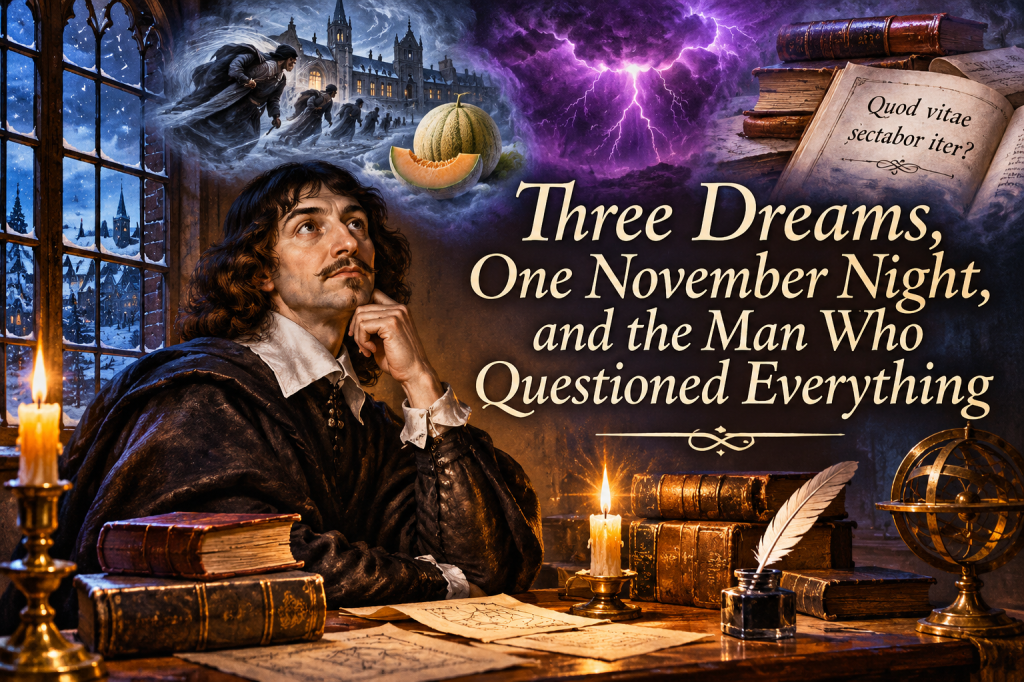
Descartes experienced three dreams.
Not three ordinary dreams that disappeared from memory by morning, but three experiences so vivid and unsettling that he would interpret them as signs pointing toward his future.
The first began with fear.
In his dream, Descartes found himself walking along a street surrounded by frightening figures. His body felt strangely weak, particularly on his right side, and he struggled to remain upright.
Then came the wind.
Not a gentle breeze, but a violent force that seemed determined to push him in directions he did not wish to go. He stumbled and turned, unable to maintain his balance while the people around him appeared to walk without difficulty.
He noticed a college and attempted to make his way toward its chapel, hoping to find a place to pray. But even that simple journey became a struggle.
The wind continued to interfere with his movements.
And then, in the middle of this disturbing experience, something almost comically unexpected happened.
Someone mentioned a gift.
A melon.
Not just any melon, apparently, but one brought from a foreign country.
Of all the things that might appear in a terrifying dream filled with shadows, weakness, and violent winds, there was suddenly a mysterious melon.
Four centuries later, it remains one of the strangest details in the account.
Descartes eventually awakened, deeply disturbed by what he had experienced.
According to the story preserved by his biographer, he feared that an evil spirit might have been troubling him. He prayed and spent time reflecting on the dream before returning to sleep.
But the night was far from over.
His second dream was shorter and perhaps even more startling.
He believed he heard an enormous crashing sound, something resembling a tremendous clap of thunder.
The noise frightened him awake.
When he opened his eyes, he reportedly perceived bright sparks or flashes of light scattered around the room.
Imagine waking in the darkness of a seventeenth-century winter night, already unsettled by one frightening dream, only to experience what seemed like an explosion of sound followed by mysterious flashes of light.
Descartes attempted to make sense of what he had experienced.
Modern researchers have suggested possible explanations involving sleep-related phenomena. One medical paper even examined whether the episode might resemble what is now called exploding head syndrome, a condition in which a person perceives a sudden loud noise while falling asleep or waking.
But nobody can diagnose a man who lived more than 400 years ago from a secondhand historical account.
We can examine the possibilities, but we cannot know exactly what happened.
Eventually, Descartes returned to sleep.
And then came the third dream.
This one was different.
There were no terrifying figures, no violent winds, and no thunderous sounds.
Instead, he found himself looking at books.
One appeared to be a dictionary or encyclopedia. Another was a collection of poetry.
As he examined the poetry, a particular Latin question captured his attention.
Quod vitae sectabor iter?
What path in life shall I follow?
The words came from a poem by Ausonius, an ancient Roman poet whose writings had survived through the centuries.
Of everything Descartes might have encountered in his dreams that night, perhaps nothing could have been more fitting.
Here was a young man who had spent his days questioning knowledge, examining the world, and searching for a direction in life.
And now, in the middle of a dream, he was confronted with the very question that seemed to occupy his waking thoughts.
What path should he follow?
The dream also included another mysterious detail. A stranger drew his attention to a poem associated with the Latin words Est et Non, meaning “Yes and No.” Descartes searched through the poetry collection, attempting to find the passage.
Books appeared, disappeared, and changed before him.
According to the surviving account, he even began interpreting parts of the dream while he was still asleep.
He understood the dictionary as representing the sciences and the poetry as reflecting wisdom and imagination.
To Descartes, the third dream seemed to offer something the first two had not.
Direction.
He believed the dreams carried a message about his intellectual future, encouraging him to pursue knowledge and seek a deeper understanding of truth.
Whether the dreams had any meaning beyond the workings of his own mind is something history cannot establish.
What we do know is that Descartes considered them important.
And that is where this story becomes even more fascinating.
The man who would become famous for questioning assumptions and demanding a rational foundation for knowledge had experienced something intensely personal that he interpreted through symbolism, faith, and imagination.
He was searching for certainty, yet one of the most memorable episodes of his early life was filled with uncertainty.
There is another mystery surrounding that November night.
Descartes recorded an account of the experience in writings associated with a notebook known as Olympica.
But the original manuscript no longer survives.
Much of what we know about the dreams comes from a biography published in 1691 by Adrien Baillet, more than 70 years after the events reportedly occurred.
Baillet had access to material that historians can no longer examine in its original form. Other early notes associated with Descartes were copied by the philosopher Gottfried Wilhelm Leibniz, helping preserve portions of his intellectual development.
Still, we cannot open Descartes’s original notebook today and read his complete account exactly as he wrote it.
We are left with a remarkable historical narrative, preserved through later writings, and the knowledge that the man at its center considered the experience significant.
Over the following years, Descartes continued his intellectual journey.
In 1637, he published Discourse on the Method, a work that helped establish his reputation as a major philosophical thinker. His mathematical contributions, particularly the relationship between algebra and geometry, would also become enormously influential.
And his famous statement, “I think, therefore I am,” would become one of the most recognizable expressions in the history of philosophy.
But those achievements did not simply appear overnight because of three dreams.
They developed through years of study, reflection, argument, and intellectual work.
The dreams were part of the story Descartes told about his search for knowledge, not a substitute for the effort that followed.
And perhaps that is what I find most interesting.
We often remember historical figures for what they accomplished, but rarely stop to consider the uncertainty they may have experienced before becoming the people history remembers.
We know Descartes as a philosopher.
We know his ideas influenced generations of thinkers.
We know his name appears in textbooks centuries after his death.
But on that November night in 1619, he was still a young man trying to determine what he was meant to do with his life.
And isn’t that something we can all understand?
Most of us have experienced moments when we questioned the direction we were taking. Perhaps we wondered whether we had chosen the right career, followed the right opportunities, or overlooked something important along the way.
Sometimes those questions arrive during major turning points.
Other times, they appear quietly, when the house is still and we are alone with our thoughts.
We may never experience three extraordinary dreams like those Descartes described. We may never wake to imagined thunder or find ourselves searching through mysterious books for an answer.
But we have probably all asked ourselves some version of the question he encountered.
More than four centuries have passed since that November night.
The wars of Descartes’s lifetime have become chapters in history books. The world he knew has changed beyond recognition. The scientific and philosophical ideas he helped develop have continued to evolve, and generations of scholars have examined, challenged, and expanded upon his work.
Yet the question from his third dream remains remarkably familiar.
Perhaps that is why I find this story so captivating.
Not because we can prove the dreams were prophetic. Not because we can explain every strange image or determine exactly what happened in that room.
But because behind one of history’s most influential minds was a young man searching for his purpose.
And somewhere between the frightening shadows, the mysterious thunder, the unexpected melon, and the pages of an imaginary book, he believed he had glimpsed a direction worth pursuing.
History remembers what he accomplished.
But on November 10, 1619, his future was still unwritten.
And perhaps the most extraordinary part of the entire story is that a question asked in a dream more than 400 years ago is one we are still asking today.
What path in life shall I follow?
—Guyton







Leave a Reply