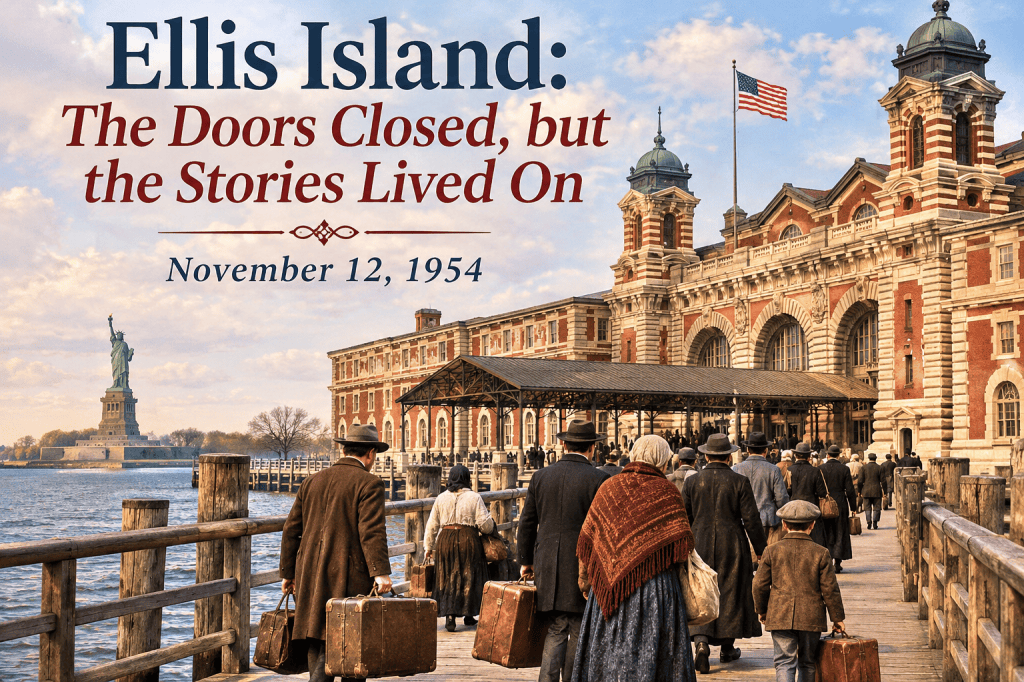
November 12, 1954.
In New York Harbor, a place that had witnessed millions of arrivals was preparing to close its doors for the final time.
For more than six decades, Ellis Island had stood between the lives people left behind and the uncertain futures they hoped to build in America.
Some arrived carrying suitcases. Others carried little more than the clothing they wore. Many spoke languages unfamiliar to the officials who greeted them. Some had traveled with their families, while others crossed an ocean alone.
They came with different histories, different circumstances, and different dreams.
Some were fleeing poverty. Others were escaping persecution or searching for opportunities they believed might never be possible in their homelands.
And for millions of them, Ellis Island became one of the first places they encountered in their new country.
I often wonder what it must have felt like to see the Statue of Liberty rising above New York Harbor after spending days or weeks aboard a ship.
Imagine standing on the deck, surrounded by strangers, looking toward a country you had never seen before.
Perhaps you were excited.
Perhaps you were frightened.
Perhaps you were wondering whether the journey had been worth everything you had left behind.
Or perhaps you were simply hoping that someone waiting on the other side would recognize your face.
Ellis Island officially opened as a federal immigration station on January 1, 1892.
The first person processed was Annie Moore, a teenage girl from Ireland who arrived with her two younger brothers.
She had crossed the Atlantic to reunite with her parents, who were already living in New York.
Imagine being that young, traveling across an ocean, and becoming the first person to pass through a place that would eventually become part of the histories of millions of American families.
Of course, Annie could not have known that her arrival would one day be remembered in history books.
To her, it was simply the beginning of another chapter in her life.
And that is something I think we sometimes forget when we study immigration.
We see photographs of crowded ships and long lines of people waiting to be inspected. We read statistics about millions of arrivals. We study laws, dates, and government policies.
But every person standing in those lines had a name.
Every person had a story.
And every person had a life that existed long before they arrived in America.
During its busiest years, Ellis Island processed extraordinary numbers of immigrants. In 1907 alone, more than one million people passed through the station.
But arriving in New York Harbor did not necessarily mean a person would be admitted into the United States.
Immigrants traveling in steerage, or third class, were generally brought to Ellis Island for medical and legal inspections. First- and second-class passengers were often inspected aboard their ships instead.
Inside the enormous Registry Room, immigrants waited to answer questions about their identities, occupations, destinations, and circumstances.
Medical examinations were conducted to identify illnesses or conditions that might prevent admission under the immigration laws of the time.
For most, the process lasted only a few hours.
But for others, the experience was far more difficult.
Some were detained for additional examinations. Families could be separated while officials decided whether someone would be allowed to enter.
And a small percentage were ultimately refused admission and sent back across the ocean.
Imagine making such a journey, believing you were beginning a new life, only to discover that you might never be allowed to leave the island.
That is why Ellis Island became known by two very different names.
The Island of Hope.
And the Island of Tears.
For some, it represented opportunity and reunion.
For others, it became a place of fear, separation, and disappointment.
And both experiences are part of its history.
The immigration station itself changed considerably over the years.
In 1897, a devastating fire destroyed its original wooden buildings. Fortunately, everyone was evacuated, but the station had to be rebuilt.
A new main building opened in December 1900, constructed with materials intended to provide greater protection against fire.
That magnificent building, with its great halls and imposing architecture, would become one of the most recognizable symbols of American immigration.
But the history of Ellis Island was never simply a story of open doors.
As immigration increased, so did political arguments over who should be allowed to enter the country.
Restrictions became more severe during the early twentieth century, particularly with the immigration quota laws enacted in 1921 and 1924.
Those laws dramatically reduced immigration from many parts of the world and changed the way newcomers were processed.
After 1924, Ellis Island was no longer the primary gateway it had once been.
Its role shifted increasingly toward detention, deportation proceedings, and other government functions.
During both world wars, parts of the island were used for military purposes. During World War II, people classified as enemy aliens, including some German, Italian, and Japanese nationals, were detained there.
The island that had welcomed millions also became a place where people could be held against their will.
That complicated history deserves to be remembered, too.
Because understanding the past means acknowledging both its hopes and its hardships.
By the 1950s, Ellis Island had become an aging facility whose original purpose had largely disappeared.
Immigration procedures had changed, and the enormous buildings were increasingly expensive to maintain.
Finally, on November 12, 1954, the last remaining detainees were removed.
Ellis Island officially closed.
After more than 60 years, the great immigration station had reached the end of an extraordinary chapter in American history.
Imagine those enormous halls standing quiet.
No crowds waiting for inspections.
No families searching for familiar faces.
No nervous travelers wondering what questions they might be asked.
The buildings remained, but the people whose voices had once filled them were gone.
And yet their stories did not disappear.
They continued in homes, neighborhoods, businesses, churches, schools, and communities across America.
They continued through children, grandchildren, and generations who would grow up hearing stories about where their families had come from.
And sometimes, those stories become part of our own lives in ways we never expected.
For me, Ellis Island holds a special connection.
My great-grandparents, Otto and Nellie Wieland, have their names commemorated on the American Immigrant Wall of Honor at Ellis Island.
Otto came from Germany, and although I do not yet know every detail of their family’s journey to America, knowing their names are preserved there means something special to me.
It makes me wonder how many other families have connections to Ellis Island without knowing the stories behind them.
How many names on that wall belong to people whose descendants are still searching for answers?
How many families have photographs tucked away in old albums, letters written in languages they cannot read, or documents containing details that have been forgotten with time?
How many stories are waiting to be rediscovered?
After Ellis Island closed, its buildings deteriorated for years.
In 1965, President Lyndon B. Johnson incorporated the island into the Statue of Liberty National Monument, recognizing its historical importance.
A major restoration eventually followed, and in September 1990, the restored main immigration building opened to the public as a museum.
The halls that had once welcomed immigrants were given a new purpose.
They became places where future generations could learn about the people who passed through them.
Today, visitors can walk through the Registry Room, explore exhibits, examine historical photographs, and research family immigration records.
The American Immigrant Wall of Honor also commemorates immigrants from many different generations and backgrounds, including people who entered the United States through ports other than Ellis Island.
It stands as a reminder that the history of immigration is not confined to one building or one harbor.
It is woven into the stories of families throughout the country.
More than seven decades have passed since Ellis Island closed its doors.
The ships that once carried millions of hopeful travelers have long since disappeared from the harbor. The officials who examined their papers are gone. The voices that filled the Registry Room belong to another era.
But the lives that began new chapters there helped shape generations that followed.
And perhaps that is what I find most remarkable.
A place can close.
A building can fall silent.
An era can come to an end.
But the stories of the people who passed through it continue long afterward.
On November 12, 1954, Ellis Island closed its doors as an immigration station.
Yet its place in American history was far from finished.
Because behind those millions of arrivals were people who loved, struggled, worked, raised families, and hoped to leave something meaningful for the generations who came after them.
And sometimes, all it takes is discovering a familiar name on a wall to remind us that history is not always something that happened to strangers.
Sometimes, history is part of our own family.
—Guyton







Leave a Reply