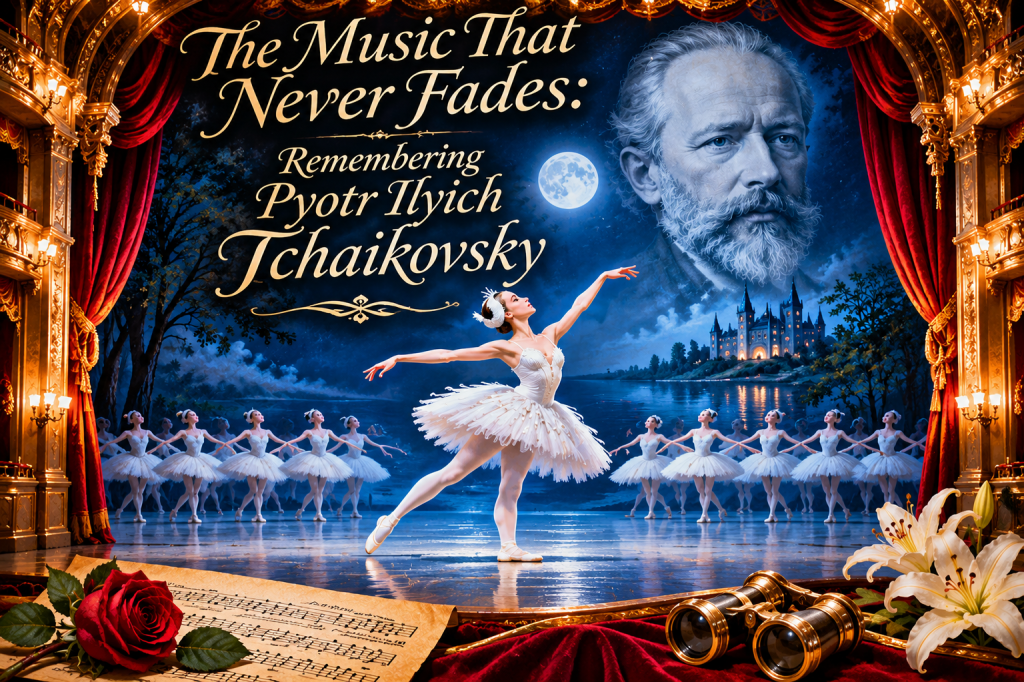
Some people leave behind photographs. Others leave behind books, paintings, or words that continue to inspire generations long after they’re gone.
And then there are those extraordinary individuals who leave behind music.
Music that can transport us to another time, stir emotions we cannot quite explain, and awaken memories we didn’t even realize we were holding onto.
For me, one of those individuals will always be Pyotr Ilyich Tchaikovsky.
Long before I understood the history of classical music, the complexities of composing a symphony, or the remarkable life of the man behind some of the world’s most beloved ballets, I had already fallen in love with his work.
And that love began when I was a little girl.
Before I was even eight years old, my grandmother had taken me to see Swan Lake twice.
I can still appreciate what a wonderful gift those experiences were. There was something about the elegance of the ballet, the beauty of the music, and the way an entire story could unfold without anyone needing to speak that captured my imagination.
I didn’t need to understand every note or every movement to know that I was witnessing something extraordinary.
I simply loved it.
Those performances helped create a lifelong appreciation for ballet and, perhaps even more importantly, introduced me to the music of a composer whose work would remain close to my heart.
Then, when I was eight years old, I saw The Nutcracker during an elementary-school field trip.
It became a tradition. Every year throughout elementary school, we went to see The Nutcracker, and every year, I looked forward to experiencing that wonderful world of music and dance again.
For some children, a school field trip might be remembered for the bus ride, the excitement of being away from the classroom, or the chance to spend an afternoon with friends.
For me, those trips became part of something much more meaningful.
They strengthened a love for classical music that had already begun taking root.
And all these years later, The Nutcracker remains one of those performances I never grow tired of seeing.
There’s something beautiful about that, isn’t there?
A composer who lived more than a century before I was born had somehow become part of my childhood, my memories, and eventually my family’s story.
Pyotr Ilyich Tchaikovsky was born on May 7, 1840, in Votkinsk, Russia.
From an early age, he demonstrated a remarkable sensitivity to music. He began studying piano as a young child, and although his family initially expected him to pursue a more conventional profession, music continued to call to him.
His childhood wasn’t without sorrow.
When Tchaikovsky was fourteen, his mother died of cholera, a devastating loss that deeply affected him.
He would eventually study law and enter government service, but the life expected of him wasn’t the life his heart truly wanted.
Music remained his passion.
In the early 1860s, he began studying at the newly established Saint Petersburg Conservatory, where he received formal training that helped shape his future as a composer.
He later taught at the Moscow Conservatory, developing his skills while working toward a career that would ultimately make his name known throughout the world.
But his success didn’t arrive without difficulties.
Like many artists, Tchaikovsky experienced criticism, uncertainty, and personal struggles. His life included periods of emotional turmoil, complicated relationships, and moments when his own sensitivity seemed to weigh heavily upon him.
Yet through it all, he continued composing.
And what extraordinary music he gave the world.
His compositions possessed an emotional richness that could make an orchestra seem to speak directly to the human heart.
There was tenderness in his melodies, drama in his orchestration, and an unmistakable ability to transform human emotions into sound.
Love, sorrow, longing, joy, fear, and hope all seemed to find their way into his work.
Among his many compositions were symphonies, concertos, operas, orchestral pieces, and three full-length ballets that would become cornerstones of classical dance: Swan Lake, The Sleeping Beauty, and The Nutcracker.
And although those ballets are celebrated around the world today, their journeys to greatness weren’t always easy.
Swan Lake, which premiered in Moscow in 1877, didn’t immediately receive the admiration it enjoys today.
The original production faced criticism, and the ballet’s eventual transformation into a masterpiece of the classical repertoire owed much to later choreography by Marius Petipa and Lev Ivanov.
That celebrated revival premiered in 1895, after Tchaikovsky’s death.
Just imagine that for a moment.
A man creates music of extraordinary beauty, yet doesn’t live to witness the full extent of the admiration it will eventually receive.
Today, Swan Lake is recognized as one of the greatest classical ballets ever composed.
Its haunting melodies accompany the story of Odette, a princess transformed into a swan, and Prince Siegfried, whose love becomes entangled in deception and tragedy.
The music is capable of conveying heartbreak and beauty in the very same breath.
Perhaps that’s one reason it has remained so dear to me.
Even as a little girl, I understood that the music was telling a story of its own.
Then came The Sleeping Beauty, which premiered in 1890, followed by The Nutcracker in 1892.
Based on Alexandre Dumas’ adaptation of E. T. A. Hoffmann’s The Nutcracker and the Mouse King, The Nutcracker introduced audiences to a magical world of childhood imagination, enchanted toys, dancing snowflakes, and extraordinary adventures.
Its music would eventually become inseparable from the Christmas season.
The delicate beauty of the Dance of the Sugar Plum Fairy, the sweeping Waltz of the Flowers, and the enchanting melodies woven throughout the ballet have delighted audiences for generations.
Yet for me, The Nutcracker has always been more than a holiday tradition.
It carries memories of being eight years old, sitting in a theater, and experiencing that sense of wonder that only a truly beautiful performance can create.
And every time I return to it, some part of that childhood excitement returns with me.
But my love for Tchaikovsky didn’t remain confined to childhood.
It followed me into adulthood and eventually into motherhood.
When I was pregnant with my son, I used to place headphones against my belly and play Tchaikovsky’s music so he could hear it while he was still in the womb.
I loved the thought of sharing something that had brought me so much happiness throughout my life with my child before he was even born.
The same music that my grandmother had introduced me to when I was a little girl was now music I wanted to share with the next generation.
And perhaps that is one of the most beautiful things about music.
It doesn’t belong to just one moment in our lives.
It travels with us.
It becomes part of our memories, our traditions, and the ways we connect with the people we love.
Tchaikovsky himself could never have imagined every life his music would touch.
He couldn’t have known about a grandmother taking her young granddaughter to the ballet generations later, or a little girl eagerly awaiting her annual school trip to see The Nutcracker.
And he certainly couldn’t have imagined that same little girl growing into a mother who would one day place headphones against her pregnant belly to share his compositions with her son.
Yet that is precisely what makes his legacy so remarkable.
His music continued living long after he was gone.
And the final chapter of his own life was as moving as many of the compositions he left behind.
In October 1893, Tchaikovsky conducted the premiere of his Sixth Symphony, commonly known as the Pathétique, in Saint Petersburg.
It was a deeply emotional work, distinguished by an unusual and profoundly sorrowful final movement.
Unlike the triumphant endings audiences might expect from a grand symphony, the Pathétique gradually fades into silence.
Only nine days after conducting its premiere, Tchaikovsky was dead.
He passed away on November 6, 1893, at the age of fifty-three.
Cholera was reported as the cause of his death, although alternative theories about the circumstances have circulated over the years.
The timing of his death, coming so soon after the premiere of such an emotionally powerful symphony, has encouraged generations of listeners to search for deeper meaning in his final composition.
But we should be careful not to confuse the emotions expressed through his music with certainty about his private intentions.
What we do know is that the world lost an extraordinary composer whose influence would continue to grow long after his final days.
He never witnessed the celebrated 1895 revival of Swan Lake.
He never saw the countless generations of dancers who would perform his ballets on stages around the world.
He never experienced the way The Nutcracker would become a cherished annual tradition for families.
And he never knew how many children would hear his music for the first time and fall in love with something that would remain with them for the rest of their lives.
Yet here we are, more than a century later, still listening.
Still attending the ballet.
Still discovering something new in compositions that have been performed thousands upon thousands of times.
There are countless remarkable composers throughout history, and each has contributed something meaningful to the world of music.
But Tchaikovsky has always held a particularly special place in my heart.
Perhaps because his music was among the first to teach me that beauty doesn’t always require words.
Perhaps because it reminds me of my grandmother and those early visits to the ballet.
Perhaps because it takes me back to those elementary-school field trips, when an ordinary school day could become an afternoon filled with wonder.
Or perhaps because, years later, it became something I could share with my own child.
Whatever the reason, his music has remained a constant thread running through different chapters of my life.
And on November 6, the anniversary of his passing, I find myself thinking not only about the extraordinary composer the world lost in 1893, but also about everything he left behind.
The music.
The memories.
The countless moments of beauty that continue unfolding every time an orchestra begins to play.
I often wonder whether artists truly understand how far their work may travel or how deeply it may touch the lives of people they will never meet.
A melody written in nineteenth-century Russia can become a treasured childhood memory in another country, another century, and another life entirely.
It can remind someone of a beloved grandmother.
It can turn a school field trip into a lifelong tradition.
It can become a gift passed from a mother to her child.
And long after the composer has taken his final bow, the music continues.
So today, I remember Pyotr Ilyich Tchaikovsky with gratitude and admiration.
Not simply because he was one of history’s greatest composers, but because his music became part of my own story.
And I will always be grateful to my grandmother for introducing me to a world of beauty that has never stopped bringing me joy.
Because some music doesn’t simply fade away when the final note is played.
It stays with us.
It becomes part of who we are.
And sometimes, if we’re fortunate enough, we get to pass that beauty along to another generation.
— GUYTON





Leave a Reply