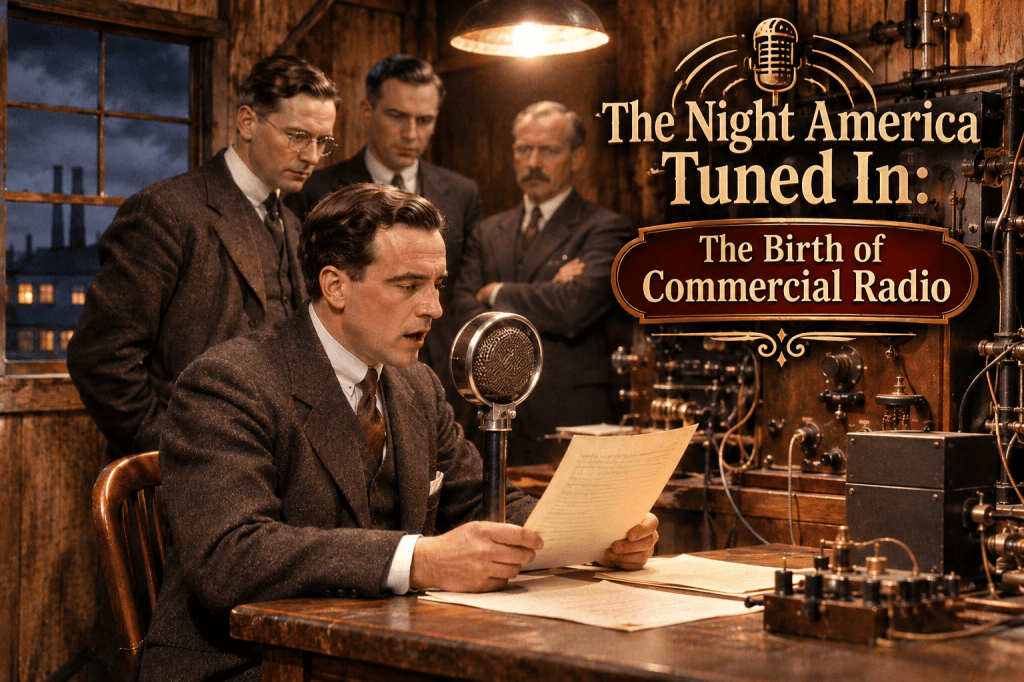
Imagine a November evening in 1920. The sun has disappeared beyond the rooftops, families are settling into their homes, and across America, people are waiting to learn who will become the next president of the United States.
For generations, newspapers had been one of the primary ways Americans received important news. Election results traveled by telegraph and telephone to newspaper offices, where they could be printed and distributed to the public. But on this particular evening, something remarkable was happening in Pennsylvania.
Instead of waiting for the next edition of the newspaper, a small number of Americans were about to hear the election results spoken directly into their homes.
And the voices weren’t coming from someone sitting across the room.
They were traveling through the air.
On November 2, 1920, a little broadcasting station associated with the Westinghouse Electric and Manufacturing Company in East Pittsburgh transmitted the results of the presidential election between Republican Warren G. Harding and Democrat James M. Cox.
The station would become famous as KDKA, and its election-night broadcast would earn a lasting place in American history.
But the story of that evening actually began years earlier, with curious inventors, experimental equipment, and a growing fascination with the possibility of sending the human voice across great distances without wires.
By the early twentieth century, wireless communication was already transforming the world. Radio signals had been used to transmit messages, particularly through Morse code, and inventors were experimenting with sending voices and music through the air.
Among those fascinated by this technology was Frank Conrad, a Westinghouse engineer who conducted radio experiments from his home in Wilkinsburg, Pennsylvania.
Conrad wasn’t working in a grand broadcasting studio. His experimental radio station operated from a garage, where he spent time improving equipment and experimenting with transmissions.
Eventually, he began broadcasting recorded music, attracting the attention of amateur radio enthusiasts who listened through their receiving equipment.
It might seem ordinary to us today, but imagine hearing music coming through a set of headphones when there was no record player or musician anywhere nearby.
For those early listeners, it must have felt like a glimpse into the future.
Conrad’s experiments helped demonstrate that radio could become something more than a method of exchanging messages between individual operators. It could deliver information and entertainment to an audience.
That possibility caught the attention of Westinghouse.
Harry P. Davis, a company executive, recognized the potential of a business built around broadcasting. If people could listen to music and news over the radio, they might want to purchase receivers of their own.
And what better way to demonstrate this extraordinary technology than by broadcasting the results of a presidential election?
The company moved quickly to establish a station in time for Election Day.
A small wooden shack was constructed on the roof of a Westinghouse factory building in East Pittsburgh. Inside, the broadcasting equipment was a far cry from the elaborate studios that would eventually become familiar to radio audiences.
There were no glamorous broadcasting booths or famous radio personalities waiting behind polished microphones.
Instead, there was a small team of men, experimental technology, and an ambitious idea.
On the evening of November 2, 1920, the station began transmitting election returns received by telephone from the Pittsburgh Post.
Leo Rosenberg served as announcer, reading the information aloud for listeners who had tuned in.
Warren G. Harding would emerge victorious over James M. Cox, but something else was happening that evening that would ultimately prove just as significant to the history of American communication.
People were hearing news as it arrived, rather than waiting to read it the following day.
And somewhere beyond that little rooftop shack, listeners were discovering a new relationship with the world around them.
The audience was tiny compared with what radio would eventually attract. Historical estimates commonly suggest around a thousand people listened, although nobody could know precisely how many receivers were tuned in.
The broadcasters themselves were eager to discover how far their signal traveled. They asked listeners to report whether they could hear the transmission and how clearly it was being received.
Imagine the excitement of receiving those responses.
A voice transmitted from a rooftop in Pennsylvania had reached people the broadcasters couldn’t see, in homes and gathering places miles away.
Radio had already existed before that evening, and other pioneers had conducted broadcasts of their own. Some stations had even established programming before KDKA’s famous election-night transmission.
So November 2, 1920, wasn’t the day radio was invented, nor was it the first time a human voice traveled over the airwaves.
What made the occasion extraordinary was the demonstration of radio’s potential as a commercially organized broadcasting service, designed to reach a public audience.
It helped usher in a new chapter.
And once Americans began discovering what radio could offer, there was little turning back.
Throughout the 1920s, radio stations multiplied across the country. Families purchased receivers, businesses recognized new opportunities, and broadcasters experimented with programs that went far beyond election results.
Music filled living rooms. Sporting events reached people who couldn’t attend the games. Religious services, educational programs, news reports, and dramatic performances found audiences far beyond their original locations.
Eventually, radio became a gathering place of its own.
Families pulled their chairs closer to their receivers, children listened to adventures unfolding through sound alone, and entire communities could share the same news or entertainment without ever leaving home.
There was something wonderfully intimate about it.
A broadcaster could be hundreds of miles away, yet the voice coming through the speaker might feel as familiar as that of a neighbor.
Of course, radio’s rapid growth also brought challenges. Stations competed for space on crowded frequencies, broadcasters needed ways to pay for programming, and the government faced the increasingly complicated task of regulating the airwaves.
Advertising, broadcasting networks, and new regulations would help shape the industry as it matured.
By the end of the decade, radio had become an established part of American life.
It had changed how people learned about the world, how politicians communicated with voters, and how families spent their evenings.
In the years that followed, Americans would turn to radio for reassurance during difficult times, for updates during national emergencies, and for entertainment that brought laughter, suspense, and music into their homes.
It would become a powerful companion through the Great Depression, World War II, and countless moments of national celebration and sorrow.
And long before televisions became common household fixtures, long before computers connected people across continents, and long before we carried the world’s information in our pockets, families gathered around radios to listen.
It’s remarkable to think that one of the defining developments in American mass communication can be traced, in part, to a modest wooden shack on a Pennsylvania rooftop.
On November 2, 1920, a handful of men set out to broadcast the results of an election.
What they helped demonstrate was something far greater.
They showed that a voice could reach beyond the walls of a room, beyond the streets of a city, and into the lives of people the speaker might never meet.
And in doing so, they helped open the door to a new age of communication.
One hundred and six years later, radio continues to inform, entertain, and connect listeners, even as the technology surrounding it has changed beyond anything those early pioneers could have imagined.
So the next time you turn on the radio, hear a familiar song, or listen to the news, consider that little rooftop shack and the people who dared to imagine what broadcasting might become.
Because sometimes, the most extraordinary chapters in history begin with a simple idea, a little ingenuity, and someone willing to see just how far a voice can travel.
— GUYTON




Leave a Reply