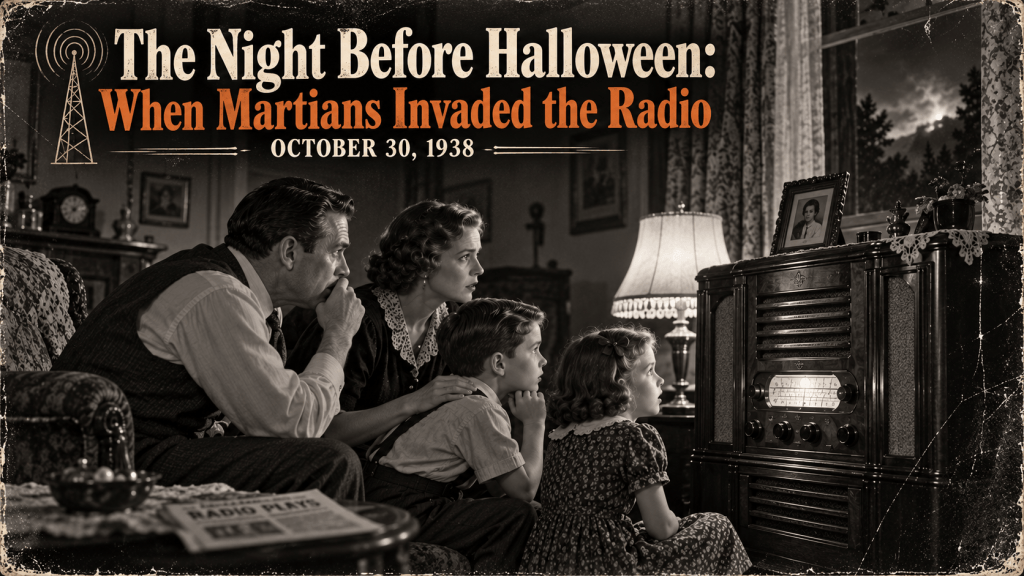
October 30, 1938.
It was a Sunday evening in America, and Halloween was just one day away.
Across the country, families were settling into their evening routines. Children were preparing for the excitement of Halloween, supper dishes were being cleared from kitchen tables, and radios were being switched on in living rooms.
In those days, the radio was more than a source of entertainment. It was a connection to the outside world. Families gathered around it for music, comedy, dramatic performances, and the latest news. When something important happened, Americans often learned about it through the voices coming from those wooden cabinets.
And on that particular Sunday evening, some listeners were about to hear something they would never forget.
At eight o’clock Eastern time, the Columbia Broadcasting System began its weekly program, The Mercury Theatre on the Air, directed by a remarkably talented 23-year-old named Orson Welles.
That night’s production was a dramatization of The War of the Worlds, the science-fiction novel written by H. G. Wells in 1898.
It was supposed to be an entertaining Halloween offering.
Instead, it would become one of the most infamous broadcasts in American history.
The program began with an announcement identifying the performance as a work of fiction. But what followed was unlike the conventional radio dramas audiences had grown accustomed to hearing.
Rather than simply telling a story, the production imitated a live radio broadcast.
Listeners heard the pleasant sounds of dance music, supposedly coming from a hotel ballroom in New York City. Then the music was interrupted.
An announcer reported unusual explosions on the planet Mars.
The music resumed.
Another bulletin followed.
Scientists were observing strange activity in the heavens.
Then came reports that an enormous object had fallen near Grovers Mill, New Jersey.
To someone listening from the beginning, the premise was part of a dramatic performance. But to someone turning the dial at just the wrong moment, the interruption might have sounded alarmingly real.
The fictional reports grew increasingly disturbing.
A correspondent described crowds gathering around the mysterious object. Something was moving inside it. The object began to open, and creatures unlike anything known on Earth emerged.
Then came the heat ray.
Within moments, the fictional scene descended into horror.
The invaders were no longer simply strange visitors from another planet. They were dangerous creatures equipped with terrifying weapons, and the reports suggested that human civilization was facing a catastrophe.
Military forces were supposedly responding. Communications were breaking down. Reports of destruction were arriving from across New Jersey.
And the voices delivering these fictional bulletins sounded remarkably convincing.
There were reporters, scientists, military personnel, and announcers, all portrayed by actors. The production used carefully timed interruptions, sound effects, and moments of silence to create the impression of an unfolding emergency.
At one point, a fictional radio correspondent described the destruction advancing toward New York City.
Imagine turning on your radio that evening, expecting music or a comedy program, and hearing a frightened voice describe an invasion apparently happening just a few states away.
There was no television news broadcast to consult. No internet to search. No mobile phone displaying instant updates.
For a listener who missed the introduction and failed to recognize the performance as fiction, uncertainty could become fear remarkably quickly.
And for some Americans, it did.
Telephone calls began reaching police departments, newspapers, and radio stations. Some listeners wanted to know whether the reports were true. Others contacted relatives to make sure they were safe.
There were people who became genuinely frightened.
But the extraordinary story did not end when the broadcast did.
In fact, another story was just beginning.
The following morning, October 31, newspapers across America carried dramatic accounts of what had supposedly happened.
Headlines described frightened citizens, frantic telephone calls, and a country thrown into confusion by reports of Martians invading Earth.
The idea was almost irresistible.
A Halloween radio performance had supposedly convinced an entire nation that creatures from another planet were attacking.
And for decades, that became the version of events most people remembered.
But was America really overcome by mass hysteria?
The historical evidence tells a more complicated story.
Although some listeners unquestionably mistook the dramatization for actual news, researchers have since challenged the idea that the broadcast caused widespread nationwide panic.
A contemporary telephone survey of approximately 5,000 households found that only about two percent were listening to the program. That finding raised an interesting question. If relatively few Americans had even heard the broadcast, how had the story of an entire nation gripped by panic become so widespread?
The broadcast also faced formidable competition.
On another network, ventriloquist Edgar Bergen and his famous dummy, Charlie McCarthy, were entertaining an enormous audience. Some listeners switched stations during that program and happened upon the Mercury Theatre performance after its opening explanation.
That timing helped create confusion for those who entered the story midway through.
But confusion was not universal, and neither was terror.
Many Americans enjoyed the program exactly as intended. Others who initially became concerned checked another station, looked for confirmation, or quickly realized that the invasion was imaginary.
Nevertheless, the newspapers had a sensational story on their hands.
At a time when radio was becoming an increasingly powerful competitor for audiences and advertising, the incident also provided newspapers with an opportunity to question whether broadcasters were behaving responsibly.
Some historians have suggested that this rivalry contributed to the exaggerated coverage.
Whatever the motivations behind individual reports, the legend grew.
The longer the story circulated, the more extraordinary it became.
What began as a frightening experience for a portion of the audience eventually entered American folklore as the night an entire country believed Martians had arrived.
But perhaps one of the most fascinating parts of this story is what ordinary Americans had to say afterward.
The Federal Communications Commission received hundreds of letters concerning the broadcast.
Some writers were furious. They believed the program had been irresponsible and demanded that something be done to prevent similar incidents.
Others defended the performers and argued that audiences should have recognized the production as entertainment.
One particularly interesting response came from Gastonia, North Carolina.
A man named M. B. Wales questioned whether punishing broadcasters for frightening listeners might also mean restricting other imaginative stories, including fairy tales.
His argument raised a question that remains relevant today.
Where should society draw the line between frightening entertainment and the responsibility of those presenting it?
The broadcast had been designed to entertain, but it also demonstrated just how persuasive a familiar form of communication could become when fiction borrowed the voice of authority.
There was another reason the performance resonated with some listeners.
In 1938, the world was already living beneath a shadow of uncertainty.
Europe was experiencing a deepening political crisis. Radio audiences had become accustomed to hearing urgent bulletins about international tensions and the possibility of war.
Against that backdrop, reports of a sudden, devastating attack did not necessarily sound as absurd as they might have during a more peaceful time.
The invaders were imaginary.
The anxiety of the era was not.
By the end of the performance, the fictional Martian invasion had reached its conclusion. The creatures that seemed capable of defeating humanity were ultimately destroyed by Earth’s microorganisms, just as in H. G. Wells’s original story.
Orson Welles returned to remind listeners that the program had been a Halloween entertainment.
The Martians had never existed.
Grovers Mill had not been invaded.
New York City was still standing.
And yet, something remarkable had happened.
A young director, a group of talented actors, and a cleverly constructed script had demonstrated the extraordinary power of radio storytelling.
Welles would go on to become one of the most celebrated filmmakers in history, directing Citizen Kane just a few years later. Howard Koch, who adapted the radio script, would eventually help write another Hollywood classic, Casablanca.
But neither man’s later accomplishments would erase the memory of that strange Sunday evening.
Eighty-eight years have now passed since the broadcast first interrupted the fictional dance music with reports of activity on Mars.
And here we are, once again, approaching Halloween.
I’ve always loved The War of the Worlds. It’s one of my favorites, and for as long as I can remember, I’ve known the famous story of the radio broadcast that supposedly sent America into a panic.
But here’s something I never knew until researching this article.
It happened on October 30.
The night before Halloween.
Of all the details I’ve known about this extraordinary piece of history, somehow that one had escaped me. And discovering it while preparing our Halloween week stories made me appreciate the coincidence even more.
A story I’ve loved for years, a broadcast that became legendary, and an anniversary falling exactly where it belongs in our week of Halloween history.
Sometimes history has a way of surprising us, even when we think we already know the story.
Today, we live in a world where alarming stories can travel around the globe in seconds. Photographs can be manipulated, voices can be imitated, and fictional events can be presented with the appearance of authentic news.
The technology has changed enormously since 1938.
Human nature, perhaps, has changed considerably less.
We still react to frightening information. We still look for reassurance when something seems terribly wrong. And we still sometimes discover that the story everyone is repeating is not quite the story that actually happened.
That may be the most haunting part of The War of the Worlds.
Not the Martians.
Not the heat rays.
Not even the frightening voices emerging from the radio.
But the realization that a story can become so powerful that its legend eventually overshadows the truth.
On October 30, 1938, the world was not invaded by creatures from Mars.
But on the night before Halloween, a radio drama became a legend.
And nearly nine decades later, we’re still talking about it.
—Guyton



Leave a Reply