There is something special about the arrival of November. The calendar turns another page, autumn settles a little deeper into the world, and the final two months of the year stretch before us. It is a season that often brings thoughts of family, gratitude, cherished traditions, and the people who have helped shape our lives.
Yet November 1 holds a significance that reaches far beyond the changing seasons.
Across different parts of the world, this date marks the beginning of observances rooted in centuries of faith, cultural heritage, and remembrance. In Christian communities, it is recognized as All Saints’ Day, a tradition honoring those who lived lives of faith and devotion. In Mexico, November 1 also forms part of Día de Muertos, or Day of the Dead, a celebration in which families remember and honor loved ones who have passed away.
Although these observances are not identical, their histories have intersected across centuries, revealing the many ways humanity has sought to honor those who came before us.
And their stories begin long before the traditions we recognize today.
To understand All Saints’ Day, we must travel back to the earliest centuries of Christianity, when believers throughout the Roman Empire sometimes faced imprisonment, persecution, and death because of their religious convictions.
Those who died for their faith became known as martyrs. Their communities remembered them through prayer, gatherings, and commemorations held on the anniversaries of their deaths.
As Christianity spread, the number of martyrs being remembered continued to grow. Eventually, Christian communities began setting aside occasions to honor multiple martyrs collectively rather than commemorating every individual separately.
Evidence of these observances appears in Eastern Christianity by the fourth century, although the dates and customs varied between communities.
Over time, the remembrance expanded beyond martyrs to include other Christians whose lives were recognized as examples of exceptional faith, holiness, and devotion.
One significant development occurred in Rome during the early seventh century.
The Pantheon, an ancient Roman monument originally associated with the worship of multiple gods, was transformed into a Christian church under Pope Boniface IV. In 609 or 610, it was dedicated to the Virgin Mary and all the martyrs.
The dedication was commemorated on May 13, demonstrating that the celebration had not always belonged to November.
During the eighth century, Pope Gregory III dedicated a chapel within St. Peter’s Basilica to the saints. His papacy became associated with the establishment of November 1 as a day of collective remembrance in Rome.
In the ninth century, during the papacy of Gregory IV, the November observance spread more widely throughout the Western Church.
What had begun as commemorations of those who died for their faith gradually developed into a celebration recognizing all the saints, including countless individuals whose names were never preserved in historical records.
Today, the Roman Catholic Church observes November 1 as the Solemnity of All Saints. Various Anglican, Lutheran, and other Protestant churches also recognize All Saints’ Day or All Saints’ Sunday, although their interpretations and practices differ.
Eastern Orthodox Christians preserve another ancient tradition, celebrating All Saints on the first Sunday after Pentecost.
Despite differences in dates and customs, these observances share a longstanding Christian concern with honoring lives shaped by faith.
And throughout Europe, the occasion has become intertwined with deeply personal traditions of family remembrance.
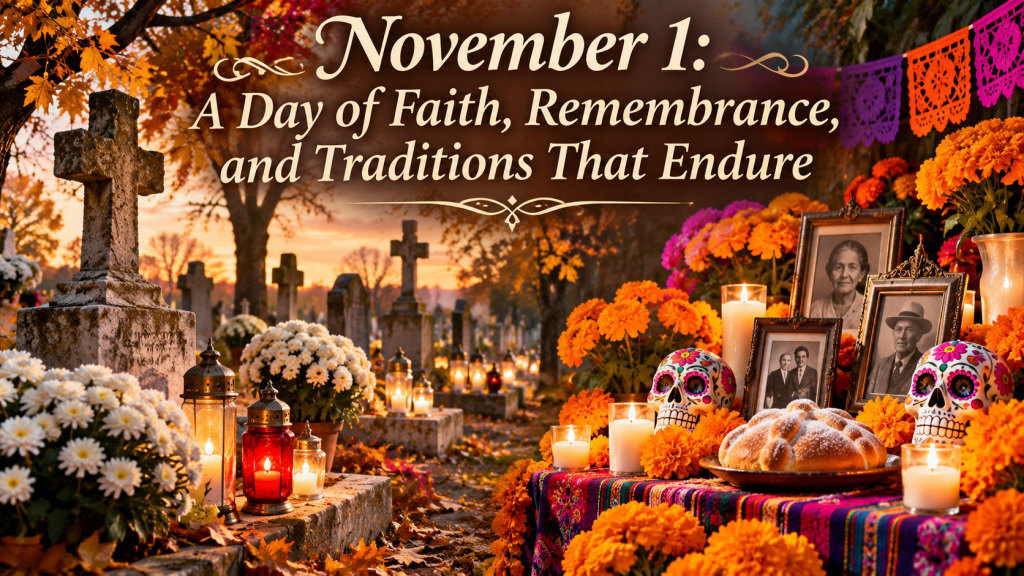
In Poland, families gather at cemeteries to clean graves, arrange flowers, and light candles. As evening approaches, countless flickering flames illuminate the burial grounds, creating a remarkable landscape of remembrance.
In France, where the observance is called La Toussaint, families traditionally place chrysanthemums on the graves of loved ones.
These customs often overlap with All Souls’ Day, observed on November 2 in the Catholic tradition. While All Saints’ Day celebrates those believed to be in heaven, All Souls’ Day is dedicated to prayer for the faithful departed.
But across the Atlantic, another extraordinary tradition developed, one that would become among the most recognizable expressions of Mexican cultural identity.
Its name is Día de Muertos.
In Mexico, remembrance is often expressed not only through solemn reflection but through vibrant colors, music, flowers, food, and gatherings that celebrate the lives of those who have died.
To understand this tradition, we must look at the history of the Indigenous peoples of Mexico and the profound cultural changes that followed Spanish colonization in the sixteenth century.
Long before Europeans arrived, Mesoamerican civilizations maintained elaborate beliefs and rituals surrounding death, ancestry, and the relationship between the living and the deceased.
Among the Mexica, often called the Aztecs, religious ceremonies honored the dead, including observances associated with deceased children and adults. Other Indigenous communities maintained their own distinct funerary practices and understandings of the afterlife.
These ancient traditions were not identical to the modern November celebration. Their ceremonies occurred at different times, and their meanings varied among cultures.
When Spanish colonizers introduced Catholicism, European observances honoring the saints and the faithful departed became part of Mexico’s changing religious landscape.
Over generations, Catholic practices and Indigenous customs interacted in complex ways. Communities adapted, preserved, and transformed traditions, producing regional expressions of remembrance that remain deeply meaningful today.
Historians continue to debate precisely how particular customs developed and which elements can be traced directly to precolonial practices. What is certain is that the modern Día de Muertos reflects centuries of cultural history rather than a single moment of invention.
Today, the celebration generally centers on November 1 and 2, although preparations and observances may begin earlier.
In many communities, November 1 is particularly associated with remembering deceased children, sometimes affectionately called angelitos, or little angels. November 2 is commonly associated with deceased adults and the broader commemoration of the faithful departed.
However, these customs are not universal. The timing and meaning of individual observances vary among Mexico’s many Indigenous communities, regions, and families.
One of the most recognizable traditions is the creation of an ofrenda, an offering or memorial display dedicated to loved ones who have died.
These arrangements are often decorated with family photographs, candles, flowers, favorite foods, and personal belongings.
Each object carries meaning.
Photographs preserve the faces of those being remembered. Favorite foods evoke memories of family meals and shared experiences. Candles provide light, while flowers contribute color, fragrance, and beauty.
Among the most recognizable flowers are the brilliant orange and yellow marigolds known as cempasúchil. In many traditions, their color and fragrance are believed to help guide the spirits of loved ones toward the offerings prepared for them.
Families may also include pan de muerto, a special bread associated with the celebration, along with colorful paper decorations called papel picado and carefully decorated sugar skulls.
To someone unfamiliar with these customs, the abundance of color and celebration might seem unexpected in an observance associated with death.
But that is part of what makes Día de Muertos so meaningful.
Rather than focusing exclusively on sorrow, many families use the occasion to celebrate the relationships, memories, and experiences that continue to connect them with those who have passed away.
Stories are shared. Favorite meals are prepared. Families visit cemeteries, sometimes gathering with music, flowers, candles, and offerings.
Within many traditional beliefs, the spirits of deceased loved ones are welcomed back for a temporary reunion with the living.
These spiritual beliefs are an important part of the cultural history of the celebration, even as individual families understand and practice them differently.
In 2003, UNESCO proclaimed Mexico’s Indigenous festivity dedicated to the dead a Masterpiece of the Oral and Intangible Heritage of Humanity. In 2008, it was incorporated into UNESCO’s Representative List of the Intangible Cultural Heritage of Humanity.
The recognition acknowledged the celebration’s cultural significance and the importance of preserving traditions passed from one generation to another.
And although Día de Muertos has become internationally recognizable, it is important to remember that Mexico is not represented by a single uniform celebration.
From one region to another, families may observe different customs, prepare different foods, and preserve traditions specific to their communities.
That diversity is part of the celebration’s extraordinary cultural richness.
When we consider All Saints’ Day alongside Día de Muertos, we discover two observances with distinct purposes, different customs, and histories that intersect through Christianity and centuries of cultural exchange.
One emphasizes the collective recognition of saints and lives of Christian faith. The other centers on honoring deceased loved ones through traditions that bring together family, memory, spiritual beliefs, and Mexican cultural heritage.
Neither tradition should be reduced to the other.
Yet both invite us to consider something that reaches beyond geographical borders and religious differences.
The importance of remembering.
History often preserves the names of kings, queens, rulers, and conquerors. Their portraits hang in museums, their accomplishments appear in books, and their lives become subjects of study.
But what about the ordinary people whose influence was never recorded?
What about the grandmother who passed down a cherished family recipe? The father whose quiet encouragement gave his children confidence? The neighbor who cared for someone in need? The person whose kindness changed another life without ever receiving recognition?
Their names may never appear in a history book, but their influence can continue through the generations.
A flower placed beside a headstone. A candle lit in remembrance. A photograph displayed in a family home. A familiar story told around the dinner table.
Different cultures have developed different ways of expressing remembrance, but each gesture can carry a lifetime of meaning.
And perhaps that is what makes November 1 such a fitting beginning to the season ahead.
As families prepare for Thanksgiving, Christmas, and the gatherings that will fill the final weeks of the year, many will find themselves returning to familiar traditions.
Some will prepare recipes handed down through generations. Others will decorate their homes with treasured ornaments, gather around tables that have welcomed loved ones for decades, or remember voices that are no longer present.
The holidays have a remarkable way of reminding us that the people who shaped our lives remain part of our stories.
Through faith, family traditions, cultural heritage, and the memories we preserve, their influence continues.
All Saints’ Day and Día de Muertos offer different perspectives on remembrance, each deserving of understanding and respect.
And together, their histories remind us that honoring the past does not prevent us from embracing the future.
Sometimes remembering where we came from helps us appreciate where we are going.
As November begins, perhaps we can carry that thought into the season ahead.
May we remember those whose lives made ours richer, appreciate the traditions that connect us, and recognize the importance of the memories we are creating for generations yet to come.
Because a meaningful legacy is not always measured by recognition, wealth, or accomplishments recorded in history.
Sometimes it lives in a familiar recipe, a cherished photograph, a story told one more time, or an act of kindness that someone never forgets.
Some names are written in history books.
Others are written upon the hearts of those who remember them.
And both have a place in the stories we leave behind.
—Guyton


Leave a Reply