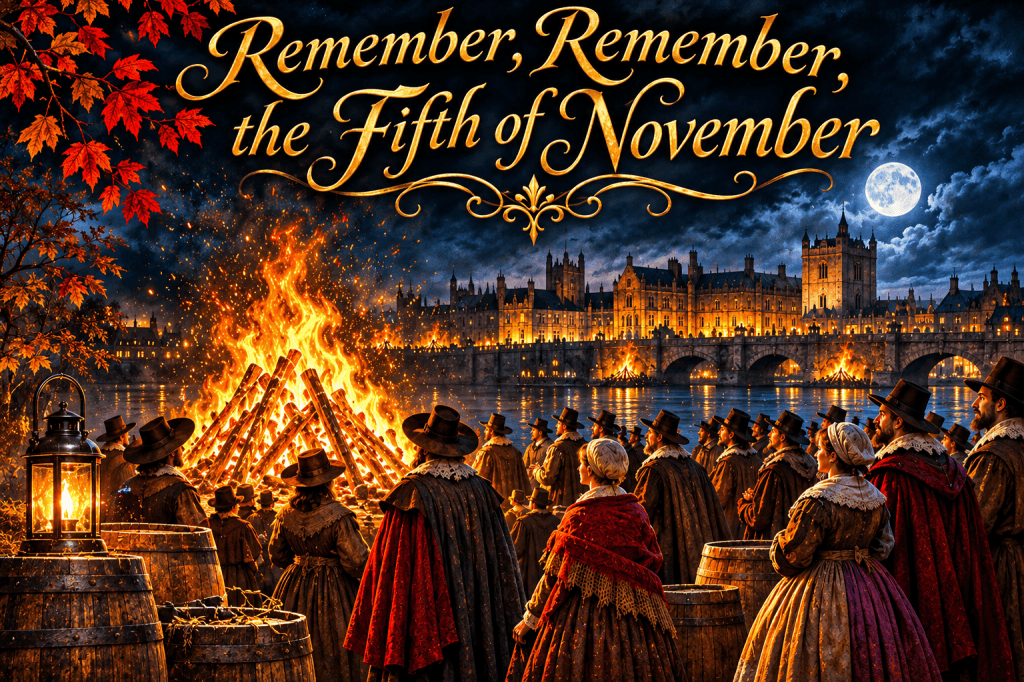
Remember, remember, the fifth of November,
Gunpowder, treason and plot.
I see no reason
Why gunpowder treason
Should ever be forgot.
It’s a rhyme that has echoed through British history for centuries. Words passed from one generation to the next, repeated around bonfires, remembered in classrooms, and woven into a tradition that continues more than four hundred years after the events that inspired it.
But have you ever stopped to wonder what actually happened on the fifth of November?
Why would an entire country continue remembering a failed conspiracy from 1605? And how did one man become the face of a plot that wasn’t even his idea?
The answers take us back to seventeenth-century England, where religious persecution, political resentment, secret meetings, and thirty-six barrels of gunpowder nearly changed the course of British history.
And at the center of it all was a man named Guy Fawkes.
Although, as it turns out, he wasn’t the man in charge.
To understand the Gunpowder Plot, we first need to understand the England in which it unfolded.
For decades, the country had been divided by religious conflict. Following England’s break with the Roman Catholic Church under Henry VIII, successive monarchs had struggled over the nation’s religious identity.
Under Queen Elizabeth I, Protestantism became firmly established, while Catholics faced increasingly severe restrictions.
Catholic priests could be imprisoned or executed for carrying out their religious duties. Families who refused to attend Church of England services faced substantial fines, and practicing their faith could mean secrecy, suspicion, and the constant fear of government informers.
For English Catholics, everyday life could become an exhausting struggle between religious conscience and obedience to the Crown.
When Elizabeth died in 1603, some Catholics hoped that her successor, King James I, would bring greater tolerance.
After all, James was the son of Mary, Queen of Scots, who had been Catholic.
But James himself was Protestant, and the hopes of those expecting meaningful religious relief were soon disappointed.
The restrictions remained, and resentment continued growing among some members of England’s Catholic minority.
Most English Catholics did not support violence against the king. Many simply wanted the freedom to practice their religion without persecution.
But a small group of men came to believe that peaceful change was no longer possible.
One of those men was Robert Catesby.
Born into a Catholic family, Catesby had already been involved in political rebellion before he began organizing the conspiracy that would make his name infamous.
He was charismatic, determined, and convinced that England’s religious circumstances required dramatic action.
In May 1604, Catesby gathered a small group of trusted associates and introduced an extraordinary plan.
They would blow up the Houses of Parliament during the ceremonial opening attended by King James I.
The explosion would kill the king, members of the royal family, leading government officials, and members of Parliament gathered inside.
With England’s leadership destroyed, the conspirators hoped to inspire an uprising and establish a new political order more favorable to Catholicism.
Their ambitions extended beyond the explosion itself.
They also intended to seize the king’s young daughter, Princess Elizabeth, who was only nine years old, and use her as a figurehead for their proposed change of government.
It was an audacious plan.
It was also a plan that would have murdered large numbers of people, including individuals who had no responsibility for the religious policies the conspirators opposed.
Catesby needed men willing to take extraordinary risks.
Among those he recruited were Thomas Wintour, Thomas Percy, John Wright, and Guy Fawkes.
Fawkes had been born in York in 1570 and had spent years serving as a soldier on the European continent.
He had fought for Catholic Spain against Protestant Dutch forces, gaining military experience and knowledge of explosives.
That experience made him especially valuable to the conspirators.
And although history would eventually remember his name above all the others, Guy Fawkes was not the mastermind behind the operation.
That distinction belonged to Robert Catesby.
Fawkes was the man entrusted with helping prepare and guard the explosives.
To conceal his identity, he used the name John Johnson and posed as a servant to Thomas Percy.
The conspirators initially attempted to gain access beneath Parliament through a neighboring property. Accounts of their preparations describe an unsuccessful effort to dig a tunnel, although the details of that undertaking have been debated by historians.
Eventually, they secured a much more convenient location.
In March 1605, the conspirators obtained the use of a rented undercroft beneath the House of Lords.
There, they concealed thirty-six barrels of gunpowder.
Imagine that for a moment.
Beneath one of the most important buildings in England, a group of men had secretly positioned enough explosives to threaten the king and much of the country’s political leadership.
Above them, ordinary government business continued.
Parliament prepared for its ceremonial opening.
People went about their daily lives.
And hidden beneath the building was a conspiracy waiting for the appointed day.
That day was November 5, 1605.
But before the conspirators could carry out their plan, something unexpected happened.
On October 26, a Catholic nobleman named Lord Monteagle received an anonymous letter.
The message warned him not to attend the upcoming opening of Parliament.
It spoke of a terrible blow that would strike the gathering, although those present would not see who had caused it.
Whoever wrote the letter clearly knew that something dangerous was being planned.
But the writer’s identity remains uncertain.
Some historians have suspected Francis Tresham, one of the conspirators and Monteagle’s brother-in-law.
Others have considered whether someone connected to the government may have been involved.
There have even been suggestions that the warning formed part of a larger political maneuver.
Yet no explanation has been established beyond doubt.
And that mystery remains one of the most intriguing elements of the entire story.
Someone knew.
Someone decided to issue a warning.
And whoever that person was may have helped prevent one of the deadliest political attacks in English history.
Monteagle did not simply ignore the letter.
Instead, he passed it to Robert Cecil, Earl of Salisbury, one of the king’s most influential ministers.
The government now had reason to suspect that something was terribly wrong.
Meanwhile, the conspirators learned that the warning had reached the authorities.
They faced a difficult decision.
Should they abandon the operation?
Should they flee?
Or should they trust that their preparations would remain undiscovered?
Despite the danger, they decided to proceed.
As November 5 approached, Guy Fawkes remained responsible for the explosives hidden beneath Parliament.
On November 4, officials began inspecting the buildings surrounding the House of Lords.
During an initial search, Fawkes was encountered near a large quantity of firewood. His explanation did not immediately expose the conspiracy.
But suspicion remained.
Later that evening, as November 4 gave way to November 5, a more thorough search was conducted under the direction of Sir Thomas Knyvett.
This time, the authorities discovered the gunpowder.
And with it, they found the man calling himself John Johnson.
Guy Fawkes was arrested.
The conspiracy had been uncovered before the opening of Parliament.
The king was alive.
The building was still standing.
And the thirty-six barrels of gunpowder that were supposed to change England’s future had never been ignited.
But the story was far from over.
News of the discovery spread, and the remaining conspirators fled London.
Robert Catesby and several of his companions attempted to gather support in the Midlands, hoping that their planned uprising might somehow continue.
Instead, their situation rapidly deteriorated.
Few people joined them.
The authorities pursued them.
And an accident involving damp gunpowder injured some of the fleeing men.
On November 8, government forces confronted the conspirators at Holbeach House in Staffordshire.
A brief exchange of gunfire followed.
Robert Catesby, the man who had conceived the plot, was killed.
Other conspirators died in the confrontation, while several survivors were captured.
Guy Fawkes, meanwhile, had been taken to the Tower of London.
There, he faced interrogation and torture.
Initially, he revealed little about his fellow conspirators. But under increasing pressure, he eventually provided information that helped authorities reconstruct the conspiracy.
In January 1606, Fawkes and the surviving defendants were tried for high treason.
They were found guilty and sentenced to one of the most brutal punishments available under English law: hanging, drawing, and quartering.
The executions took place on January 30 and 31, 1606.
Guy Fawkes was executed on January 31.
But there was one final twist in Guy Fawkes’s story.
Although he had been sentenced to be hanged, drawn, and quartered, accounts of his execution describe him breaking his neck in the fall from the gallows, dying before the remaining stages of the punishment could be carried out.
Some have suggested that Fawkes deliberately jumped to avoid the suffering that awaited him. Whether that was truly his intention remains uncertain.
What is known is that the man whose name would become synonymous with the Gunpowder Plot met his end on January 31, 1606.
The punishment was intended not merely to kill the condemned men, but to demonstrate the terrifying consequences of treason against the Crown.
Yet even after the conspirators were dead, the effects of their actions continued.
For England’s Catholic population, the failed plot brought further suspicion and hardship.
The conspiracy reinforced fears that Catholics might threaten the Protestant monarchy, even though the overwhelming majority had taken no part in the plan.
The actions of a small group became another justification for restrictions affecting an entire religious community.
And that is one of the more troubling aspects of this history.
The conspirators had responded to religious persecution by planning an act of mass murder.
Their failure then contributed to further discrimination against people who shared their religion but not their methods.
It was a cycle of fear, violence, and intolerance in which ordinary people continued paying the price.
But while the consequences were serious, the discovery of the plot also produced something rather unusual.
A national tradition.
On November 5, 1605, Londoners were encouraged to light bonfires in celebration of the king’s survival.
The following year, Parliament established an annual day of thanksgiving to commemorate the failure of the conspiracy.
Over time, November 5 became known by several names.
Guy Fawkes Night.
Bonfire Night.
Fireworks Night.
Communities gathered around bonfires, fireworks illuminated the sky, and effigies representing Guy Fawkes were sometimes burned.
Interestingly, Guy Fawkes was not always the figure represented on those bonfires.
During earlier celebrations, effigies of the Pope were sometimes burned, reflecting the fierce anti-Catholic hostility that had become intertwined with the tradition.
Over time, Guy Fawkes became the more familiar figure associated with the bonfires, particularly during the nineteenth century.
Even the traditions themselves had changed with the passing centuries.
Children learned verses about the events of 1605.
And one rhyme, in particular, became inseparable from the occasion.
Remember, remember, the fifth of November…
The words endured even as the meaning of the celebration evolved.
What began as a commemoration of the Protestant monarchy’s survival gradually became, for many families, a more secular evening of fireworks, community gatherings, and seasonal tradition.
Today, Bonfire Night is still observed in parts of Britain.
But perhaps one of the most remarkable traditions continues inside Parliament itself.
Even today, before the State Opening of Parliament, the Yeomen of the Guard conduct a ceremonial search of the cellars beneath the Palace of Westminster.
The tradition commemorates the discovery of the Gunpowder Plot in 1605. Although modern security measures have long since replaced the need for such a search as a practical safeguard, the ceremony remains.
More than four centuries later, the very institution the conspirators intended to destroy continues to remember the night that changed its history.
And although the celebrations may look very different from those of the seventeenth century, the date remains recognizable.
But there is another curious detail about this story.
Why do we remember Guy Fawkes so readily while Robert Catesby, the man who actually organized the conspiracy, is far less familiar?
Perhaps because Fawkes was the man discovered beside the gunpowder.
Perhaps because his arrest offered a dramatic image that could be repeated in stories, illustrations, and public celebrations.
Or perhaps because history sometimes remembers the most recognizable figure rather than the person who made the decisions.
Whatever the reason, Fawkes became a symbol that eventually took on meanings far beyond the original conspiracy.
Centuries later, a stylized mask resembling Guy Fawkes would become internationally recognizable through the graphic novel and film V for Vendetta.
That mask subsequently appeared in demonstrations and protest movements around the world.
It is a remarkable transformation.
A man arrested while helping prepare an attack on Parliament became, over the centuries, a figure whose image has been used to represent resistance to authority.
Yet the historical reality is more complicated than any single symbol.
Guy Fawkes was neither a solitary revolutionary nor the leader of the Gunpowder Plot.
He was one member of a conspiracy born amid genuine religious persecution, but committed to an act of violence that would have killed many people.
And remembering that distinction matters.
History is rarely as simple as the stories we inherit.
Sometimes the familiar version leaves out the people who were truly responsible.
Sometimes it overlooks the circumstances that drove events forward.
And sometimes a rhyme repeated for centuries conceals a history far darker than its playful rhythm suggests.
I find that particularly fascinating about November 5.
A few familiar words can carry us back more than four hundred years, into a world of secret identities, royal politics, religious divisions, hidden explosives, and a mysterious letter whose author has never been conclusively identified.
It sounds almost like the plot of a historical thriller.
Except it really happened.
And perhaps the most extraordinary part is how close the conspirators came to carrying out their plan before everything unraveled.
One anonymous warning.
A suspicious government.
A search beneath Parliament.
And a man standing guard over thirty-six barrels of gunpowder.
Had those events unfolded differently, England’s history might have taken a dramatically different course.
Instead, the conspiracy failed, its participants met violent ends, and the date became embedded in British tradition.
So when November 5 arrives, and that familiar little rhyme makes its annual appearance, perhaps we’ll remember a little more than the words themselves.
We’ll remember the religious conflict that helped create the conspiracy.
We’ll remember Robert Catesby, the mastermind whose name history often leaves in the shadows.
We’ll remember the mysterious letter that helped expose the plot.
And we’ll remember Guy Fawkes, the man whose name became attached to a night of bonfires and fireworks that continues centuries after his death.
Because behind every tradition, there is a story.
And sometimes the stories we think we know are far more complicated than we ever imagined.
Remember, remember, the fifth of November,
Gunpowder, treason and plot.
More than four centuries later, the words are still remembered.
And now, perhaps, so is the history behind them.
— GUYTON


Leave a Reply