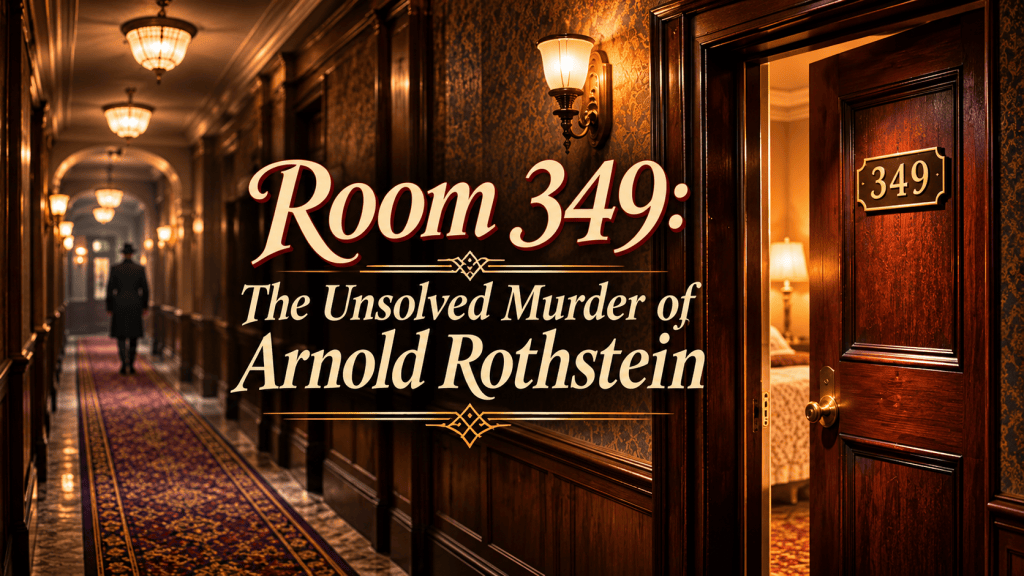
On the evening of November 4, 1928, one of New York City’s most powerful underworld figures received a telephone call.
Not long afterward, he was found staggering through a Manhattan hotel, bleeding from a gunshot wound.
He would survive for nearly two days.
Long enough to speak.
Long enough to answer questions.
And, quite possibly, long enough to identify the person who had shot him.
But he refused.
His name was Arnold Rothstein, and ninety-eight years later, nobody has ever been convicted of his murder.
What makes this particular case so fascinating isn’t simply that a notorious gambler was shot in a New York hotel. It is the possibility that somewhere, buried in nearly a century of police records, forgotten evidence, and unanswered questions, the truth might still be waiting to be discovered.
And with all the extraordinary advancements in modern forensic technology, I cannot help wondering whether a murder committed in 1928 could still be solved today.
But before we consider that possibility, we need to understand who Arnold Rothstein was, why so many people had reasons to dislike him, and what happened inside Room 349 of the Park Central Hotel.
To understand Rothstein, we need to return to New York City during the Roaring Twenties.
It was an era of jazz music, fashionable nightclubs, illegal liquor, and enormous fortunes made in the shadows of Prohibition.
Behind the glittering lights and crowded streets was another world entirely.
A world of underground gambling establishments, bootleggers, political corruption, and organized criminal enterprises.
And Arnold Rothstein knew that world better than most.
Born in New York City on January 17, 1882, Rothstein grew up in a financially comfortable family. His father, Abraham Rothstein, was a respected businessman known for his religious devotion and charitable work.
Arnold, however, developed an early fascination with gambling.
He discovered that money could be made not only by taking risks, but also by understanding the people willing to take them.
Over time, he became far more than an ordinary gambler.
He was a financier, an organizer, a businessman, and a powerful figure whose connections extended into gambling operations, criminal enterprises, and the political establishment.
He acquired nicknames such as “The Brain” and “The Big Bankroll.”
Those names reflected his reputation as a man who preferred strategy and money to the street violence associated with many other criminals.
Rather than personally participating in every illegal operation, Rothstein could provide financing, arrange connections, and profit from the activities of others.
He was also widely associated with the development of organized crime in New York during Prohibition.
His reputation became so notorious that his name was connected to one of the most infamous scandals in American sports history.
The 1919 World Series.
That year, members of the Chicago White Sox were implicated in a conspiracy to deliberately lose the championship to the Cincinnati Reds.
The scandal shocked baseball fans and damaged public confidence in the sport.
Rothstein was accused of involvement in the gambling arrangements surrounding the fixed games, although his precise role remains disputed.
He denied participating, and he was never convicted in connection with the scandal.
Nevertheless, the allegations became a permanent part of his public reputation.
By the late 1920s, Rothstein had become one of those extraordinary figures whose influence seemed to reach into nearly every corner of New York’s underworld.
But power and money do not necessarily make a person safe.
Sometimes they simply create more enemies.
And in 1928, Rothstein found himself entangled in a gambling dispute involving an enormous amount of money.
During a high-stakes poker game that September, Rothstein reportedly lost hundreds of thousands of dollars.
Accounts differ on the exact amount and how the debts were divided, but the total was extraordinary even by the standards of wealthy gamblers.
Rothstein refused to settle the debt.
He maintained that the game had been rigged against him.
Whether he was genuinely cheated, believed he had been cheated, or simply wanted to avoid paying remains a matter of historical debate.
But one thing was clear.
The people expecting their money were not pleased.
Among the men connected to the gambling dispute was George “Hump” McManus, another figure in New York’s gambling circles.
McManus would soon become the central suspect in Rothstein’s murder.
On Sunday evening, November 4, Rothstein was spending time at Lindy’s, a well-known Broadway restaurant frequented by entertainers, gamblers, and other prominent New Yorkers.
Then a telephone call arrived.
The caller wanted Rothstein to come to the Park Central Hotel.
According to contemporary accounts, Rothstein indicated that he was going to see McManus.
Room 349 had been associated with McManus, and it was there that investigators would eventually focus their attention.
What happened after Rothstein entered the hotel remains one of the great unanswered questions of the case.
Who was waiting for him?
How many people were present?
Was the meeting intended to settle the gambling dispute?
Did an argument erupt?
Was the shooting deliberate, or did a confrontation suddenly turn violent?
No one has ever established the complete sequence of events beyond doubt.
What we do know is that Rothstein was shot once in the lower abdomen.
He was subsequently discovered badly wounded near a service entrance of the hotel.
Imagine the scene.
A luxurious Manhattan hotel.
Guests moving through the building, unaware that one of New York’s most notorious gamblers had just been shot.
A wounded man struggling to reach help.
And somewhere nearby, the person responsible for firing the shot.
Rothstein was taken to Polyclinic Hospital, where doctors attempted to save his life.
His injuries were severe.
The bullet had caused extensive internal damage, and his condition deteriorated.
Police wanted answers.
They wanted to know who had been in Room 349.
They wanted to know what had happened during the meeting.
Most importantly, they wanted Rothstein to identify his attacker.
But he would not cooperate.
Several versions of his exchanges with investigators have circulated over the years.
In one widely repeated account, a detective asked who had shot him, and Rothstein responded by suggesting that the officer knew better than to expect an answer.
Another version has him telling investigators that they should attend to their own business while he attended to his.
The precise wording is difficult to establish, but contemporary newspaper reports confirm the essential fact.
Rothstein refused to identify the person who had shot him.
That silence has become one of the most enduring mysteries surrounding his death.
Was he protecting someone?
Was he following an underworld code against cooperating with police?
Did he expect to survive and settle the matter himself?
Or was there another reason he would not speak?
We may never know.
On November 6, 1928, Arnold Rothstein died at the age of forty-six.
The man who had spent much of his life calculating odds, managing risks, and building a fortune through gambling had lost the one wager he could never recover from.
But the investigation was only beginning.
Police had a hotel room.
They had witnesses.
They had a suspect.
And they had a firearm recovered outside the hotel.
Investigators connected the fatal bullet to a gun discovered in the street below the building, although historical descriptions of the weapon and its handling have varied.
Contemporary accounts also described damage consistent with the weapon having fallen from an upper floor. The revolver’s barrel was reportedly damaged when it struck the pavement, complicating the ballistic examination and limiting what investigators could establish about the weapon.
If someone had thrown it from a window after the shooting, that might help explain how it came to be outside.
But proving who handled it was another matter.
Investigators also encountered serious problems with the physical evidence.
Rothstein’s bloodstained clothing, which could have helped establish details about the shooting, was reportedly lost while in police custody.
That was an extraordinary failure.
Even in 1928, clothing from a gunshot victim could provide valuable information about the location and characteristics of a wound, the distance from which a weapon might have been fired, and other circumstances surrounding an attack.
And once such evidence disappears, the opportunities it might have provided disappear with it.
And the missing clothing was not the investigation’s only troubling failure.
According to historical accounts, investigators also failed to obtain Rothstein’s fingerprints after his death. That omission reportedly prevented them from comparing his prints with a fingerprint discovered on a drinking glass in Room 349.
A single fingerprint might not have identified the killer, but the inability to establish whether it belonged to Rothstein left investigators with yet another unanswered question.
The police also struggled to establish exactly who had been inside Room 349 when the shooting occurred.
George McManus became their principal suspect.
He had been connected to the gambling dispute, and his association with the hotel room made him an obvious person of interest.
On November 27, 1928, McManus surrendered to authorities after police had spent weeks looking for him.
He was charged with murder.
But suspicion is not the same thing as proof.
When McManus eventually went on trial in 1929, the prosecution faced substantial difficulties.
Witnesses were uncooperative.
The evidence did not conclusively place McManus in the room with Rothstein at the moment of the shooting.
And prosecutors could not establish a sufficiently convincing connection between the defendant and the fatal weapon.
The case was so weak that the judge directed an acquittal.
George McManus walked free.
And Arnold Rothstein’s murder remained unsolved.
Over the years, different theories have circulated about who might have fired the shot.
Some have continued to suspect McManus.
Others have suggested that another participant in the gambling dispute was responsible.
Still other accounts have proposed that the shooting was accidental, perhaps during an argument in which a weapon was drawn.
There have also been theories involving unrelated underworld rivalries.
But theories are not verdicts.
And without conclusive evidence, none of those explanations can honestly be presented as an established solution.
That brings me to the question I find most fascinating about this entire case.
With all the extraordinary advancements in technology and forensic science over the past ninety-eight years, couldn’t this murder finally be solved?
Think about it.
We live in a world where DNA evidence has helped investigators identify suspects in cases that went cold decades ago.
Fingerprints can be examined using technology that detectives in 1928 could never have imagined.
Even the smallest traces of biological evidence can sometimes reveal information that once seemed impossible to uncover.
So what if somewhere, tucked away in an old evidence room or forgotten archive, something from Arnold Rothstein’s murder investigation still exists?
Could a piece of evidence that meant very little to investigators in 1928 finally reveal the identity of his killer?
I realize that nearly a century has passed, and there’s no guarantee that any usable evidence survives.
But isn’t it remarkable to think that technology developed long after Rothstein’s death might someday answer the very question he refused to answer himself?
Not every murder investigation from the 1920s has surviving physical exhibits.
Evidence can be destroyed, misplaced, discarded, or deteriorate over time.
Records may be incomplete.
Storage conditions may have been unsuitable.
And in Rothstein’s case, we already know that at least some potentially important material was lost during the original investigation.
But what about the firearm recovered outside the hotel?
What about photographs, fingerprint records, laboratory reports, or other exhibits that might have been preserved?
Could something still be sitting in an evidence collection, an archive, or an old case file?
I have not found reliable confirmation that the original physical evidence from Rothstein’s murder remains in official custody today.
And that distinction is important.
We cannot assume that investigators still possess a usable weapon or other materials simply because those items existed in 1928.
But if any original evidence has survived, modern forensic science might offer possibilities that detectives at the time could scarcely have imagined.
Consider fingerprints.
Fingerprint identification was already in use during the 1920s, but investigators did not have today’s computerized searching capabilities.
A surviving, properly preserved fingerprint impression might potentially be reexamined using modern methods.
A comparison could be made against known historical prints, if suitable records still existed.
Of course, even a match would have limitations.
A fingerprint might show that someone handled an object without establishing when or why.
And the absence of a match would not necessarily eliminate a suspect.
Then there is DNA.
Today, forensic laboratories can sometimes recover biological material from evidence that is decades old.
Under favorable circumstances, modern techniques can identify extremely small quantities of genetic material.
But ninety-eight years is a very long time.
Any surviving evidence from Rothstein’s murder would have been collected long before investigators understood DNA profiling.
Objects may have been handled repeatedly by police officers, medical personnel, attorneys, or other individuals.
Biological material may have degraded.
And even if DNA could be recovered, determining whether it belonged to the killer rather than an innocent person who handled the object could prove extremely difficult.
Modern forensic technology is remarkable, but it is not magic.
It cannot automatically reconstruct everything that happened inside a hotel room nearly a century ago.
Still, the possibilities are intriguing.
A preserved weapon might be examined.
An old fingerprint could potentially be compared again.
Historical records might be reviewed alongside witness accounts and the physical layout of the hotel.
Even the original medical documentation could be useful in reassessing theories about the angle of the shot and the circumstances under which it was fired.
Investigators could also consider whether any surviving biological evidence was suitable for modern DNA analysis.
And in certain circumstances, investigative genetic genealogy has helped identify individuals connected to long-unsolved cases.
Whether that approach could be useful here would depend on obtaining a suitable DNA profile, having reliable evidence of its relevance, and meeting the applicable investigative requirements.
There is another complication, of course.
Anyone who shot Rothstein in 1928 would almost certainly be dead today.
A modern investigation would therefore be unlikely to lead to a criminal trial.
But solving a historical murder does not necessarily have to mean putting someone in prison.
Sometimes the purpose is simply to establish the truth.
To answer a question that has remained unresolved.
To correct the historical record.
And to understand what really happened.
I find that possibility especially compelling in Rothstein’s case because so much of the story has been shaped by reputation and speculation.
He was a powerful man with a complicated history.
He had connections to people involved in serious criminal activity.
He was linked to gambling scandals, enormous financial disputes, and a world where silence could be considered a form of loyalty or self-preservation.
Those circumstances make for a dramatic story.
But they also make it easy for rumors to become accepted as facts.
Nearly a century later, the difference between what investigators proved and what people merely suspected still matters.
We know Rothstein went to the Park Central Hotel on November 4, 1928.
We know he was shot.
We know he refused to identify his attacker.
We know he died two days later.
We know George McManus was tried and acquitted.
And we know that no one was ever convicted of the murder.
Everything beyond those established facts requires careful examination.
Perhaps the most unsettling detail is that Rothstein may have taken the answer to his grave.
A man who understood the criminal underworld better than almost anyone in New York had the opportunity to help police identify the person responsible for his death.
Yet he chose silence.
And that silence has echoed through ninety-eight years of unanswered questions.
When I think about Room 349, I don’t just picture a hotel room in 1928.
I picture an investigation frozen in time.
A telephone call.
A gambling debt.
A discarded weapon.
Missing evidence.
A wounded man refusing to speak.
And a courtroom where the prosecution could not prove its case.
Then I think about the world we live in today.
A world where DNA can sometimes identify a person from biological material left behind decades earlier.
Where old fingerprints can be digitally examined.
Where forgotten case files can be reopened, and evidence once considered useless can sometimes reveal new information.
Could those advances finally tell us who shot Arnold Rothstein?
Possibly.
But only if enough reliable evidence survives, and only if that evidence can actually distinguish the killer from everyone else connected to the case.
Until then, the mystery remains.
And perhaps that is what makes this story so extraordinary.
On November 4, 1928, Arnold Rothstein entered a Manhattan hotel expecting a meeting.
He left with a fatal gunshot wound.
He never revealed who was responsible.
And ninety-eight years later, we are still asking the same question detectives asked at his hospital bedside.
Who shot Arnold Rothstein?
Perhaps the person responsible is long gone.
Perhaps the evidence has disappeared with the passing decades.
But with everything modern science has accomplished, I cannot help wondering whether the answer is still out there, waiting for someone to look at an old mystery with new eyes.
Could the murder of Arnold Rothstein finally be solved after ninety-eight years?
I certainly think it’s a question worth asking.
— GUYTON



Leave a Reply