Imagine walking into a polling place on Election Day. Perhaps there’s a line of people waiting their turn, a familiar face behind the registration table, or a little sticker waiting for you after you’ve cast your ballot.
For many Americans, voting has become such a familiar part of life that it’s easy to overlook just how extraordinary that opportunity once was.
But there was a time in this country’s history when millions of Americans were denied a voice in the very government that made decisions affecting their lives.
Some were told they couldn’t vote because they were women. Others were denied because of their race, their ancestry, or laws that prevented them from becoming citizens. Still others possessed the constitutional right to vote on paper but faced intimidation, violence, and deliberately constructed obstacles when they attempted to exercise it.
And behind every amendment, every court decision, and every change in the law were real people who refused to accept that their voices didn’t matter.
On this Election Day, November 3, 2026, it’s worth remembering just how long and difficult the road to the ballot box has been.
When the United States declared its independence in 1776, its founding ideals spoke of liberty and equality. Yet the ability to participate in elections was largely reserved for men, and voting qualifications varied from state to state. Property ownership, race, sex, and other restrictions determined who could have a say.
Even among men, voting rights weren’t universal. Many states initially imposed property or taxpaying requirements, and the expansion of voting rights for white men unfolded gradually during the early nineteenth century.
Women, meanwhile, were generally excluded from political participation at the ballot box, although a few exceptions existed. In early New Jersey, for example, certain property-owning women were permitted to vote before that right was restricted in 1807.
But women weren’t content to remain on the sidelines forever.
In July 1848, a gathering in Seneca Falls, New York, became one of the defining moments of the American women’s rights movement.
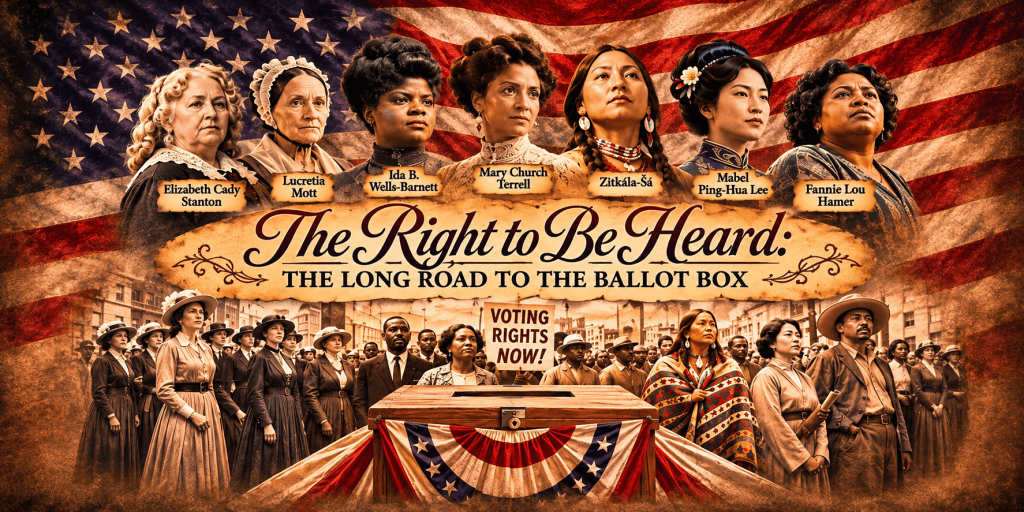
Organized by reformers including Elizabeth Cady Stanton and Lucretia Mott, the convention brought together people determined to challenge the legal and social inequalities women faced.
Among the demands outlined in the Declaration of Sentiments was the right to vote.
At the time, the idea that women should participate equally in elections was controversial, even among some supporters of women’s rights.
Yet the demand remained.
And it would continue to grow.
Over the following decades, women organized associations, circulated petitions, delivered speeches, and challenged laws that denied them political representation.
Some western territories and states began granting women voting rights before the federal government acted. Wyoming Territory extended voting rights to women in 1869, followed by Utah Territory in 1870, although Utah women temporarily lost that right under later federal legislation.
The movement was gaining ground, but progress was uneven, and victory remained far from certain.
The struggle also revealed painful divisions.
Black women were fighting not only for recognition as women but also against the racial discrimination that shaped American society.
Women such as Ida B. Wells-Barnett and Mary Church Terrell understood that the fight for equality couldn’t be separated neatly into questions of sex and race.
Wells-Barnett, a journalist and anti-lynching activist, challenged injustice with remarkable determination. Terrell, an educator and civil rights leader, advocated for both women’s rights and racial equality.
Their work was especially important because parts of the predominantly white suffrage movement marginalized Black women, even while demanding equal rights for women.
During the great women’s suffrage procession in Washington, D.C., in March 1913, Wells-Barnett refused to accept racial separation from her Illinois delegation. She joined the march alongside members of that delegation, asserting her place in a movement to which she had contributed.
It was a powerful reminder that equality couldn’t be genuine if it was extended only to some.
Meanwhile, another struggle for the ballot had already been unfolding since the Civil War.
The abolition of slavery through the 13th Amendment in 1865 transformed the nation, but freedom alone didn’t guarantee political equality.
The 14th Amendment, ratified in 1868, established citizenship for people born or naturalized in the United States and subject to its jurisdiction, while guaranteeing equal protection under the law. The 15th Amendment, ratified in 1870, prohibited denying voting rights because of race, color, or previous condition of servitude.
For Black men, the 15th Amendment represented a historic constitutional victory.
During Reconstruction, Black Americans registered, voted, held public office, and participated in shaping governments across the South.
But those gains provoked fierce resistance.
As Reconstruction ended and white supremacist governments regained power across the South, discriminatory laws and violent intimidation were used to strip Black citizens of political influence.
Poll taxes placed a financial burden on voting. Literacy tests were administered discriminatorily. Grandfather clauses protected certain white voters while excluding Black voters. Threats, assaults, and murders discouraged people from attempting to exercise their rights.
The Constitution might have promised protection, but the reality at the ballot box could be entirely different.
For generations, countless Black Americans were forced to fight for a right that the nation had already claimed to guarantee.
And women were still fighting for theirs.
By the early twentieth century, the women’s suffrage movement had become impossible to ignore.
Thousands marched through American cities. Protesters gathered outside the White House. Members of the National Woman’s Party endured arrests and imprisonment, and some imprisoned suffragists were subjected to force-feeding after beginning hunger strikes.
Their determination helped keep the question of women’s voting rights before the nation.
Finally, in August 1920, the 19th Amendment was ratified.
It declared that the right to vote could not be denied or abridged by the United States or any state on account of sex.
It was a tremendous achievement, the result of decades of organizing and sacrifice.
But the story didn’t end there.
The 19th Amendment didn’t erase discriminatory racial restrictions, citizenship requirements, or other barriers that continued to keep many women away from the polls.
For Black women in much of the South, the same Jim Crow practices that had disenfranchised Black men remained firmly in place.
For Native American women, the situation involved an additional and complicated history of tribal sovereignty, citizenship, and state restrictions.
And for many Asian immigrant women, discriminatory naturalization laws still made voting impossible.
The right to vote had expanded, but it was far from equal in practice.
Long before the United States existed, Native nations governed themselves according to their own political systems and traditions. Their histories of political participation didn’t begin with American citizenship.
Yet as the United States expanded, Native Americans faced dispossession, broken treaties, forced assimilation, and complicated federal policies concerning citizenship.
Some Native Americans became U.S. citizens through treaties, marriage, military service, allotment policies, or other legal provisions before 1924.
Then, on June 2, 1924, Congress passed the Indian Citizenship Act, extending U.S. citizenship to Native Americans born within the territorial limits of the country who had not already acquired it.
But citizenship didn’t automatically guarantee that every Native American could vote.
Some states continued imposing restrictions based on interpretations of tribal status, residency, guardianship, or other discriminatory qualifications.
In Arizona, for example, a state constitutional interpretation had been used to exclude Native Americans from voting until the Arizona Supreme Court rejected that interpretation in 1948.
Other barriers persisted elsewhere, and the struggle for meaningful voting access continued.
Among the advocates for Native American rights was Zitkála-Šá, also known as Gertrude Simmons Bonnin, a Yankton Dakota writer, musician, and activist.
She worked to advance Native American citizenship and political rights while also defending Indigenous cultures and identities against policies that sought to erase them.
Her life reminds us that political equality shouldn’t require people to surrender who they are.
Asian Americans faced yet another set of barriers, particularly those created by federal immigration and naturalization laws.
For much of American history, eligibility for naturalized citizenship was restricted by race.
The Chinese Exclusion Act of 1882 intensified discrimination against Chinese immigrants, and laws excluding many Asian immigrants from naturalization prevented them from becoming voters even when they had lived and worked in the United States for years.
One remarkable woman who challenged the injustice of this era was Mabel Ping-Hua Lee.
Born in China and raised in New York City, Lee became an outspoken advocate for women’s suffrage while still a teenager.
In 1912, she participated in a major suffrage parade in New York, riding on horseback as women demanded the right to vote.
Yet even after the 19th Amendment was ratified, Lee herself remained affected by citizenship restrictions imposed on Chinese immigrants.
She had helped fight for a right that the law still prevented her from exercising.
It wasn’t until 1943 that Congress repealed the Chinese Exclusion Act and made Chinese immigrants eligible for naturalization under federal law.
Restrictions affecting other Asian immigrant communities were gradually dismantled, with the Immigration and Nationality Act of 1952 eliminating racial restrictions on naturalization.
These changes didn’t erase discrimination, but they removed major legal obstacles that had denied generations of Asian immigrants the possibility of becoming voting citizens.
And still, the struggle for equal access continued.
By the middle of the twentieth century, the American civil rights movement was confronting the contradiction between constitutional promises and the treatment of Black citizens, especially in the South.
One of the most courageous voices of that movement belonged to Fannie Lou Hamer.
Born in Mississippi in 1917, Hamer grew up in a society where Black citizens faced severe discrimination and political exclusion.
In 1962, she attempted to register to vote.
That decision changed her life.
Hamer faced retaliation for her political activism, losing her employment and home. She later endured a brutal beating while imprisoned in Mississippi.
Yet she refused to abandon the struggle.
She helped organize voter registration efforts and became a powerful national voice for civil rights, speaking openly about the violence and intimidation Black Americans faced when they attempted to participate in democracy.
Her courage was part of a much larger movement involving thousands of people whose names would never become famous.
Teachers, ministers, students, farmers, domestic workers, and ordinary families risked their livelihoods and sometimes their lives to challenge disenfranchisement.
In March 1965, voting-rights demonstrators attempted to march from Selma to Montgomery, Alabama.
On March 7, a day remembered as Bloody Sunday, peaceful marchers crossing the Edmund Pettus Bridge were attacked by state troopers and other law enforcement officers.
Images of the violence shocked the nation and intensified demands for federal action.
Later that month, a federally protected march successfully reached Montgomery.
On August 6, 1965, President Lyndon B. Johnson signed the Voting Rights Act into law.
The legislation prohibited discriminatory voting practices and established powerful federal mechanisms to address racial discrimination in elections.
It represented one of the most consequential civil rights achievements in American history.
But voting-rights reform continued beyond 1965.
The 24th Amendment, ratified in 1964, had already prohibited poll taxes in federal elections, and a 1966 Supreme Court decision struck down state poll taxes under the Equal Protection Clause.
In 1971, the 26th Amendment lowered the voting age from 21 to 18 for citizens otherwise qualified to vote.
And in 1975, Congress expanded the Voting Rights Act to address discrimination affecting certain language-minority communities.
These protections were especially significant for many Latino, Native American, Alaska Native, and Asian American voters who had encountered language barriers or discriminatory election practices.
In jurisdictions meeting the law’s coverage requirements, election materials and assistance had to be made available in applicable minority languages, helping eligible voters participate more fully in the electoral process.
The change acknowledged something important: a right can exist in law and still remain difficult to exercise when people cannot meaningfully understand or participate in the process.
Over time, voting rights have continued to be shaped by legislation, court decisions, public debate, and efforts to ensure fair access.
The story isn’t one of a single moment when every barrier suddenly disappeared.
It’s a history of progress, resistance, setbacks, and people who continued pushing forward.
And perhaps that’s what makes it so important to remember.
When we study the history of voting rights, we aren’t simply reading about amendments and legislation.
We’re remembering women who marched when society told them to stay home.
We’re remembering Black Americans who approached registration offices knowing that doing so could cost them their jobs, their homes, or even their lives.
We’re remembering Native Americans who fought discriminatory restrictions while maintaining their identities and the sovereignty of their nations.
We’re remembering Asian immigrants and their descendants who challenged laws that treated their ancestry as a reason to exclude them from citizenship and political participation.
We’re remembering Latino communities and other language-minority voters who worked to ensure that language wouldn’t become another instrument of exclusion.
And we’re remembering the countless people whose names never appeared in history books but whose courage helped change the country.
Their experiences were not identical. Their struggles unfolded in different places, under different laws, and across different generations.
But they shared something deeply human.
They wanted their voices to matter.
Today, Americans hold different political beliefs, support different candidates, and disagree about the direction their country should take.
That freedom to disagree is itself part of democratic life.
Yet beyond those differences lies a history worth remembering, regardless of political affiliation.
The right to vote wasn’t simply handed to everyone at the nation’s founding.
It was expanded through generations of organizing, sacrifice, legal challenges, and determination.
And for many, the journey to the ballot box required far more courage than most of us can imagine.
So on this Election Day, November 3, 2026, perhaps we can look beyond the campaign signs, political advertisements, and election-night headlines for just a moment.
Think of the people who came before us.
The women who refused to remain silent.
The men and women who stood in registration lines despite the threats waiting outside.
The activists who marched across bridges, spoke before Congress, challenged discriminatory laws, and demanded that the promises of American democracy apply to them, too.
Some lived long enough to see progress. Others never witnessed the changes they helped make possible.
But their courage left a legacy that continues to shape the nation.
Because the history of voting in America is more than the history of elections.
It’s the history of people who insisted that their lives, their experiences, and their voices deserved to count.
And that is a history worth remembering every time we approach the ballot box.
— GUYTON


Leave a Reply