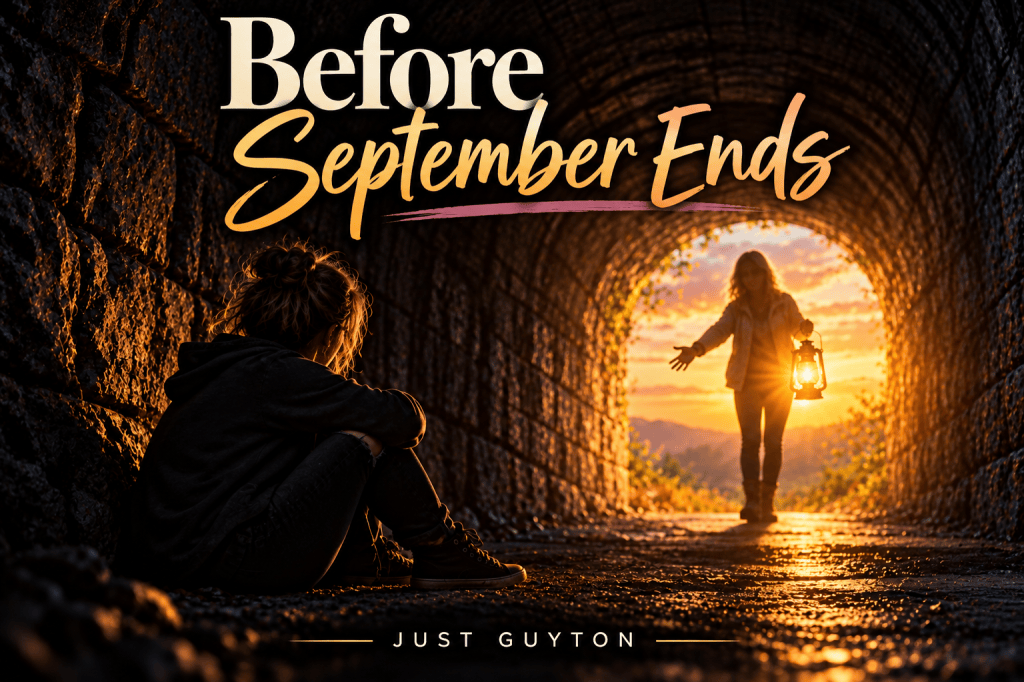
September is almost over.
National Recovery Month is almost over. Suicide Prevention Month is almost over.
But addiction isn’t going to look at the calendar on October 1 and disappear. Mental illness isn’t going to pack its bags because September ended. And the people struggling with either—or both—are still going to wake up the next morning and have to figure out how to make it through another day.
So before this month ends, I need to say something.
Your life is precious.
I could say that a million times. One person might believe me. Another might not.
Maybe right now you’re stuck so deep inside a tunnel that you can’t see the way out.
But somewhere, somebody is holding a lantern.
I’ve lived portions of my life in a cloud of smoke, a drunken daydream, and what I can only describe as a pharmaceutical nightmare.
Half the time, nobody even knew.
Funny what people actually pay attention to.
I’ve done my dance with psychiatric institutions. I know what it’s like to do the Thorazine shuffle.
Those days were many, many moons ago, but they’re still part of me.
They’re my stories.
And trust me, I have the receipts.
There were things about myself I didn’t understand then that I understand now. I hadn’t been diagnosed with ASD yet. There were times when other people spoke for me when what I desperately needed was the opportunity to speak for myself.
There are also pieces of that history I cannot share right now.
Maybe someday.
What I can tell you is that surviving something doesn’t erase it. Recovery doesn’t require me to pretend those years never happened.
Those stories are still mine.
They just aren’t my current address anymore.
One thing I learned a long time ago was this:
An addiction is an addiction is an addiction is an addiction.
That doesn’t mean every addiction is medically identical. It doesn’t mean everybody needs the same treatment. And it certainly doesn’t mean everybody’s recovery will look the same.
It means I don’t need your drug of choice to have been my drug of choice to recognize something in you.
And mental illness works similarly.
Your diagnosis doesn’t have to be mine for me to understand what it feels like when your own mind becomes somewhere you don’t particularly want to be.
Sometimes lived experience gives us a language that other people simply don’t have.
That doesn’t mean someone who hasn’t lived it can’t love you, sit beside you, listen to you, or help you find someone qualified to help.
It does mean they shouldn’t pretend to understand something they don’t.
Sometimes the most helpful words in the world are:
I don’t know what this feels like, but I’m here.
We need to talk about this part too.
Loving someone doesn’t mean cosigning their bullshit.
There. I said it.
Enabling someone isn’t helping them.
Giving someone money you know will feed an addiction isn’t necessarily love. Lying for them isn’t necessarily love. Protecting them from every consequence isn’t necessarily love.
Sometimes love has boundaries.
Sometimes love says no.
Sometimes love says, I’ll drive you to treatment, but I won’t help you keep destroying yourself.
But there’s another side to this.
Some people believe they’re practicing “tough love” when what they’re actually practicing is cruelty.
Shaming somebody isn’t treatment.
Humiliating somebody isn’t treatment.
Telling somebody with serious mental-health problems to “get over it” isn’t treatment.
And pretending you know how to fix somebody because you watched a documentary, read something online, or knew somebody once isn’t treatment either.
There is a fine line here.
Love without boundaries can become enabling.
Boundaries without compassion can become cruelty.
Sometimes the most responsible thing you can say is, This is bigger than me. We need help.
About eighteen years ago, I had a sponsor named Judy.
She was this wonderful little old lady who was just as lovely as lovely could be.
We did what sponsors and sponsees do. We worked. We talked. She challenged me.
And sometimes she asked me to read her things I had written.
Back then, I had an idea for a book.
I was going to call it I Heard It in an AA Meeting.
I never wrote the book.
I didn’t stay around those rooms long enough during that chapter of my life to finish it.
But I did write one piece.
And eighteen years later, I still have it.
The beginning was made up of things I had actually heard people say in meetings:
I’m not an alcoholic.
I don’t think.
I got a DUI and lost my kids, but my willpower is strong.
I don’t think about drinking.
I’m only here because I have to be.
I haven’t drank in nine months.
I have sponsors. I have an ex-boyfriend, a boyfriend, and a group of people who don’t drink. They sponsor me.
I remember thinking how completely insane some of it sounded.
And then I wrote about what the program had begun doing in my own life:
I had gotten a woman sponsor who walked with me through the Twelve Steps.
I didn’t need a pat on the ass.
I needed my ass to be saved.
The God of my understanding, the program, AA, a female sponsor, and continuous growth were doing that for me at the time.
I wrote that I’d been handed the keys to the kingdom and AA was helping me learn how to take care of them.
And then I ended it with this:
I thought I came to AA because I fell down. I came because I really stood up.
Judy believed there was a book in there somewhere.
Turns out she was right about the writer.
We were just wrong about which book she’d eventually write.
I’ve heard people say anonymous recovery programs are a cult.
People have plenty of opinions about them.
Here’s my question:
When you were chasing that high, how many things did you chase without questioning them?
How many places did you go?
How many people did you trust who didn’t deserve your trust?
How much time, money, dignity, energy, and peace did you sacrifice?
Addiction had rules too.
We just didn’t call them steps.
AA began in 1935 when Bill W. and Dr. Bob met and discovered something incredibly powerful in one alcoholic helping another alcoholic.
What grew from that idea has helped people around the world.
Does that mean AA is right for everybody?
No.
Recovery isn’t one-size-fits-all.
There are Twelve-Step fellowships, other peer-support programs, professional treatment, therapy, medication when appropriate, rehabilitation programs, faith-based programs, secular programs, and combinations of those things.
Find what helps you get well.
And please don’t ridicule somebody else’s healthy recovery simply because it isn’t the path you would choose.
Getting sober isn’t simply about putting down drugs and alcohol.
That’s where some of the real work begins.
Eventually, you have to look at yourself.
Not everybody else.
You.
Your behavior.
Your resentments.
Your excuses.
Your relationships.
Your coping mechanisms.
The things people did to you.
And, sometimes much harder, the things you did to other people.
Sobriety can take away the thing you were using to avoid all of that.
Then you have to learn how to live.
You have to learn what to pick up after you put the substance down.
Accountability.
Honesty.
Connection.
Boundaries.
Faith, if that’s part of your recovery.
Professional help when you need it.
Self-respect.
Purpose.
Life.
It isn’t always easy.
But I can tell you something about my own recovery:
My worst day sober is better than my best day when I was out there.
There is someone I need to mention here.
I won’t tell you his name. I won’t tell you his diagnosis. Those things belonged to my friend.
But I loved him dearly.
He struggled with mental illness and sobriety.
Then COVID happened.
The world shut down. People became isolated. Meetings, routines, relationships, support systems—so much of ordinary life suddenly changed.
My friend relapsed.
I was only a couple of months sober myself.
I tried.
I connected him with people I knew in the recovery community in Florida. I said the things I knew to say. I tried to be there.
One of the last things he ever told me was that I was such a great friend and that he didn’t deserve a friend like me.
After that, I messaged him every day.
Sometimes all I could do was remind him:
Your life is precious.
I hope you’re doing well today.
Your life is precious.
I hope you have a wonderful day.
Your life is precious.
Every day.
And then I got the call.
My friend had died from a fentanyl overdose.
Years have passed.
It still fucking hurts.
There is an important truth here that people who love someone struggling with addiction or mental illness need to hear:
Sometimes you can love somebody.
You can show up.
You can offer resources.
You can say the right things.
You can remind them that they’re loved.
And you still cannot control what happens next.
We cannot love another person into recovery by force.
We cannot make someone stay alive through sheer determination.
Sometimes we do everything we know how to do and still lose someone.
I wish that weren’t true.
But it is.
There is a line from a Mod Sun song that has stayed with me:
“I finally loved myself the way I loved getting high.”
That one is true for me.
Because addiction takes devotion.
You think about it. Plan around it. Find money for it. Protect it. Hide it. Chase it.
Imagine taking some of that determination and turning it toward yourself.
Toward staying.
Toward getting well.
Toward becoming somebody you actually want to know.
I finally learned to do that.
My recovery wasn’t a straight line.
Neither was my mental-health journey.
Neither was becoming a writer.
Life rarely gives us straight lines.
But I’m here.
And if you’re reading this from somewhere inside your own tunnel, I’m going to tell you what I told my friend:
Your life matters.
Your life is precious.
You may not believe me today.
That’s okay.
Borrow somebody else’s belief for a while.
Find the meeting.
Call the professional.
Tell somebody the truth.
Ask for help.
And if you cannot see the way out of the tunnel yet, keep looking.
Somewhere, somebody is holding a lantern.
Maybe they’re holding it for you.
And maybe one day, you’ll be the one holding it for somebody coming behind you.
—Guyton
If you need help: In the United States, call or text 988 to reach the 988 Suicide & Crisis Lifeline. Support is free and confidential. For mental-health or substance-use treatment, FindTreatment.gov is a confidential and anonymous treatment locator. SAMHSA’s National Helpline is also available 24/7 at 1-800-662-HELP (4357) for treatment information and referrals. If there is an immediate life-threatening emergency, call 911.




Leave a comment