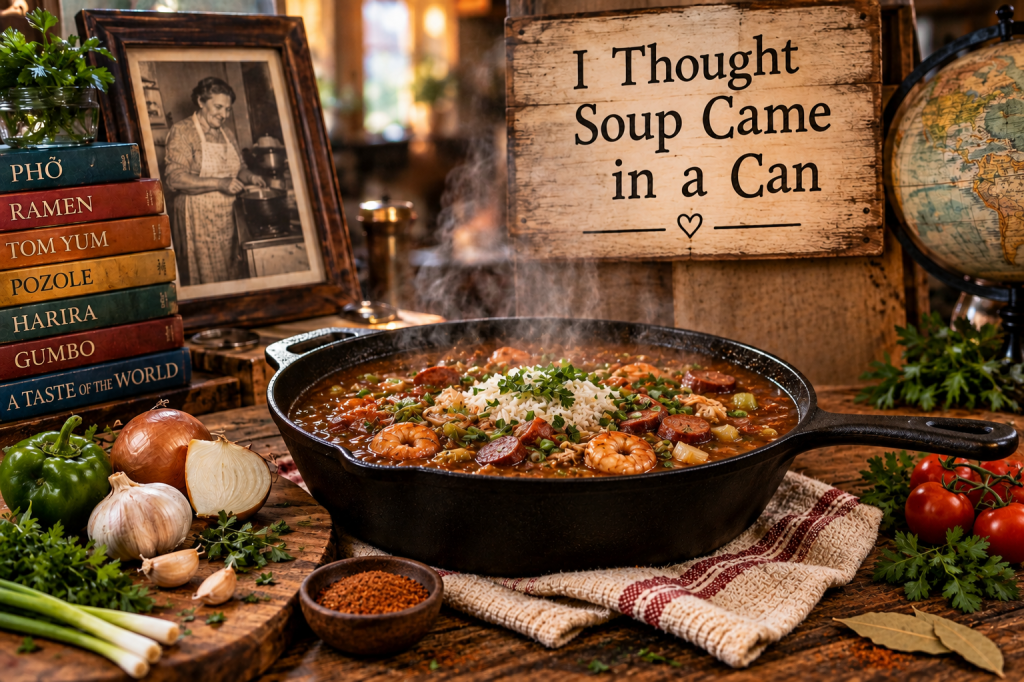
When I was a kid, I thought soup came in a can.
You opened it, dumped it into a pot, heated it up, and there you had it.
Soup.
Unless my granny was cooking.
Granny made soups and stews from scratch. She made chicken and dumplings and plenty of other things whose names I can’t even remember anymore. But I remember watching her cook, and I remember her cast-iron skillet.
When she passed away, that skillet was the only thing I asked for.
It’s older than I am. I watched her cook in it when I was a child, and now I cook in it myself.
Some people inherit jewelry.
I wanted the cast iron.
Somewhere along the way, I discovered that soup was a whole lot bigger than the canned aisle at the grocery store.
Vietnam has phở, with its fragrant broth, rice noodles, herbs, and layers of flavor. Japan has an entire world of ramen, far beyond the little instant packages many of us grew up eating.
Thailand has tom yum, spicy, sour, and full of aromatics, and tom kha, with its creamy coconut broth, lemongrass, galangal, and lime.
Mexico has pozole, a hearty hominy-based dish with deep roots and countless variations. The Philippines has sinigang, known for its wonderfully sour broth. Morocco has harira, filled with ingredients like tomatoes, lentils, chickpeas, herbs, and spices. Greece has avgolemono, a comforting combination of lemon, egg, broth, and often chicken and rice.
And that’s barely scratching the surface.
Then you’ve got soup’s heartier cousins—the stews.
There’s Hungarian goulash, rich with paprika. Irish stew, simple, hearty, and made for a cold day. Brazil has feijoada, a slow-cooked black-bean stew. Morocco gives us tagine, named for the vessel it’s traditionally cooked in. Louisiana has gumbo, with influences from several cultures coming together in one pot. And Korea has a whole world of bubbling jjigae.
Different ingredients. Different spices. Different histories.
Yet people all over the world apparently looked at a pot and collectively decided:
“Put some stuff in there and let it cook.”
We just disagreed beautifully about what the stuff should be.
And maybe that’s one of the reasons I enjoy cooking so much now. There is always something new to discover, but no matter what I’m making, I still carry a little bit of what Granny taught me into the kitchen.
When somebody really likes something I’ve cooked, they’ll occasionally ask what I put in it.
I like to tell them there’s a special ingredient.
“I can’t tell you what it is.”
Then eventually I laugh and give up the secret.
It’s love.
That’s what I was taught.
Sometimes I follow the recipe.
Sometimes I don’t.
Sometimes I add a little extra special ingredient and season it until the ancestors tell me to stop.
If you’re the kind of cook who measures garlic with your heart instead of a teaspoon, you understand.
One of the best things about food is knowing I’ll probably never run out of something new to try. And soups and stews might be one of the easiest places to start.
Maybe you’ve never tried phở. Maybe you’ve never heard of harira. Maybe tom kha sounds completely outside your comfort zone.
Try it anyway.
Find a restaurant that makes it authentically. Find a recipe and make it yourself. Learn a little about where the dish came from while you’re at it.
You don’t have to love everything you taste. Being adventurous doesn’t mean abandoning your boundaries.
It just means giving unfamiliar a chance.
So go out on a limb.
Dare to be bold.
Try something different.
Taste the world. Your palate will thank you.
And when you’re standing over that pot wondering if it needs just a little more seasoning, listen closely.
The ancestors will tell you when to stop.
Turns out, Granny left me more than a cast-iron skillet.
She taught me what to put in it.
—Guyton




 Just Guyton
Leave a comment