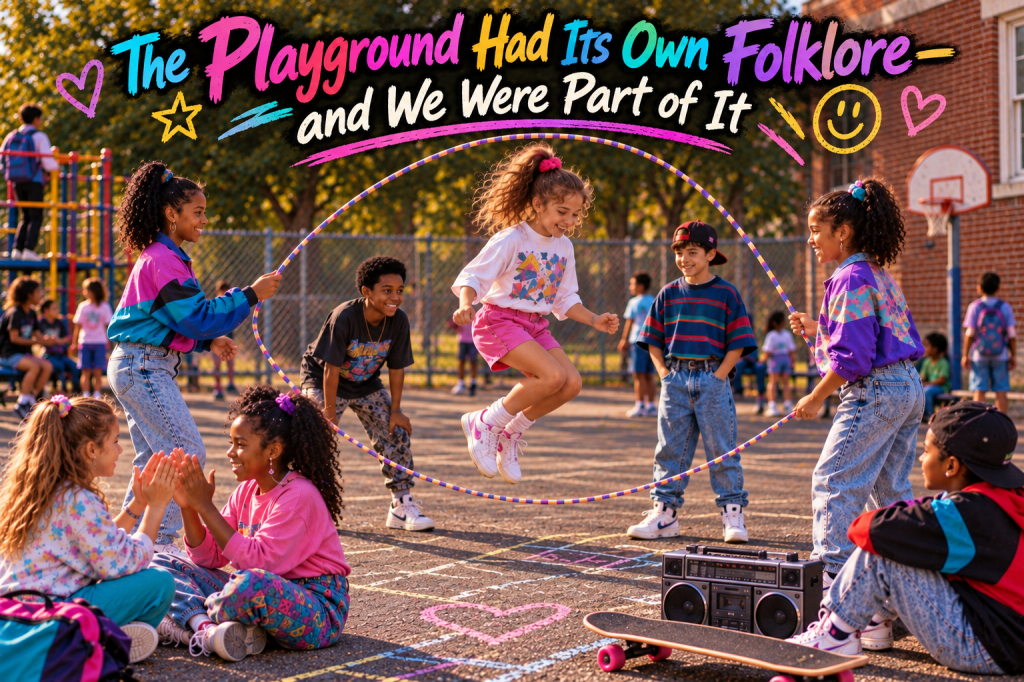
Yesterday, I fell down a Lizzie Borden rabbit hole.
I had just finished watching Monster: The Lizzie Borden Story, and if there is one thing Ryan Murphy knows how to do, it is make me start asking questions.
So I started asking them.
One question became another, which became another, until eventually I had to accept that I was probably not going to solve a murder from 1892 before bedtime.
Then something occurred to me.
I used to Double Dutch to a rhyme about Lizzie Borden.
And somehow that seemed perfectly normal when I was a kid.
That realization opened an entirely different rabbit hole.
Because Lizzie Borden wasn’t the only rhyme floating around the playground when I was growing up. I remembered Miss Mary Mack. Down Down Baby. Cinderella. Miss Susie Had a Steamboat. 3-6-9.
Some were hand-clapping games. Some went with jumping rope or Double Dutch. Some probably moved back and forth between the two.
I don’t remember who taught them to me.
That’s the part that got me curious.
Who taught all of us?
There weren’t instructions handed out at recess. Nobody passed around sheet music. We weren’t Googling the words. Somehow one kid knew something, taught another kid, somebody changed a word or a movement along the way, and the game kept traveling.
Turns out, there’s a name for that.
Children’s folklore.
Sometimes called childlore, it includes the games, rhymes, jokes, chants, sayings, traditions and little bits of culture that children pass among themselves.
Folklorists Iona and Peter Opie spent decades documenting exactly this kind of thing. During the 1950s and 1960s, they collected playground games, rhymes, stories and traditions directly from thousands of children across Britain. Their work helped demonstrate something adults have apparently been worrying about for generations: children haven’t suddenly forgotten how to play. Their play changes.
And some of the things we were doing as kids were much older than we ever knew.
Take Miss Mary Mack.
A recognizable version was documented in Henry Carrington Bolton’s The Counting-Out Rhymes of Children in 1888.
- 1888.
I was standing on a playground about a hundred years later clapping along to something that children had already been passing around for generations.
The words didn’t remain frozen in 1888, either. Different versions developed as the rhyme traveled through communities and generations. It also became part of documented Black American hand-game traditions. Scholar Kyra D. Gaunt has studied games like Miss Mary Mack and Double Dutch as part of Black girls’ musical and social culture.
That’s something I certainly didn’t know while I was playing.
Then there’s Down Down Baby, another hand-clapping game documented within Black American children’s traditions. Like so much playground folklore, versions vary depending on when and where children learned it.
That’s really the point.
There wasn’t somebody standing over us making sure we were doing folklore correctly.
Kids were changing it.
We were supposed to.
Even Cinderella made it onto the playground.
Researchers have collected different Cinderella jump-rope rhymes over the decades, with the familiar fairy-tale character getting dropped into completely different situations depending on the version. Cinderella belonged to the storybooks, but playground kids apparently decided she belonged to us too.
Then we had Miss Susie Had a Steamboat, which deserves recognition for teaching generations of children the fine art of making adults think you were about to say something you absolutely were not supposed to say.
Kids are creative like that.
And 3-6-9, which many people associate with Shirley Ellis and The Clapping Song, has roots in children’s oral rhyme traditions that predate that 1965 recording.
That’s another fascinating part of this.
Playground culture and popular culture didn’t live in separate worlds. Children’s rhymes could influence music, music could find its way back onto playgrounds, and kids could change everything again.
Then there was Double Dutch.
I loved Double Dutch.
I couldn’t tell you today whether I could still do it, but that certainly wouldn’t stop me from trying.
Double Dutch became especially significant within Black urban communities during the twentieth century, particularly among girls. It wasn’t simply two ropes and somebody jumping in the middle. There was rhythm, timing, footwork, coordination and cooperation between the people turning the ropes and the person jumping.
And, of course, there were the chants.
Looking back, I realize how much culture was being exchanged while we thought we were simply playing.
Which brought me to another question:
Do kids still do this?
Because I will admit, my first thought was probably the same one adults have been having forever.
Kids today have phones, tablets, video games and the internet. Surely all of this old playground stuff has disappeared.
Except researchers studying children’s play today have found something much more interesting.
Children are still creating, sharing and adapting games.
Modern playground research has documented children continuing hand-clapping, skipping, rhyming and imaginative games while incorporating pieces of the world they live in now—including popular music, movies and digital technology.
In other words, technology didn’t necessarily kill children’s folklore.
The kids put technology into the folklore.
Of course they did.
That’s what children have apparently been doing all along.
They inherit something.
They play with it.
They change it.
Then they hand it to somebody else.
Yesterday I thought I was researching Lizzie Borden.
This morning I discovered that part of my childhood belonged to a much bigger story.
Those playground chants weren’t just silly little songs we happened to know. The hand claps weren’t meaningless. Double Dutch wasn’t simply something we did to pass the time.
We were learning from one another.
We were changing things without realizing it.
We were carrying pieces of culture that children before us had carried too.
The playground had its own folklore.
And we were part of it.
Now I’m curious about yours.
What did you sing, chant, clap or jump rope to when you were a kid? Where in the world did you grow up? Do you remember who taught it to you?
And if you have children or grandchildren, what are they doing now?
Maybe the playground never went quiet.
Maybe we just grew up and stopped listening.
—Guyton


 Just Guyton
Leave a comment