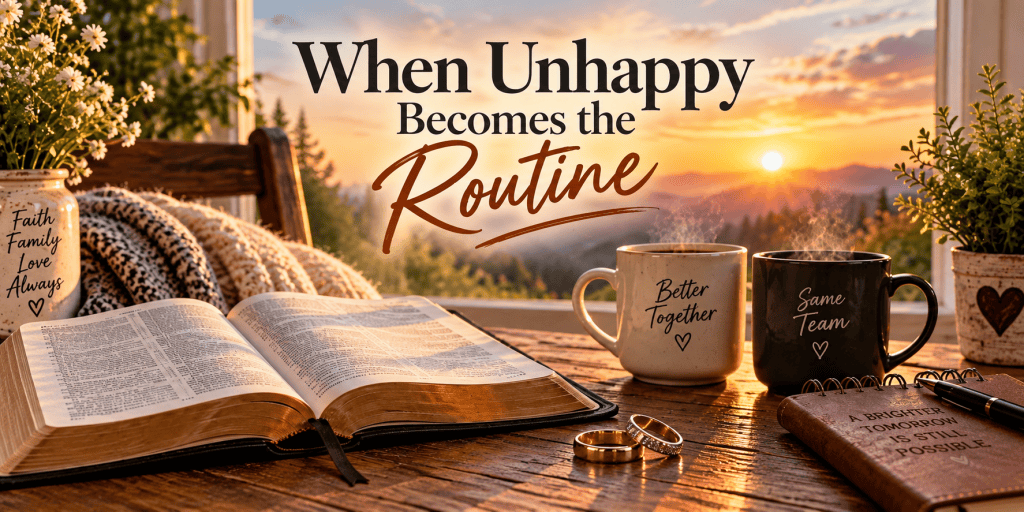
I’ve been thinking a lot about marriage lately.
Not because there’s something wrong with mine, but because sometimes you watch the world around you and it makes you take a closer look at your own beliefs.
I’ve watched people become stuck.
The same arguments. The same resentment. The same unhappiness. Day after day, everybody seems miserable, yet nobody changes anything.
And eventually, unhappy stops being something that happened.
It becomes the routine.
I think what bothers me most is when that unhappiness starts spilling over onto the children. Kids didn’t create the problems between the adults in their home, but they still live inside the atmosphere those adults create. They hear the yelling. They feel the tension. They learn from what they see.
That doesn’t mean parents aren’t allowed to have bad days. Of course we are. People lose their patience. Couples argue. Houses get messy. Dinner doesn’t always get cooked. Life happens.
I’m talking about when those things stop being the occasional bad day and start becoming everyday life.
And I find myself wondering: if everyone is miserable, why are we so afraid to admit that something needs to change?
Maybe that means having an uncomfortable conversation. Maybe it means counseling. Maybe it means looking at yourself and admitting that you’ve contributed to the problem. Maybe both people have.
I certainly don’t have marriage figured out.
I’ve been married a couple of times, so this is definitely not my first rodeo.
But I think that’s also why I understand some things now that I didn’t understand when I was younger.
My grandmother Eleanor was one of the smartest women I knew. She used to tell me, “There isn’t anything in this world that your marriage can’t get through.”
For a long time, I don’t think I truly understood what she meant.
I do now.
I don’t think she was telling me that being married meant accepting anything another person could possibly do to you. I think she was talking about two people who are willing to stand on the same side when life gets hard.
There’s a difference.
My marriage today is rooted in my faith. Chris and I believe marriage is a covenant, and we try to treat it that way.
The Bible says, “the two shall become one flesh” (Mark 10:8). I understand that differently today than I once did. Becoming one doesn’t mean losing yourself. To me, it means understanding that marriage isn’t supposed to be me against you. We’re on the same team. If something is hurting one of us or hurting our home, it becomes something we need to face together.
Scripture also gives us a pretty demanding picture of love.
“Love is patient, love is kind.” It isn’t supposed to keep score. It isn’t supposed to delight in somebody else’s failures. It protects, trusts, hopes, and perseveres. (1 Corinthians 13:4–7)
Those verses are beautiful at weddings.
Living them on a random Wednesday when somebody is tired, irritated, stressed, or has gotten on your last nerve?
That’s marriage. 😂
And biblical marriage asks something of both people.
Ephesians 5 talks about marriage in terms of love, respect, sacrifice, and care. Husbands are told to love their wives as Christ loved the church—a love defined by sacrifice, not domination. Marriage isn’t supposed to be one person demanding everything while giving nothing.
It asks both people to show up.
That doesn’t mean Chris and I never disagree. It doesn’t mean either one of us is perfect. And it certainly doesn’t mean I’m qualified to hand out marriage certificates of excellence from my kitchen table.
It means we try.
We talk. We laugh. We pray. We apologize. We irritate each other. We forgive each other. We choose each other.
And maybe that word—choose—is what I finally understand.
A wedding happens once.
Marriage happens every day.
You can stay married for years and still stop choosing one another somewhere along the way. You can live under the same roof while resentment slowly becomes the loudest thing living there.
The number of anniversaries tells us how long two people have been married.
It doesn’t tell us what those years felt like.
And when there are children in that home, I think the responsibility becomes even greater.
Our children learn about love long before they’re old enough to define it. They watch how adults speak to each other. They watch how disagreements are handled. They notice whether apologies happen. They learn whether home is somewhere they can make a mistake and still feel safe and loved.
That makes the way we treat one another matter.
Chris and I don’t have children together, but my children still get something incredibly important from our marriage: they finally get to see their mother happy.
They get to see me loved. They get to see me respected. They get to see what it looks like when two people genuinely enjoy being together, even when life isn’t perfect.
And they finally have someone in my life who is worthy of being called their stepdad.
That means more to me than I can adequately put into words.
Because no matter how old our children become, I think there is something powerful about letting them see that love doesn’t always have to look like struggle. Sometimes it looks like friendship. Sometimes it looks like laughter. Sometimes it looks like prayer, patience, forgiveness, and two people deciding over and over again that they’re on the same team.
I don’t know what happens behind anybody else’s closed doors, and I would never pretend that I do. Every marriage has chapters nobody outside of it will ever read.
But I do know what I want inside mine.
I want friendship. I want laughter. I want respect. I want faith. I want a home where the people inside it know they are loved.
And when something isn’t working, I want us to love each other enough to say so instead of simply learning how to live unhappily around it.
It took me more than one marriage and a whole lot of living to finally understand something my grandmother knew long before I did.
There really are incredible things a marriage can get through.
But you have to be willing to go through them together.
“Therefore what God has joined together, let no one separate.” — Mark 10:9
And somewhere, I think Eleanor would be proud that I finally understand what she meant.
— GUYTON





 Just Guyton
Leave a comment