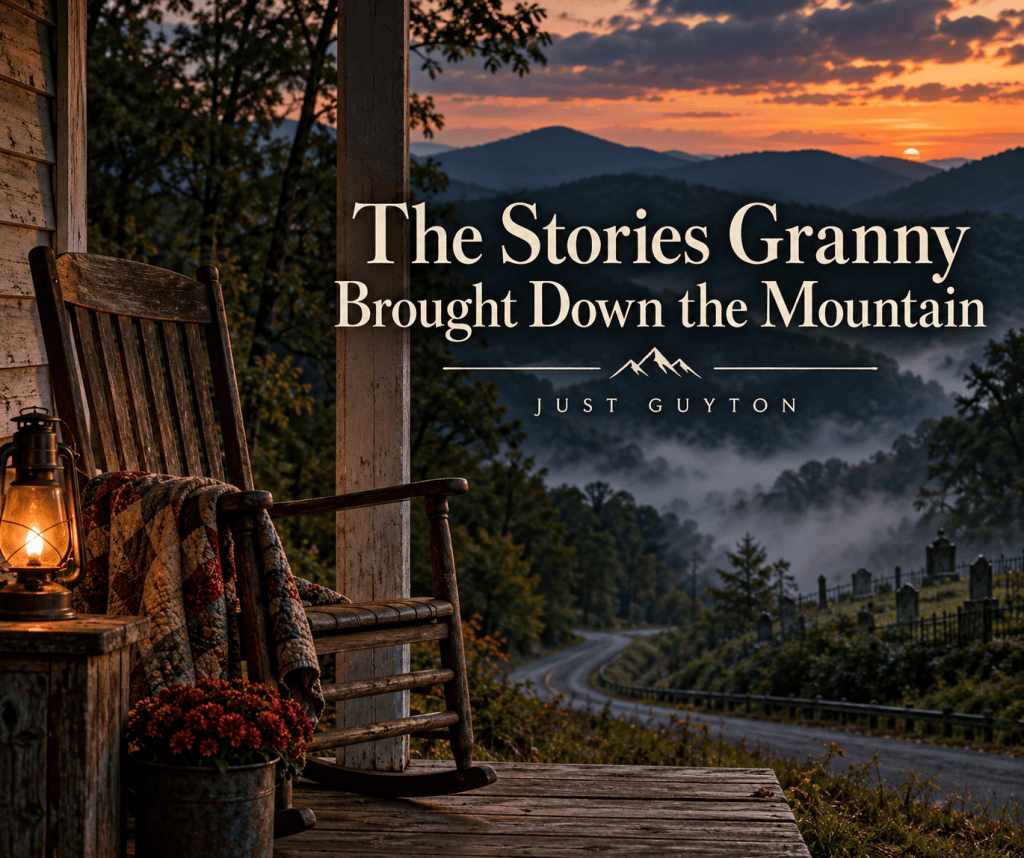
My granny grew up in Jolo, West Virginia.
If you’ve never heard of Jolo, I wouldn’t be surprised. It’s a tiny place tucked into McDowell County in the Appalachian Mountains. But in my family, Jolo was never just a dot on a map.
It was where Granny came from.
I haven’t been to Jolo since I was a child. Most of what I carry with me about that place now doesn’t come from roads I remember traveling or landmarks I could point out.
It comes from Granny.
It comes from her stories.
And Granny came down from that mountain carrying plenty of them.
She was a storyteller—the kind who could make you listen. She told us about growing up in Jolo, about graveyards after dark, strange happenings, and the things you simply did or did not do.
If you grew up around Appalachian folklore, some of this will probably sound familiar.
Close the curtains after dark.
If you hear someone call your name when nobody is there, don’t answer.
Don’t go wandering around a graveyard after dark.
And if you encounter something strange in the woods that you cannot explain, perhaps you don’t need to investigate it.
Not every noise needs to be followed.
Not every strange thing needs to be touched, picked up, brought home or figured out.
Sometimes you leave things exactly where you found them and continue on your way.
There are countless versions of these old warnings throughout Appalachia. Families and communities have their own stories, superstitions and variations, passed from one generation to another until nobody quite remembers where the telling began.
Growing up, though, I wasn’t thinking about any of that as folklore.
It was just Granny telling us stories.
And Granny had stories.
She once told us she saw a man looking for his head.
That’s basically all I remember about that particular one. I couldn’t tell you where she was, how old she was or what happened afterward.
But apparently when you’re a child, “I saw a man looking for his head” is plenty of information.
Your brain handles the rest.
Thanks, Granny.
Sleep was overrated anyway.
Then there was another story connected to Jolo—except this time I was technically there.
I was so little, probably not even three, that I don’t actually remember it. I know the story because my family told it.
Mama, Daddy, Granny, Grandpa and tiny little me were traveling up the mountain toward Jolo. Daddy always described it as basically one way up and one way down.
And that night it was dark.
Not cute Halloween dark.
Not turn-off-the-lights-and-watch-a-scary-movie dark.
I mean early-1980s, Appalachian-mountain, your-headlights-aren’t-doing-nearly-enough dark.
Daddy nearly drove us off the mountain.
And somewhere down below—or what everyone thought was below, because apparently nobody could see much of anything—were little red, beady eyes staring back at them.
Now, am I saying my family encountered Mothman?
No.
Am I saying they definitely didn’t?
Also no.
I’m just saying: West Virginia. Mountain. Darkness. Red eyes.
Do with that information what you will.
Maybe that’s another lesson Granny’s stories taught me.
Sometimes you don’t investigate.
Sometimes you get your behind down the mountain and go home.
But here’s the thing about Granny.
She loved a good horror movie.
Some of my favorite memories are of just the two of us sitting together watching them. Granny would cringe at certain parts, then laugh and giggle at others.
As I’ve gotten older, I’ve wondered about that.
What exactly does Hollywood have to offer a woman who grew up in Jolo hearing—and apparently experiencing—stories that could compete with the movie screen?
I don’t know.
Maybe she simply loved horror movies.
Maybe she thought some of them were ridiculous.
Maybe Granny knew things.
I’ll leave that right there.
Then there were the Halloween parties at Granny’s house.
My Uncle David’s birthday falls right around Halloween, and when I was growing up, those Halloween parties were a family affair—or at least that’s how I remember them.
David was only about nine or ten years older than me, so while I was a kid, he was a teenager.
And that boy could make a costume.
Remember, this was the late ’80s and early ’90s. Nobody was clicking “Buy Now” on a screen-accurate costume and having it delivered the next morning.
You worked with whatever you could find and whatever imagination you had.
David apparently had plenty.
I remember his Jason Voorhees costume. He made my Uncle Robert an incredible Freddy Krueger costume. He made a Michael Myers costume that was convincing enough that I still remember it decades later.
And just so nobody thinks David’s artistic range ended at fictional murderers, he once made a beautiful Elvis Presley costume.
Jason. Freddy. Michael. Elvis.
The man had range.
Looking back, it’s easy to see how all of it became tangled together in my mind.
Jolo and Granny’s mountain stories.
The old warnings about what you leave alone after dark.
Halloween at Granny’s house.
David turning ordinary materials into movie monsters.
And sitting beside Granny watching horror films while she cringed, laughed and giggled.
But somewhere along the way, I inherited something more important than a love for spooky things.
I inherited a love for stories.
My granny passed away in 2016, so I can’t call her and ask her to tell me these stories again. I can’t ask her to fill in the pieces I’ve forgotten or explain the details that childhood didn’t think were important enough to hold onto.
What I have are the stories she gave me and the pieces of Jolo she carried down from that mountain.
And maybe that’s why they mean even more to me now.
I haven’t been to Jolo since I was a child, and Granny hasn’t been here to tell me her stories for ten years.
Yet somehow, when I tell one of them, there she is again.
The storyteller who could make me listen.
The granny who could tell me about a man looking for his head and then sit beside me watching a horror movie, cringing one minute and giggling the next.
Now I’m a grandmother.
And it’s my turn to tell the stories.
I want my grandchildren to know about their family and the tiny place called Jolo, West Virginia, where their story reaches back. I want them to know about Granny and the mountain she grew up on.
I want them to hear the funny stories, the family stories and, yes, the spooky ones.
Even the man looking for his head.
Especially the man looking for his head.
And I hope my granddaughters remember.
I hope someday, long after I’m gone, one of them sits with her own grandchildren and begins:
“My Nana used to tell me stories that her Granny told her about growing up in Jolo, West Virginia…”
That’s how stories survive.
Granny carried hers down the mountain.
She gave them to me.
I’ll give them to my grandchildren.
And hopefully, they’ll carry them farther than either Granny or I will ever know.
Maybe that’s the real magic in old family stories.
The storyteller may leave us.
The story doesn’t have to.
And one last thing.
If somebody calls your name from outside after dark and nobody is there…
Don’t answer.
Some of Granny’s advice doesn’t need updating.
— GUYTON


 Just Guyton
Leave a comment